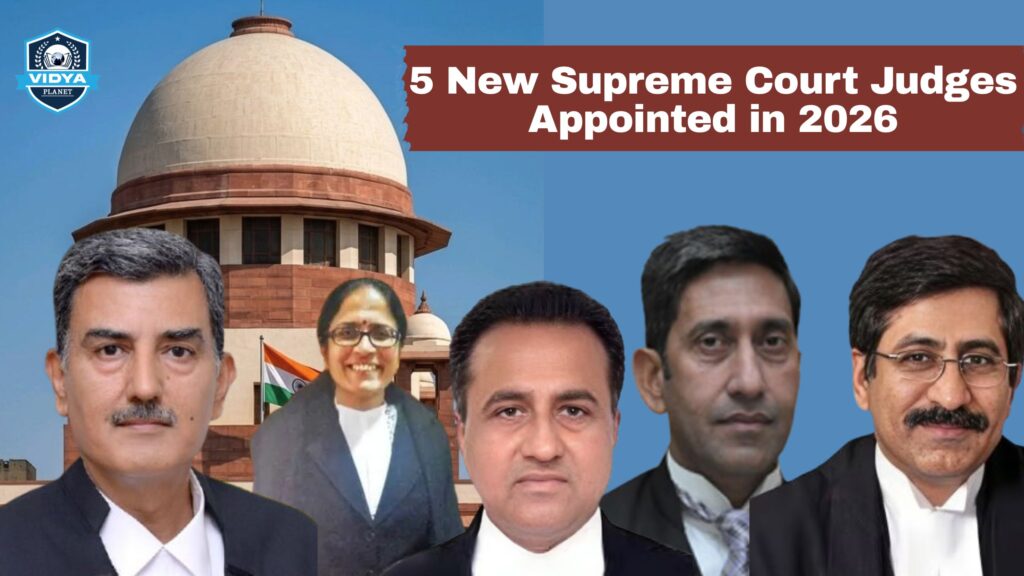
On June 1, 2026, the Central Government approved the appointment of five new judges to India’s Supreme Court, marking a significant development for the country’s highest court. The notification, issued by Union Minister of State (In-Charge) for Law and Justice Arjun Ram Meghwal, follows recommendations made by the Supreme Court Collegium, led by Chief Justice of India Surya Kant. The five appointees include four current High Court Chief Justices and one Senior Advocate elevated directly from the Bar, which is a rather rare occurrence in India’s constitutional history.
Constitutional and Legislative Background
The appointments are particularly significant in view of a recent constitutional revision. Just days before this announcement, the government approved an order that increased the Supreme Court’s sanctioned strength from 34 to 38 judges. With the five new appointments, 37 of the 38 sanctioned slots are now filled, resulting in a nearly complete bench that demonstrates the government’s commitment to addressing the Supreme Court’s severe backlog.
The appointment of Supreme Court judges is governed by Article 124 of the Indian Constitution, which states that every Supreme Court judge shall be appointed by the President of India after consultation with such Supreme Court and High Court judges as the President deems necessary. Following the important Second and Third justices Cases (1993 and 1998), this procedure is effectively overseen by the Supreme Court Collegium, which is made up of the Chief Justice of India and the Supreme Court’s four most senior justices. The executive’s function has mainly been confined to formal notification of the Collegium’s recommendations.
The Five New Appointees
- Justice Sheel Nagu (Punjab & Haryana High Court)
- Justice Shree Chandrashekhar (Bombay High Court)
- Justice Sanjeev Sachdeva (Madhya Pradesh High Court)
- Justice Arun Palli (J&K and Ladakh High Court)
- Senior Advocate V. Mohana
The Question of Gender Representation
While V. Mohana’s appointment is remarkable, it also raises new concerns about woman representation on the Supreme Court bench. Following her oath, just two women, Justice B.V. Nagarathna and Justice Mohana, will serve as sitting judges in the Supreme Court. Justice Nagarathna is also well-regarded as a potential candidate for Chief Justice of India. The ongoing underrepresentation of women, however, remains a structural issue that the Collegium system has been tasked with addressing more rigorously.
The Collegium System and Judicial Independence
The current round of appointments is notable not just for the new judges’ profiles, but also for the Government’s relatively quick response to the Collegium’s recommendations. Historically, delays in the executive’s approval of Collegium recommendations have been a source of contention between the judiciary and the government. The quick notice in this case has been hailed as a positive sign for judicial independence and institutional efficiency.
The Collegium system, while subject to constant dispute about transparency and accountability, maintains the constitutional instrument for efficiently controlling judicial selections. The inclusion of direct promotion from the Bar, as in the instance of V. Mohana, is a constitutionally acceptable but practically rare activity that adds to the Court’s institutional variety.
Conclusion
The elevation of five new judges to the Supreme Court of India represents a significant moment in the institutional life of India’s apex judiciary. Coming on the heels of an expansion in the Court’s sanctioned strength, these appointments signal a concerted effort to reduce the growing backlog of cases and restore the Court to near-full working capacity. The diverse professional backgrounds of the new judges; spanning High Court administration, Bar practice, legal services, and judicial inquiry; augur well for the continued vitality and breadth of the Supreme Court’s jurisprudence.
Most significantly, the appointment of Senior Advocate V. Mohana marks a quiet but profound milestone: a reminder that the highest court of a constitutional democracy must, in both composition and spirit, reflect the pluralism it is called upon to uphold.
OFFICIAL NOTIFICATION OF SUPREME COURT OF INDIA: Click here