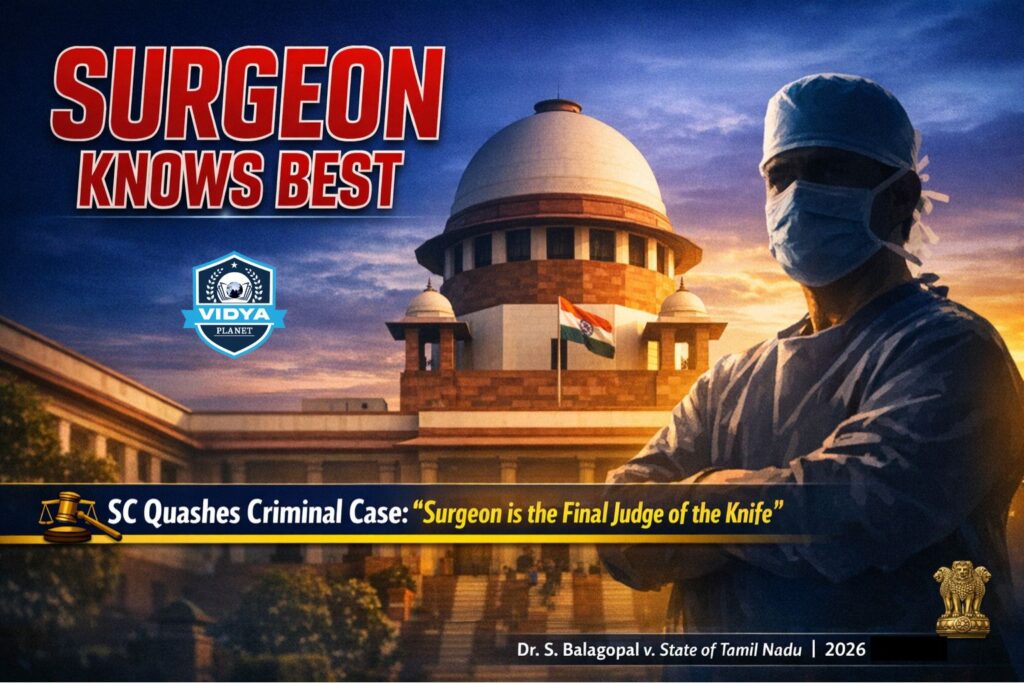
In an important decision reaffirming medical professionals’ autonomy, the Supreme Court of India recently rejected criminal charges against a paediatric surgeon, saying that the operating surgeon is the best judge of which surgical procedure to use. The decision in Dr. S. Balagopal v. State of Tamil Nadu AIR 2026 is a significant reiteration of the rules governing medical negligence, particularly in criminal law.
The Court highlighted that a mere difference in medical opinion or procedure selection does not establish negligence unless it exceeds the level of extreme incompetence or recklessness.
Factual Background
The issue arose from a medical treatment performed on a toddler who was diagnosed with a dangerous testicular disease that necessitated surgical intervention. Dr. S. Balagopal, the operating surgeon, performed an orchidectomy (testis removal), which was later disputed.
The children’s guardians claimed that:
- The procedure used was unneeded or excessive.
- A less invasive option may have been explored.
- The surgeon’s judgment constituted medical malpractice, warranting criminal punishment.
Criminal proceedings were filed against the doctor based on these claims under the Indian Penal Code’s negligence provisions, including Section 304A (causing death by carelessness) and related clauses.
Legal Issue
The main question before the Court was:
“Whether a surgeon’s decision to perform a certain medical procedure in the face of various possibilities constitutes criminal negligence under the law?”
Supreme Court’s Observations
The Supreme Court ruled overwhelmingly in favor of the doctor, ending the proceedings and expressing the following key observations:
- Surgeon is the Best Judge
The Court found that:
“The operating surgeon is the best judge to decide the appropriate course of treatment based on the patient’s condition, medical history, and exigencies during surgery.”
This principle recognizes the complicated, real-time decision-making involved in medical practice, which cannot be questioned retroactively unless there is clear evidence of carelessness.
- Difference Between Civil and Criminal Negligence
The Court reiterated a well-established distinction:
- Civil negligence is based on a failure to exercise due care (preponderance of probabilities).
- Criminal negligence involves excessive negligence or recklessness, with a higher threshold.
Key Precedents
Jacob Mathew vs. State of Punjab AIR 2005 SUPREME COURT 3180
In this case, the Court established the primary standard for criminal medical negligence.
It concluded that:
- A doctor can only be found criminally accountable for negligence if the act is flagrant or reckless.
- A lack of adequate care, an error of judgment, or an accident is insufficient to establish criminal responsibility.
- Before taking action against doctors, courts must exercise caution and seek an independent medical opinion.
Kusum Sharma vs. Batra Hospital AIR 2010 (3) SCC 480
The case established extensive rules for evaluating medical malpractice. The Court ruled:
- A doctor is not negligent if they adhere to a practice approved by a responsible organization of medical experts.
- Courts should not substitute their own judgment for that of medical professionals.
- Differences in medical opinion are not considered negligence.
These cases demonstrate that criminal responsibility emerges only when conduct is so blatantly irresponsible that it endangers life.
Application of the Bolam Test (Bolam v. Friern Hospital Management Committee) [1957] 1 WLR 583
- The court implicitly relied on the Bolam test, which states:
- A doctor is not negligent if their acts are supported by a responsible group of medical specialists with expertise in that particular subject.
In the current case:
- The chosen procedure (orchidectomy) was a legitimate medical choice.
- There was no evidence that the judgment was illogical or inconsistent with standard medical practice.
Protection against Frivolous Prosecution
The Court raised worry over the increasing inclination to criminally prosecute doctors for unfavorable outcomes, noting that:
- Fear of prosecution may result in defensive medicine.
- It may prevent clinicians from making required but dangerous judgments.
As a result, courts must exercise discretion when allowing criminal proceedings in medical negligence instances.
Relevant Legal Provisions
The case included consideration of the following provisions:
- Section 304A, IPC – Causing death by negligence
- Sections 337 and 338 of the Indian Penal Code – Causing grievous harm through an act endangering life.
The Court underlined that these laws cannot be used lightly against medical personnel unless the negligence is severe and obvious.
Key Takeaways
- Medical discretion is crucial; courts should not substitute their judgment for that of a qualified surgeon.
- There may be multiple legitimate medical approaches, resulting in a difference in treatment and neglect.
- Criminal culpability has a high bar, with only gross carelessness attracting prosecution.
- Judicial restraint is necessary – Courts must prohibit the use of criminal law against doctors.
Conclusion
The decision in Dr. S. Balagopal v. State of Tamil Nadu (2026 INSC 319) is an important reaffirmation of the legal protections available to medical practitioners in India. By determining that the surgeon is the best judge of the surgery, the Supreme Court has protected doctors’ independence, expertise, and decision-making authority.
At the same time, the decision does not undermine accountability; rather, it assures that criminal law is used only in circumstances of truly responsible carelessness, not in response to regrettable medical outcomes.
This balance of patient rights and medical autonomy is critical for a fair and functional healthcare system.