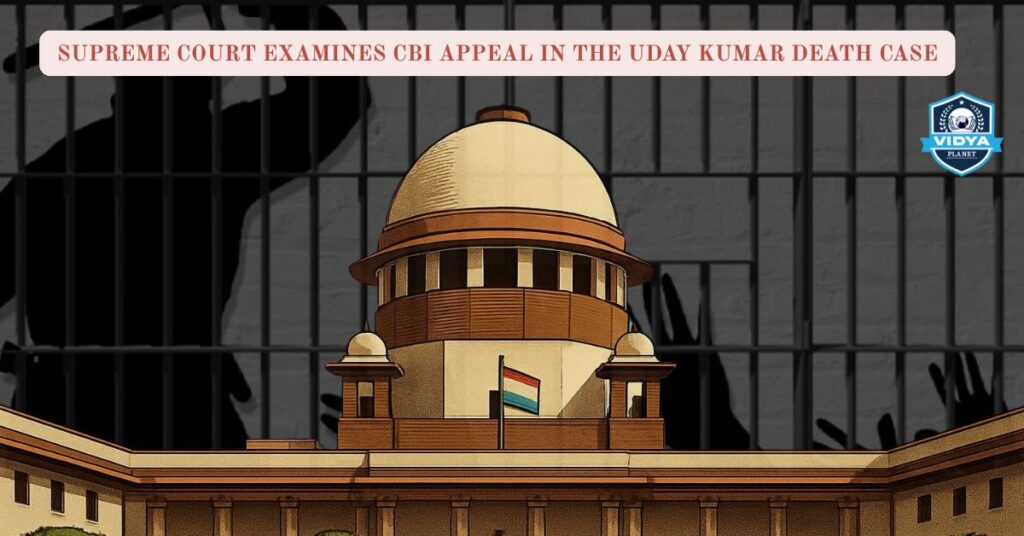
Custodial violence continues to be one of the most distressing aspects of the criminal justice system in India. The recent development in the Udayakumar custodial death case, in which the Central Bureau of Investigation (CBI) has approached the Supreme Court to challenge the acquittal of police officers by the Kerala High Court, highlights the ongoing issue of police excesses and the weakness of accountability mechanisms. This case is about more than just one person’s death; it highlights a broader systemic failure that continues to haunt India’s rule of law.
Background to the Case
Udayakumar’s prison death case dates back to 2005 in Kerala. Police arrested Udayakumar, a young engineering student, on theft accusations. He was brutally tortured during interrogation, which resulted in his death. The facts of the case revealed alarming evidence of custodial brutality, such as physical assault and harsh treatment, which led to grave injuries.
The investigation was subsequently transferred to the CBI due to the gravity of the allegations and the involvement of state police personnel. The trial court convicted several police officers of custody exploitation and death. The conviction was viewed as an important step toward accountability in cases of police violence.
However, the Kerala High Court acquitted four of the accused police officials, raising severe questions regarding proof standards and evidence interpretation in custodial death cases. This acquittal prompted the CBI to petition the Supreme Court for the restoration of the convictions and justice for the victim.
Supreme Court Obsevation:
The Supreme Court has recently issued notice on the CBI’s appeal opposing the acquittal. The Court’s decision to hear the appeal demonstrates the gravity of the situation and the importance of judicial review at the highest level.
In its appeal, the CBI argues that the High Court made an error in interpreting the evidence and failed to evaluate the consistent order of circumstances pointing to custodial violence. The agency highlighted that the trial court’s conclusions were supported by credible evidence, including as medical records and witness testimony, which clearly showed the accused officers’ involvement in the custodial death.
The Supreme Court’s intervention is critical because it will establish whether the acquittal was reasonable or constituted an injustice. The result would also have a broader impact on how custodial death cases are addressed in India.
Legal Framework Regulating Custodial Deaths
Custodial deaths violate constitutional rights. Article 21 of Indian Constitution provides the right to life and personal liberty, including the right to live with dignity and protection from torture.
Several sections of the Indian Penal Code (IPC) are relevant in incidents of custodial violence, including:
- Section 302 applies to murder.
- Section 304 applies to culpable homicide that does not constitute murder.
- Sections 330 and 331 (Voluntarily causing harm or grave harm to get confession)
- Section 342 (wrongful confinement)
Furthermore, the Code of Criminal Procedure (CrPC) includes safeguards including mandatory medical examination and production before a magistrate. The Bharatiya Nyaya Sanhita (BNS), which replaced the IPC, includes identical rules addressing custodial violence.
Despite these measures, enforcement remains ineffective, and custodial torture continues to occur with horrifying rates.
Judicial precedents on custodial violence
Indian courts have consistently condemned custodial torture and stressed the importance of strict accountability. Some landmark decisions include:
D.K. Basu vs. State of West Bengal (1997)
This lawsuit established extensive criteria to prevent custodial torture, including mandatory arrest procedures, paperwork, and the detainee’s right to notify a relative or friend. These standards have become a cornerstone of custodial law.
Nilabati Behera vs. State of Orissa (1993)
The Supreme Court ruled that compensation can be granted for custody deaths as a remedy for violations of basic rights under Article 21.
Joginder Kumar vs. State of Uttar Pradesh (1994)
The Court highlighted that arrests should not be regular and must be warranted, strengthening protections against arbitrary imprisonment.
Prakash Singh vs. Union of India (2006)
Although the case was largely about police reforms, it also underlined the importance of institutional improvements to promote police accountability and prevent abuse of authority.
These judgments demonstrate that custodial torture is not only a criminal crime, but also a constitutional violation that requires stringent scrutiny.
Issues:
The High Court’s decision to acquit the accused police officers raises several key issues:
- Standard of Proof in Custodial Death Cases: Custodial deaths frequently occur in closed contexts, making direct proof scarce. Courts must rely on circumstantial evidence, medical findings, and witness statements. Even when there is clear proof of custodial violence, a strict reliance on direct evidence might lead to acquittal.
- Burden of Proof: In custodial instances, it should be up to the police to explain the circumstances that led to the death of a person in their care. This notion has been acknowledged in various decisions, but it is not always applied consistently.
- Institutional bias and impunity: Police personnel frequently receive institutional protection, which can influence investigations and prosecutions. This fosters a culture of impunity and undermines public trust in the legal system.
- Delay in Justice: The Udayakumar case has been underway for almost two decades. Such delays weaken the prosecution and reduce the impact of justice.
Relevance of Recent Developments
The question of accountability for law enforcement agents extends beyond custodial deaths. For example, in a recent Delhi court decision, two CBI officers were convicted of trespass and violence on an IRS inspector. This case indicates that central investigative agencies are not immune to scrutiny and can be held accountable for abuse of power.
Such developments point to a broader judicial trend of requiring responsibility from law enforcement authorities. However, the variance in outcomes, such as acquittals in custodial death cases, suggests that much more work has to be done.
The Role of the CBI in this Case
The CBI’s decision to fight the acquittal demonstrates its determination to seek justice in this matter. As an impartial investigation body, the CBI plays an important role in cases where state police are suspected of wrongdoing.
The CBI approached the Supreme Court not only to seek justice for Udayakumar, but also to underscore the notion that custodial violence cannot be condoned under any circumstances.
Need for Police Reforms
The Udayakumar case emphasizes the urgent need for significant police reforms in India. Key metrics include:
- Implementation of Directives Issued in Prakash Singh v. Union of India.
- Establishing independent police complaint authorities.
- Regular instruction in human rights and custodial processes.
- Use of technology such as CCTV cameras in police stations.
- Strict enforcement of the arrest guidelines
Without systemic changes, custodial violence will continue to undermine the rule of law.
A Comparative Perspective: Madurai Custodial Death Case
The intensity of custodial violence was shown in the recent Madurai custodial death case, in which nine police officers were convicted and sentenced to death. This case was a rare occurrence in which the judiciary imposed the heaviest sentence on law enforcement authorities for custodial abuse that resulted in death.
The Madurai case is in sharp contrast to the acquittal in the Udayakumar case. While the first demonstrates strict accountability, the second raises questions about evidentiary standards and judicial inconsistency.
These examples highlight the multiple realities of the Indian judicial system: one in which the judiciary can act decisively against custodial brutality, and another in which systemic flaws allow criminals to avoid prosecution.
Conclusion
The Udayakumar custodial killing case serves as a sharp reminder of the ongoing issues in dealing with custodial violence in India. The Supreme Court’s decision to hear the CBI appeal provides an important chance to reinforce the ideals of accountability and fairness.
Custodial Violence are not isolated instances; they are a reflection of larger structural difficulties within the police force. While legal precedents have established strong safeguards, effective implementation remains a difficulty.
The discrepancy between the Udayakumar case and the Madurai custodial death case highlights the importance of consistency in court outcomes and stricter enforcement of legal safeguards. Justice in custodial death cases must be based on certainty and the rule of law, not chance or circumstance.
As the Supreme Court considers the CBI’s appeal, the conclusion will not only determine the fate of the accused officers, but will also send a strong statement about the judiciary’s stance on custodial assault. In a democracy based on the rule of law, no authority, no matter how powerful, can function above the Constitution.
READ THE ORDER HERE:
CENTRAL BUREAU OF INVESTIGATION Petitioner(s) VS. JITHA KUMAR K. ETC. Respondent(s)