Introduction
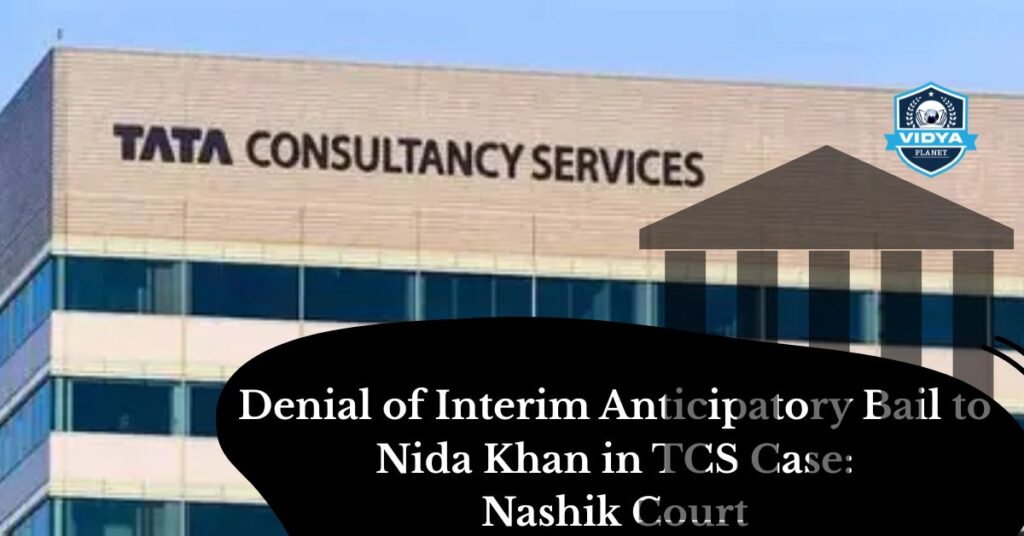
The recent developments in the Tata Consultancy Services (TCS) Nashik case have reignited critical debates regarding the intersection of criminal law with religious freedoms, workplace harassment, and anticipatory parole. Nida Khan, the accused, was denied interim anticipatory relief by the Nashik Sessions Court, which represents a significant procedural development in a case that is already intricate and involves allegations of religious coercion and sexual harassment in a corporate environment.
This article offers a thorough legal examination of the case, with a particular emphasis on the statutory framework that governs anticipatory bail, pertinent provisions under the Bharatiya Nyaya Sanhita (BNS), judicial precedents, and the broader implications for corporate accountability and criminal jurisprudence in India.
Factual Context of the Case
The controversy is the result of a succession of complaints submitted by employees at a Business Process Outsourcing (BPO) unit in Nashik that is affiliated with TCS. The allegations encompass the following:
- Sexual harassment and inappropriate workplace behavior
- Religious harassment, including insulting remarks about Hindu deities.
- Alleged attempts to coerce or compel religious conversion.
Several personnel were the subject of multiple First Information Reports (FIRs). The majority of the accused have been arrested; however, Nida Khan is the sole individual who has not yet been arrested.
Nida Khan applied for anticipatory bail before the Sessions Court on many grounds, including her pregnancy and the contention that she is not the primary culprit. Nevertheless, the court declined to grant interim protection from arrest and rescheduled the matter for a subsequent hearing on April 27.
Legal Framework: Anticipatory Bail in India
Section 482 of the Bharatiya Nagarik Suraksha Sanhita (BNSS).
Anticipatory bail is regulated by Section 482 of the Bharatiya Nagarik Suraksha Sanhita, which permits an individual to apply for bond in advance of an arrest. The provision safeguards individual liberty and prevents arbitrary detention in accordance with Article 21 of the Indian Constitution.
The primary considerations for granting anticipatory bail are:
- The nature and gravity of the charge
- Background of the applicant
- Possible escape from prosecution
- Chance of tampering with evidence or influencing witnesses
The court’s decision to deny interim anticipatory release in this instance suggests that there were insufficient grounds to grant immediate protection.
The charges and the corresponding penal provisions are as follows:
The broader case encompasses severe offenses under the Bharatiya Nyaya Sanhita, 2023 (BNS), including: despite the fact that the specific sections invoked against Nida Khan differ across FIRs.
- Section 74 BNS: Criminal force or assault against a woman
- Section 75 BNS: Sexual harassment.
- Section 79 BNS: Insulting a woman’s modesty
- Section 299 BNS: Deliberate acts intended to provoke religious sentiments
- Section 3(5) BNS: Common intention
The claims reflect a pattern of conduct that includes both gender-based harassment and religious targeting, raising the gravity of the charges.
Denial of Interim Relief: The Judicial Basis
The court’s denial of interim anticipatory bail must be interpreted in accordance with the well-established judicial principles. Although the precise order is not entirely accessible to the public, it is possible to derive certain conclusions:
- The gravity of the allegations: The case revolves around allegations of systemic harassment and numerous FIRs that were filed over a particular period. Generally, courts are hesitant to grant anticipatory bail in cases involving severe offenses that affect public morality and dignity.
- Non- Compliance with the procedures: Apparently, Nida Khan is not yet in police custody, and investigators are currently working to locate her. When the accused appears to be evading investigation, courts frequently deny pre-arrest parole.
- Ongoing Investigation: Multiple accused and the presence of a Special Investigation Team (SIT) indicate that the investigation is in a critical phase. Effective investigation may be impeded by the provision of interim protection.
- Maintaining a Balance Between Liberty and Investigation: The court appears to have prioritized the integrity of the investigation over the immediate liberty of the accused, a balance that is frequently emphasised in criminal jurisprudence.
Key Judicial Precedents on Anticipatory Bail
Gurbaksh Singh Sibbia v. State of Punjab (1980)
The Supreme Court ruled that anticipatory bail is a tool for protecting individual liberty and should not be subject to stringent restrictions. Nevertheless, it must be granted within the context of judicial discretion.
Siddharam Satlingappa Mhetre v. State of Maharashtra (2011)
The Court underscored the importance of granting anticipatory parole liberally in cases where there is no likelihood of the accused fleeing or tampering with evidence.
Sushila Aggarwal v. State (NCT of Delhi) (2020)
The Supreme Court has clarified that anticipatory parole may be granted without a time limit and should not be unduly restricted.
Pradeep Sharma v. State of Madhya Pradesh (2014)
The principle that cooperation with investigation is essential was reaffirmed by the Court, which ruled that anticipatory parole should not be granted to an absconding accused.
Nida Khan’s denial of interim bail is consistent with judicial trends, particularly in light of the severity of the charges and the allegation of evasion, in light of these precedents.
Intersection with Workplace Harassment Laws
The case also raises significant issues under the Sexual Harassment of Women at Workplace Prevention, Prohibition and Redressal Act, 2013 (POSH Act).
Key observations consist of:
- The apparent inability of institutional systems, particularly the POSH Committee, to handle complaints
- Arrest of an operations manager associated with the committee for alleged inaction
- Potential corporate liability for failing to guarantee a secure work environment
This underscores a pervasive failure to enforce workplace safety standards, which could have averted the escalation into criminal proceedings.
Criminal Liability and Religious Coercion
The allegations of religious harassment and coercion underscore constitutional safeguards under:
- Article 25 pertains to the right to freedom of religion.
- Instances of public order, morality, and health, which are reasonable restrictions
Penal liability under BNS provisions may be imposed for actions that are intended to incite religious sentiment or coerce conversion, provided that they are proved. Throughout history, courts have maintained a strict stance toward offenses that disrupt communal harmony.
A Legal Perspective on Pregnancy as a Ground for Bail
The accused’s pregnancy was one of the primary defense arguments. Although humanitarian factors are taken into account by courts, pregnancy alone is not an indisputable basis for anticipatory bail.
The Supreme Court in Ramesh Bhavan Rathod v. Vishanbhai Hirabhai Makwana (2021) determined that the nature of allegations must be balanced against personal circumstances.
Consequently, the court’s denial implies that the severity of the accusations outweighed the mitigating factor of pregnancy at this juncture.
Consequences for Corporate Governance and Criminal Justice
- Enhancing Investigative Autonomy: The ruling reaffirms the principle that courts should refrain from prematurely intervening in ongoing investigations.
- Corporate Responsibility: The case reveals deficiencies in the internal grievance redressal mechanisms, particularly those implemented under the POSH Act.
- The Expansion of the Range of Workplace Crimes: An evolving comprehension of workplace malfeasance is suggested by the inclusion of religious harassment in conjunction with sexual harassment.
- Judicial Approach to Anticipatory Bail: The decision emphasizes the importance of a cautious approach when allegations entail systemic abuse and multiple victims.
Analysis of the Critical Nature
Although the denial of interim anticipatory parole is consistent with legal principles, there are specific issues that require consideration:
Presumption of Innocence: The accused may be prejudicially affected prior to trial as a result of media coverage and public discourse.
Critics contend that anticipatory bail jurisprudence is inconsistent.
Requirement for Comprehensive Judicial Orders: Public confidence would be fortified by increased transparency in reasoning.
In the same vein, the gravity of the allegations necessitates a rigorous judicial examination.
Conclusion
The TCS Nashik case is a complex intersection of constitutional rights, employment regulation, and criminal law. Nida Khan’s denial of interim anticipatory bail by the Nashik court is indicative of a meticulous equilibrium between the necessity of a fair and comprehensive investigation and the right to individual liberty.
The final adjudication of the anticipatory bail petition, and ultimately the trial, will have significant implications for the legal treatment of workplace misconduct in India, corporate accountability, and anticipatory bail jurisprudence as the matter advances.
The case serves as a reminder that anticipatory bail is a critical safeguard of personal liberty, but it is not absolute and must be subject to the demands of justice, particularly in cases involving severe and systemic allegations.