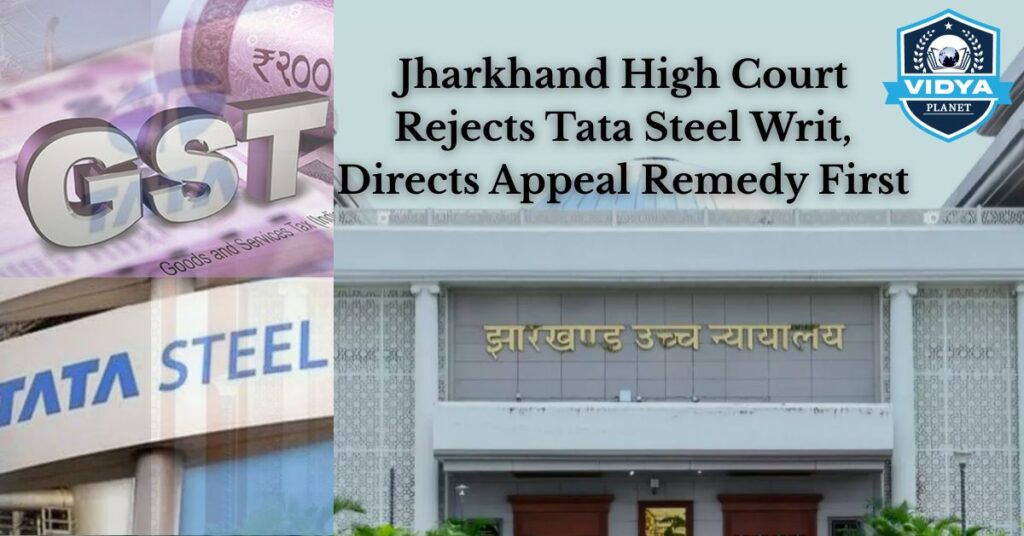
In a significant decision reaffirming the doctrine of alternative statutory remedy, the Jharkhand High Court denied Tata Steel Limited’s writ petition challenging a Goods and Services Tax (GST) demand order issued under Section 74 of the Central Goods and Services Tax Act, 2017 (CGST Act). The Court determined that the company had an effective appeal procedure available under the Act and that Article 226 jurisdiction should not normally be exercised in such circumstances. However, the Court gave Tata Steel relief by permitting it to file a statutory appeal within four weeks of the limitation period.
This decision is significant because it emphasizes two recurring issues in tax litigation: first, High Courts generally oppose bypassing statutory appeal channels; second, courts may still shield petitioners from limiting difficulties if processes were pursued legitimately.
Background to the Dispute
The controversy erupted after tax authorities filed an Order-in-Original against Tata Steel under Section 74 of the CGST Act of 2017. Section 74 addresses circumstances in which tax is alleged to have been unpaid, underpaid, incorrectly reimbursed, or Input Tax Credit (ITC) has been improperly obtained or used as a result of fraud, intentional deception, or suppression of facts in order to escape tax.
According to sources, the GST requirement resulted in significant financial risk. Public debates imply a tax component of roughly ₹493 crore and penalties surpassing ₹638 crore, resulting in a total demand of around ₹1,132 crore.
Tata Steel filed a writ suit in the High Court against the ruling rather than filing a statutory appeal under Section 107 of the CGST Act.
Tata Steel’s Key Arguments
The corporation apparently presented many concerns before the High Court:
1. Improper use of Section 74
Tata Steel claimed that the jurisdictional conditions for invoking Section 74 were lacking. It argued that claims of fraud, suppression, or willful falsification were not founded on facts.
This point is legally significant because if Section 74 is applied without the necessary conditions, proceedings may be challenged as lacking jurisdiction.
2. Violation of Natural Justice.
In addition, the petitioner claimed a violation of natural justice principles. It argued:
The show cause notice was based on a contested audit report, explanations were not adequately examined, and the decision was arbitrary.
3. Call Book and Limitation Issues
It was also stated that proceedings were removed from the “Call Book” to circumvent limitation difficulties. Matters are frequently sent to a Call Book in indirect tax administration when adjudication is postponed due to policy or legal developments.
4. Write Maintainability Despite Alternative Remedy
Tata Steel attempted to bring the case inside the acknowledged exclusions in which High Courts can hear writ petitions despite alternative remedies.
The Revenue Stand
The GST authorities challenged the writ petition, claiming that:
- The adjudicating authority had jurisdiction,
- The conclusions were based on facts,
- The petitioner had a statutory right to appeal under Section 107, and
- The High Court should not operate as an appellate venue under Article 226.
Legal Issues Before the Court
The main question before the Court was:
Whether a taxpayer bypasses the statutory appellate process and seek writ jurisdiction over a GST adjudication ruling under Section 74?
High Court’s Findings
A Division Bench, led by Chief Justice M. S. Sonak and Justice Rajesh Shankar, dismissed the writ petition on maintainability grounds.
1. Alternate Remedy Rule applies.
The Court determined that Tata Steel had a clear appellate procedure under Section 107 of the CGST Act, which allows for appealing against decisions or orders issued by adjudicating agencies.
Section 107 normally allows the following:
- If an aggrieved individual appeals within three months, they may be granted a one-month stay (subject to statute).
- The Court highlighted that if a proper statutory framework exists, writ jurisdiction should not be used to circumvent legislative procedures.
2. No Exceptional Circumstances Are Out
The High Court stated that writ jurisdiction can still be exercised in restricted instances, such as:
- There is a lack of jurisdiction,
- If there is a breach of natural justice,
- If there is violation of statute, and clear arbitrariness.
However, the Court determined that Tata Steel’s case did not meet these exclusions.
3. Disputed Facts Require Appellate Review
The Bench stated that the issues highlighted necessitated a thorough analysis of the facts, evidence, and accounting records, particularly in terms of improper ITC utilization and tax liability.
These exercises are more suited to appellate authority than writ courts.
4. The proper officer had jurisdiction.
The Court rejected the allegation that the order was entirely without jurisdiction. Because the appropriate officer was competent within the CGST framework, the issue became one of correctness of findings rather than jurisdictional nullity.
Landmark Precedent Judgements
1. Whirlpool Corporation v. Registrar of Trademarks
The Supreme Court in Whirlpool concluded that alternative remedy does not bar writ jurisdiction where:
The fundamental rights and principles of natural justice are violated, and the proceedings lack jurisdiction.
This is still the leading authority.
2. State of Maharashtra vs. Greatship (India) Limited
The Court reaffirmed its caution in using writ jurisdiction in cases where legislative remedies exist.
3. Assistant Commissioner (CT) vs. Commercial Steel Ltd.
In GST cases, the Supreme Court has often underlined that taxpayers should first file statutory appeals.
Relief granted on limitation:
Although the writ petition was dismissed, the High Court provided significant relief.
Recognizing Tata Steel’s bona fide pursuit of the writ remedy, the Court instructed that if the business files an appeal within four weeks, the appellate authority should hear it on merits rather than dismiss it on limitation grounds.
This was a balanced order, because:
- The Court maintained statutory discipline while protecting the taxpayer from procedural prejudice.
Relevant Statutory Provisions
Section 74 in the CGST Act
Applicable where the tax shortage or improper ITC is caused by:
- Fraud,
- willful falsehood, and
- concealment of facts.
Has stronger repercussions, including penalties.
Section 107 in the CGST Act
Provides the first appeal procedure for adjudication orders.
Article 226, Constitution of India.
Allows High Courts to issue writs, but jurisdiction is discretionary.
Why This Decision Matters
1. Strong Message for Taxpayers
Large corporations and regular assessees cannot frequently avoid appellate remedies simply because the demand amounts are considerable.
2. GST Litigation Discipline.
The decision enhances the GST appellate process while reducing direct writ petitions against assessment orders.
3. Natural justice must be clear and patentable.
An accusation of unfairness is insufficient. The infringement must be substantial and obvious.
4. Limitation Equity
Courts may nevertheless provide equitable remedies to parties that pursued the improper forum in good faith.
Practical Takeaways for Business
- Always assess appeal timelines soon after getting GST instructions.
- Writ petitions should only be used in extraordinary cases involving jurisdiction or constitutional difficulties.
- Maintain documentary evidence to refute Section 74 claims.
- If you approach the High Court first, ask for protective relief over the limitation.
Conclusion
The Jharkhand High Court’s decision in Tata Steel’s case reiterates a well-established principle of tax law: when a statutory appeal exists, that remedy must usually be explored first. The Court refused to treat writ jurisdiction as an appellate replacement for factual GST disputes. However, by giving Tata Steel four weeks to file an appeal without a limitation objection, the Bench achieved fairness while maintaining procedural discipline.
The decision will most likely be cited in future GST disputes in which taxpayers attempt to challenge Section 74 adjudication orders directly before High Courts rather than through the appeal process.