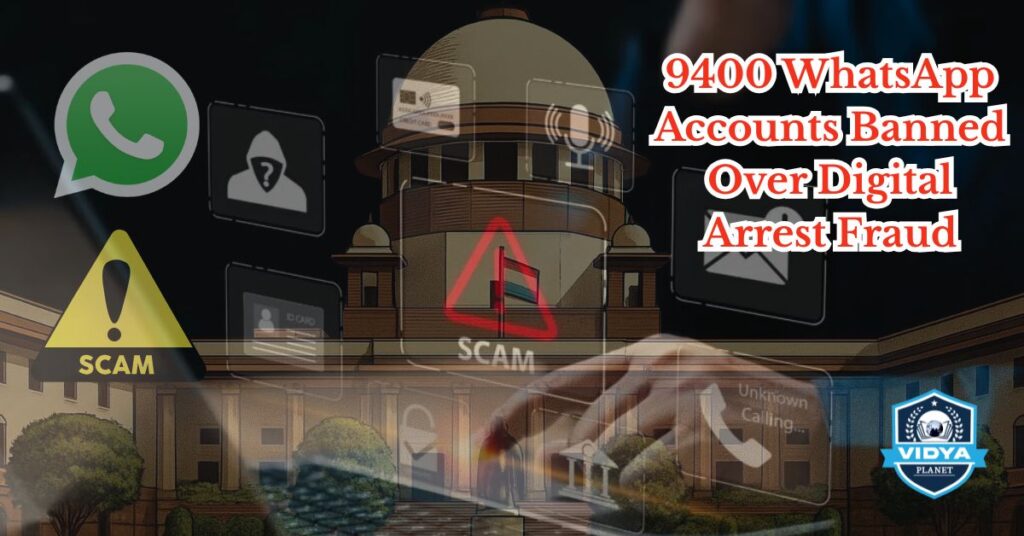
Connectivity, commerce, and convenience have been provided to millions by India’s swiftly expanding digital ecosystem. However, it has created new opportunities for sophisticated cyber fraud. One of the most concerning trends in recent years has been the rise of the so-called “digital arrest scam”- a fraudulent plan in which criminals mimic police personnel, CBI officials, ED officers, courts, or telecom authorities to frighten victims into sending money. In a noteworthy breakthrough, the Union Government notified the Supreme Court that WhatsApp had banned 9,400 accounts associated with such schemes during a concentrated inquiry began in January 2026.
This disclosure emphasizes both the gravity of the threat and the expanding role of digital intermediaries in preventing cybercrime. It also presents critical issues about platform liability, privacy, cyber policing, and public awareness.
What is a Digital Arrest Scam?
A “digital arrest” is not a legal concept recognized under Indian law. It is simply a fake statement created by scammers to instill fear. In these scams, criminals contact victims via WhatsApp calls, video calls, or messaging and falsely claim that they are involved in money laundering, parcel smuggling, Aadhaar fraud, narcotics trafficking, or tax avoidance.
Victims are then threatened with immediate arrest, account freezing, or public humiliation until they cooperate. Scammers frequently ask people to remain on continuous video conferences, mimicking custody, and to transfer monies into “safe accounts” for verification purposes.
Such frauds frequently target seniors, professionals, and first-time digital users.
Proceedings before the Supreme Court
The Supreme Court has been monitoring the issue of an increasing number of digital arrest scams through suo motu cases. During the hearing, the Ministry of Home Affairs, through the Indian Cyber Crime Coordination Centre (I4C), presented a status report outlining the steps taken by telecom carriers, regulators, law enforcement agencies, and digital platforms like WhatsApp.
The Court was informed that WhatsApp proactively disabled over 9,400 accounts associated with these schemes over a 12-week period commencing in January 2026. Many of these accounts apparently used names like “Delhi Police,” “CBI,” or other official titles to deceive users.
This is an important example of court monitoring influencing coordinated executive action in public cyber safety.
Relevant Legal Provisions in India
1. Information Technology Act of 2000.
Section 66C
- Identity Theft
- Punishes the fraudulent use of passwords, digital signatures, or unique identity features.
Section 66D
- Cheating via Personation with Computer Resources.
- Very important to digital arrest scams. Fraudsters impersonate public officials using electronic communication.
Section 66F
- In exceptional circumstances involving major cyber threats, larger crimes may be used.
Section 79
- Intermediary Liability
- Provides safe harbor for intermediates such as WhatsApp, subject to due diligence and compliance.
Bharatiya Nyaya Sanhita, 2023 (BNS)
Section 318
- This provision of the act addresses cheating.
- Where one individual fraudulently induces another to deliver property.
Section 319
- This section deals with Cheating via Personation
- Directly applicable when scammers impersonate police or government officials.
- Criminal Intimidation Provisions
- Threatening arrest or prosecution can also result in criminal penalties.
3. The Information Technology (Intermediary Guidelines and Digital Media Ethics Code) Rules, 2021
- These regulations require intermediaries to use due care, remove illegal content upon notification, designate grievance officers, and cooperate with law enforcement.
WhatsApp’s role as an intermediary
WhatsApp serves as a middleman under Indian law. It does not generate fraudulent content but does give a communication platform. Section 79 of the IT Act exempts intermediaries from responsibility provided they exercise mandatory due diligence.
In this matter, WhatsApp apparently implemented many precautionary steps, including:
- Identifying and banning fraudulent accounts.
- Detecting Impersonation Patterns.
- Flagging the misuse of logos and official iconography.
- Working on SIM-binding to strengthen account verification.
- Cooperating with Indian agencies on cyber fraud typologies.
This highlights how platforms can actively assist while maintaining end-to-end encryption.
Key Judicial Principles and Case Law
1. Shreya Singhal v. Union of India (2015), 5 SCC 1.
The Supreme Court overturned Section 66A of the IT Act but upheld Section 79’s safe harbor rights, subject to reasonable compliance. This case remains essential to intermediary liability law.
2. K.S. Puttaswamy v. Union of India (2017, 10 SCC 1)
The right to privacy is recognized as a fundamental right under Article 21. Any anti-fraud solutions must strike a balance between privacy and surveillance concerns.
3. Anuradha Bhasin v. Union of India (2020), 3 SCC 637.
Despite its focus on internet shutdowns, the decision underlined the constitutional significance of access to digital communication and the need for proportional limits.
These decisions show that cyber regulation must safeguard users while upholding civil freedoms.
Why do these scams succeed?
Digital arrest frauds are based less on hacking and more on psychological manipulation. They exploit:
- Fear of police action.
- Lack of legal awareness.
- Trust in uniforms, logos, and official languages.
- Urgency and panic.
- Isolating victims during video conferences
Many victims cooperate because they are unaware that arrests, summonses, or investigations cannot be conducted legally via a random WhatsApp call.
Can Police Make Arrests Through WhatsApp?
Absolutely not. Indian criminal procedure involves legitimate arrest by authorized authorities who follow legislative safeguards. Arrests must adhere to constitutional safeguards outlined in Articles 21 and 22 of the Constitution, which include grounds for arrest, access to counsel, and production before a magistrate.
No police officer may “digitally arrest” an individual via video call and demand money.
The Government’s Multi-Agency Response
The report before the Supreme Court proposes a coordinated framework that includes:
- Ministry of Home Affairs
- I4C Telecom operators
- RBI and banks
- Digital platforms
- State police cybercells
Such collaboration is required since scams encompass communication lines, forged SIM cards, mule bank accounts, and cross-border syndicates.
Some scam activities were apparently tracked back to centers in Southeast Asia, particularly Cambodia, demonstrating that the crime has multinational implications.
What Citizens Should Do?
If you get such a call:
- Disconnect immediately.
- Do not share OTP, Aadhaar, PAN, or financial information.
- Never move funds to “safe accounts.”
- Check with the relevant agency independently.
- Report promptly to the National Cybercrime Helpline 1930 or the cybercrime portal.
- Save screenshots, numbers, and recordings.
The Way Forward
While banning 9,400 accounts is substantial, it is merely the first step. Fraud networks quickly generate fresh numbers and identities. India needs:
- Stronger KYC requirements for SIM issuing.
- Faster freezing of questionable accounts.
- Public awareness campaigns in regional languages.
- Real-time bank fraud warnings.
- Cross-border collaboration in cybercrime.
- AI-powered fraud detection with privacy measures.
Conclusion
The Supreme Court’s surveillance of digital arrest schemes, as well as the revelation that WhatsApp has banned 9,400 connected accounts, highlight the scope of cyber fraud that threatens ordinary Indians. This episode demonstrates that police alone cannot combat cybercrime; courts, regulators, telecom companies, banks, and digital platforms must all work together to address the issue.
Most essential, citizens must recall a legal fact: there is no such thing as a digital arrest under Indian law. Fear is the scammer’s most powerful weapon, while awareness is the citizen’s best defensive. The law must continue to evolve to guarantee that technology is used to benefit people rather than exploit them.
Check the Cyber Crime Manual by I4C here: