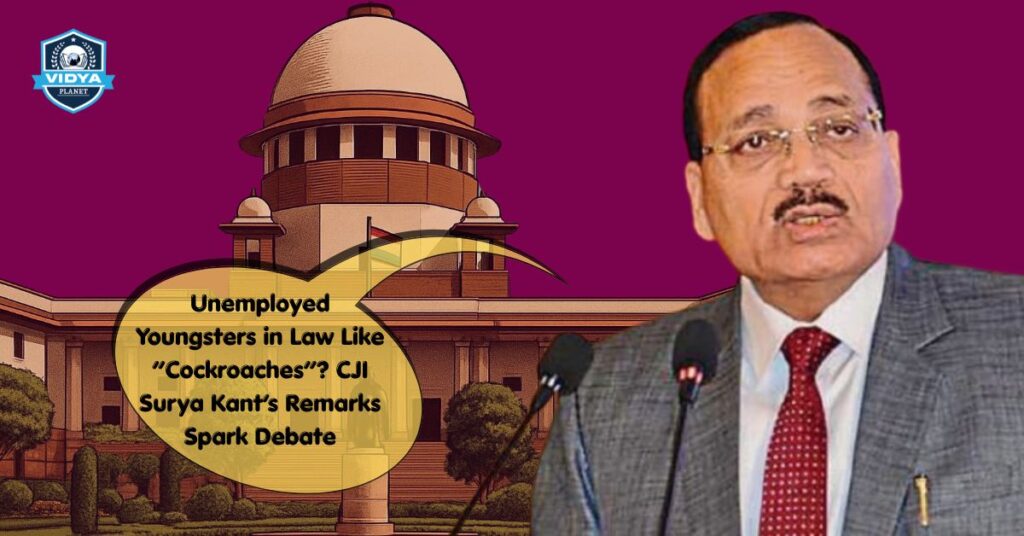
The Indian judiciary has once again become the subject of public controversy, following controversial comment made by Chief Justice of India Surya Kant comparing many unemployed young lawyers to “cockroaches.” The speech, made during Supreme Court proceedings, drew swift criticism from lawyers, students, activists, and civil society groups around the country. The remarks also sparked broader debates about legal unemployment, the role of social media activism, abuse of the Right to Information (RTI) process, judicial accountability, and the boundaries of judicial expression in a constitutional democracy.
The controversy arose during a hearing on the designation of senior advocates and accusations of fraudulent law degrees. While expressing concern about individuals purportedly targeting institutions and abusing legal processes, the CJI noted that some unemployed young lawyers “take to social media, RTI activism,” and become part of what he termed as “parasites” destroying the system.
The comment swiftly shared across media platforms, eliciting strong public reactions due to both the terminology used and the broader implications it had for unemployed young and democratic activism.
Context Behind the Remarks
The observations were made as the Supreme Court was considering a case involving challenges to the process of appointing senior attorneys in the Delhi High Court. Throughout the proceedings, the Bench voiced anger with what it saw as repeated attempts to undermine judicial institutions through petitions, contempt cases, media campaigns, and activism.
According to sources, the Court also expressed worry about false law degrees and the growing number of people joining the legal profession without basic competence or ethics. The remarks were thus made in light of institutional criticism and the legal profession’s integrity.
However, what transformed the courtroom observation into a national controversy was the metaphor employed by the CJI. Comparing unemployed youth to “cockroaches” was widely perceived as dehumanizing and dismissive, especially at a time when India continues to face severe unemployment challenges among educated youth, including law graduates.
Judicial Speech and Constitutional Morality
Judges hold a unique constitutional status in India. Their remarks hold institutional power and moral credibility that extend well beyond ordinary public conversation. Consequently, judicial speech is frequently required to embody constitutional morality, moderation, dignity, and sensitivity.
The Supreme Court has consistently stressed the significance of basic ideals like dignity under Article 21 of the Constitution. The right to dignity is acknowledged as an essential component of the right to life and personal liberty. In this context, critics claim that terminology comparing certain segments of society to pests or parasites undermines the constitutional ethos of respect and inclusion.
The controversy highlights an important constitutional question: may forceful judicial criticism become problematic when it appears to denigrate disadvantaged social groups?
Courts in democratic systems serve more than only as adjudicators; they also protect constitutional principles. Judicial language thus has symbolic meaning. Constitutional courts’ harsh criticisms can change public perception, institutional culture, and citizens’ trust in the legal system.
The words were criticized not because the judiciary denounced the misuse of legal instruments, but because the rhetoric employed appeared to be inconsistent with the empathy and neutrality that constitutional authorities are expected to exhibit.
Social Media Activism and Democratic Participation
Another significant aspect of the debate concerns the Court’s apparent censure of social media users and RTI advocates. The words imply that certain unemployed youngsters use activism and internet criticism to harm institutions.
This observation refers to a developing friction in India between institutions and internet activists.
Social media has emerged as a significant venue for democratic involvement, public accountability, legal awareness, and citizen journalism. RTI activism has also evolved as an effective constitutional tool for ensuring transparency and accountability in governance. The Right to Information Act of 2005 is based on Article 19(1)(a) of the Constitution, which protects freedom of speech and expression.
While abuse of RTI or social media is clearly present, broad generalizations about activists may risk delegitimizing genuine public participation in democracy.
Many notable public interest revelations in India, such as corruption scandals, administrative anomalies, and rights violations, have been made possible via RTI applications and independent action. Civil society activism has frequently strengthened rather than undermined constitutional governance.
However, the judiciary’s concerns are not completely baseless. The proliferation of misinformation, sensationalism, internet abuse, and frivolous lawsuits has posed serious institutional issues. Research into online ecosystems shows how social media may fuel rumors, antagonism, and concerted attacks on institutions.
Thus, the constitutional task is to strike a balance between institutional protection and democratic freedom.
The Crisis of Unemployment in the Legal Profession
The words also unwittingly revealed a more serious structural issue: unemployment and underemployment within the legal profession itself.
Every year, India generates thousands of law graduates, but the legal market remains deeply unequal. Many young lawyers suffer financially in their early years in practice. Unlike other professions, litigation frequently lacks consistent entry-level pay, institutional support, and social security. Junior advocates frequently labor long hours for little or no compensation.
Due to economic insecurity, many law graduates have pursued alternative jobs such as legal journalism, policy advocacy, legal content development, RTI work, social media commentary, and public activism. These fields are not necessarily illegitimate. In fact, they are progressively becoming part of a larger legal ecosystem in a digital constitutional democracy.
The dispute thus reflects an inherent generational rift within the profession. Younger attorneys today interact with the law not only in courtrooms, but also via internet forums, policy discourse, and rights-based activism.
Many critics stated that instead of discarding unemployed young, institutions should work to improve legal education standards, regulate bogus degrees, broaden professional prospects, and develop ethical legal practice.
Public Reaction and Criticism
The comments sparked significant outrage throughout social media platforms and legal circles. Several commenters called the language disrespectful and improper for the head of the judiciary.
Critics criticized the demeaning metaphor of “cockroaches,” claiming that constitutional authority must avoid terminology that undermines human dignity. Some legal scholars cautioned that associating activity with institutional antagonism could have a chilling impact on free speech and criticism.
At the same time, other supporters justified the CJI’s remarks as expressions of dissatisfaction with aggressive litigation, professional misconduct, and coordinated attacks on institutions. According to this viewpoint, the Court was not condemning all unemployed youngsters or activists, but rather those who allegedly used democratic venues for personal gain or harassment.
Clarification by the CJI
Following the backlash, reports claimed that CJI Surya Kant later stated that his words had been “misquoted” or taken out of context. He explained that his findings were primarily focused at those who entered the legal profession using forged or false degrees and then attempted to exploit organizations.
The clarification reduced the controversy, although it did not completely eliminate it. By then, the matter had morphed into a larger debate over judicial sensitivity, language, and democratic responsibility.
Importantly, the clarification shows how public scrutiny serves as an accountability tool in constitutional democracies. Institutional critique and public debate are not inherently anti-system; rather, they are frequently necessary components of democratic governance.
Judicial Accountability and Freedom of Criticism
One of the most important constitutional features of this debate is the link between judicial authority and public criticism.
The judiciary in India has extensive constitutional protection and independence. However, judicial independence does not guarantee immunity from criticism. The Supreme Court has acknowledged that legitimate criticism of judicial functioning is permitted within democratic parameters.
The issue emerges when criticism is interpreted as malevolent, libelous, or institutionally detrimental. Courts have repeatedly used contempt jurisdiction to safeguard judicial authority, but excessive intolerance of criticism may undermine democratic accountability.
This dispute exemplifies the tricky balance between protecting institutional dignity and upholding citizens’ constitutional rights to question public institutions.
Conclusion
CJI Surya Kant’s statements sparked an important national conversation that goes much beyond a judicial observation. At the heart of the dispute is a bigger constitutional issue about dignity, democratic dissent, unemployment, and institutional accountability.
While concerns about phony legal degrees, foolish activism, and institutional attacks are legitimate, constitutional authorities must use calm and sympathetic language. In a constitutional democracy based on dignity and equality, public institutions are strengthened not just by authority, but also by public trust.
The dispute also highlights the difficulties that young attorneys in India face, such as economic hardship, professional uncertainty, and the need to seek alternative paths of legal participation. Social media activism, RTI work, legal journalism, and public advocacy are increasingly staples of modern legal debate.
Finally, the episode serves as a reminder that constitutional democracy is sustained not by silence, but by dialogue, criticism, accountability, and mutual respect between institutions and citizens. The court, as the custodian of constitutional morality, must continue to uphold these ideals not only via its decisions but also by the language it uses.