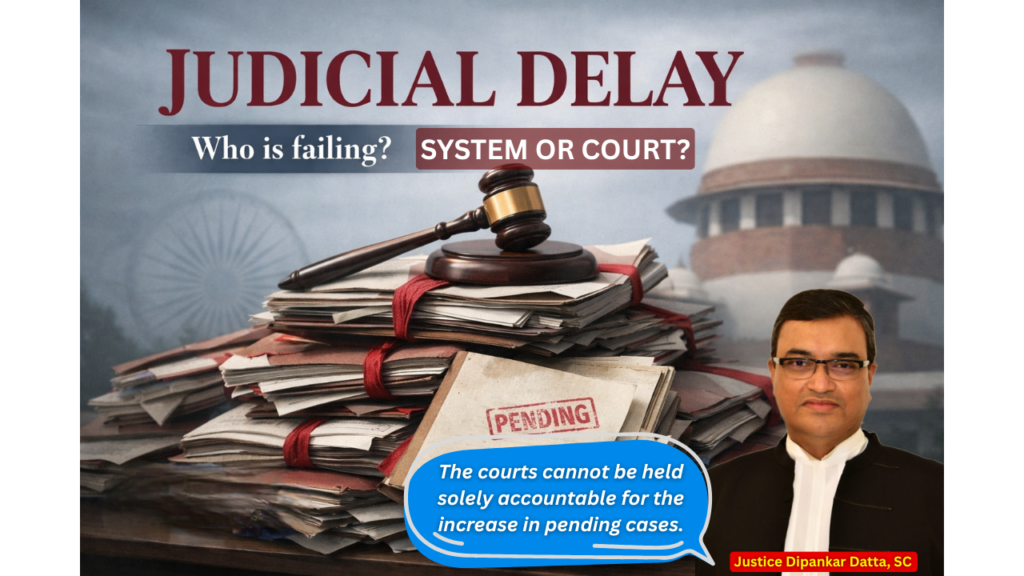

The Government of India’s decision in 2026 to increase the Supreme Court’s sanctioned strength from 34 to 38 judges is one of the most significant judicial moves in recent years. The decision comes at a time when the Indian judiciary is dealing with a massive backlog of pending cases, more constitutional litigation, and a growing public desire for prompt justice. While the extension is hailed as a progressive institutional reform, it has sparked critical issues about judicial efficiency, structural reforms, and access to justice in India.
The Supreme Court of India holds a unique and powerful role within the country’s constitutional system. Established under Article 124 of the Constitution, it serves not only as the highest appeal court, but also as the Constitution’s guardian and protector of fundamental rights. Population growth, increased legal awareness, the expansion of public interest litigation, business issues, and constitutional challenges have all contributed to the Court’s enormous increase in jurisdiction and workload over the decades. As a result, boosting judicial capacity has become more vital.
Constitutional Basis for Expansion
The Constitution does not establish a permanent number of Supreme Court judges. Instead, Article 124 authorizes the Parliament to legislate the Court’s strength. This constitutional flexibility enables the government to increase or decrease the number of judges based on the institutional needs of the judiciary.
Since 1950, the Supreme Court’s strength has steadily evolved. At its inception, the Court was made up of the Chief Justice of India and seven puisne justices. As litigation grew, Parliament periodically revised the Supreme Court (Number of Judges) Act, 1956, to boost judicial capacity. The recent decision to expand the number of judges to 38 is part of a long-running constitutional and administrative procedure aimed at improving judicial functioning.
The Pendency Crisis and Rising Judicial Workload
The alarmingly high number of cases pending before the Supreme Court is one of the main causes of the expansion. Thousands of cases have been outstanding for years, including constitutional conflicts, criminal appeals, civil matters, business litigation, and Special Leave Petitions (SLPs). The increasing number of lawsuits has put immense strain on the current judicial apparatus.
The issue of pendency is more than just administrative; it directly impacts constitutional rights and public trust in the legal system. Delayed justice has an impact on undertrial prisoners, prolongs civil disputes, disrupts business transactions, and reduces citizens’ trust in judicial institutions. The well-known legal adage “Justice delayed is justice denied” is especially important in this instance.
Today, the Supreme Court serves many functions at the same time, Courts include:
- Constitutional Court,
- Appellate Court,
- Guardian of Fundamental Rights,
- Court of Record, and
- Constitutional Interpreter.
Unlike many highest courts throughout the world, the Indian Supreme Court has a very broad jurisdiction. This has greatly increased the workload for judges, necessitating institutional expansion.
Expansion Through Legislative Mechanism
The Supreme Court (Number of Judges) Act, 1956 was amended to make the expansion possible. When Parliament was not in session, the government first invoked Article 123 to issue an ordinance.
Article 123 authorizes the President to issue temporary ordinances with the force of law. However, such ordinances must be passed by Parliament. The employment of the ordinance route in judicial proceedings sometimes provokes disagreement about parliamentary scrutiny and democratic deliberation, even though it is constitutionally acceptable.
Following the expansion, the Supreme Court will be composed of:
- Chief Justice of India
- 37 other judges.
This expansion is likely to allow the Court to form more benches at once, enhancing disposal rates and relieving pressure on current justices.
Importance of Constitution Benches
One of the primary advantages of expanding judge strength is the ability to form more Constitutional Benches. According to Article 145(3), important constitutional interpretation concerns require a minimum of five judges.
Due to a lack of judges and an increasing workload, major constitutional issues frequently sit pending for years. Expansion of the Court may allow for more frequent Constitution Bench sittings, resulting in faster resolution of urgent constitutional issues.
Judicial Appointments and the Collegium Debate
The expansion reignites the controversy over judge selections. Increasing sanctioned strength is insufficient unless vacancies are filled quickly. The Collegium system, which oversees appointments to the upper judiciary, is thus important to the topic.
The Collegium system developed through key judicial pronouncements, including:
- First Judges Case (1981)
- Second Judges Case (1993)
- Third Judges Case (1998)
The current procedure requires the Chief Justice of India and the four most senior Supreme Court judges to recommend nominations. While advocates say that the Collegium safeguards judicial independence by restricting presidential meddling, detractors frequently object to a lack of openness and accountability.
The National Judicial Appointments Commission (NJAC), established by Parliament to reform appointments, was overturned by the Supreme Court in 2015 on the grounds that judicial independence is part of the Constitution’s Basic Structure.
Will Expansion Alone Solve the Problem?
Despite the optimism around the decision, numerous analysts contend that just raising the number of judges will not address India’s judicial crisis. Pendency exists not just in the Supreme Court, but also in the High Courts and the lower courts. Judicial vacancies, limited infrastructure, procedural delays, and frequent adjournments continue to have an impact on the justice system’s efficiency.
Meaningful judicial reform requires a broad institutional strategy that includes:
- Faster appointment procedures.
- Digital court infrastructure.
- AI-driven case management.
- Strengthening the lower judiciary.
- Procedure simplification.
- Improved court management through regional benches of the Supreme Court.
Many constitutional experts believe that the Supreme Court should focus on constitutional adjudication rather than regular appellate litigation. Some have proposed establishing a National Court of Appeal to ease the burden on the apex courts.
Conclusion
The Supreme Court’s expansion to 38 judges marks a significant constitutional and institutional reform aimed at increasing judicial efficiency and lowering pending cases. It reflects the increasing demands on the Indian judiciary and recognizes the critical need to strengthen the justice delivery system.
However, the effectiveness of this reform will ultimately be determined by how well the vacancies are filled and whether deeper structural reforms follow the rise in judge strength. Judicial efficiency cannot be accomplished solely through numerical expansion; it also demands modernity, transparency, technological integration, and institutional responsibility.
In a constitutional democracy like India, an efficient and independent judiciary is critical for defending rights, upholding the rule of law, and sustaining public trust in democratic governance. The increase to 38 judges is thus more than just an administrative move; it is a significant step toward enhancing constitutional justice in the world’s largest democracy.