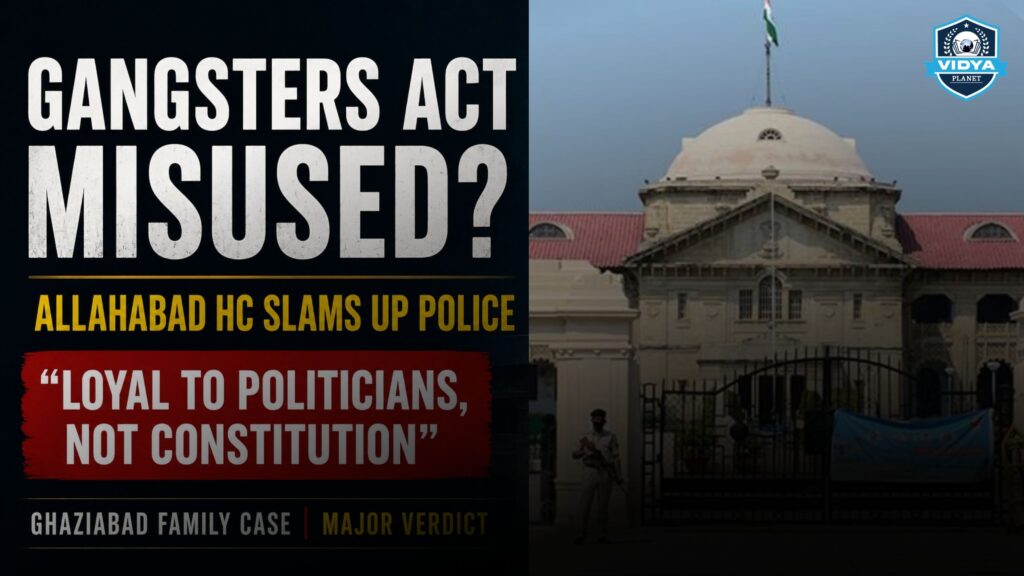
The Allahabad High Court has stated, in a sweeping and harsh condemnation that has echoed across the country’s legal landscape, that police personnel in Uttar Pradesh owe their devotion not to the Indian Constitution, but to the political establishment that rules them. Delivered on June 3, 2026, by Justice Vinod Diwakar in the matter of Rajendra Tyagi & 2 Others v. State of Uttar Pradesh. & Another, the 31-page judgment quashed criminal proceedings against a Ghaziabad family under the Uttar Pradesh Gangsters and Anti-Social Activities (Prevention) Act, 1986, producing what is arguably the most scathing judicial critique of the state’s law enforcement machinery in recent memory.
Background
The case originated from FIR No. 101 of 2023 registered at Nandgram Police Station in Ghaziabad, where Rajendra Tyagi, his son Deepak Tyagi, and his daughter-in-law Lalita Tyagi were charged under Sections 2 and 3 of the Gangsters Act. The prosecution claimed that the family maintained an organised criminal gang that committed large-scale fraud, forgery, and criminal intimidation in connection with land deals in Ghaziabad and Jalaun districts.
The petitioners challenged the Gangsters Act’s invocation before the High Court under Section 482 of the Code of Criminal Procedure, arguing that the underlying disputes were primarily civil and commercial in nature — disputes rooted in financial transactions relating to land deals — and did not meet the statutory threshold required to invoke such stringent legislation. The High Court agreed.
Even if claims of cheating and forgery were taken at face value, Justice Diwakar ruled that they did not show the existence of an organised gang under the Act. The Court found no evidence of violence, intimidation, coercion, or any other systematic criminal action that would place the defendants under the jurisdiction of the Gangsters Act. As a result, the whole proceedings, including the Special Sessions Trial underway before the Additional Sessions Judge in Ghaziabad, were thrown aside.
The Case of Lalita Tyagi: Unlawful Arrest, 80 Days in Custody
The most concerning component of the decision involved Lalita Tyagi, a 35-year-old homemaker and Rajendra Tyagi’s daughter-in-law. The Court observed that the charge sheets in the underlying criminal cases contained no particular allegation against her that may demonstrate her involvement in organized criminal conduct. Despite the utter lack of incriminating evidence, she was arrested the next day after the Gangsters Act FIR was filed, and she was forced to remain in judicial detention for almost 80 days until she was granted bail.
Justice Diwakar described her arrest as “patently illegal, arbitrary, and wholly unwarranted in law,” and said that it represented the police’s complete failure to apply established legal criteria before depriving someone of their liberty. The case of Lalita Tyagi became, in the Court’s opinion, a microcosm of the larger institutional illness affecting Uttar Pradesh’s law enforcement system—the casual, consequence-free disregard for individual rights whenever the machinery is set in motion against a target.
Political Penetration and the Transfer-Posting Economy
While the Tyagi family’s appeal was the immediate reason for the verdict, Justice Diwakar utilized it to make broad institutional judgments. The Court remarked that, during successive regimes, Uttar Pradesh’s administrative machinery has been vulnerable to deep political involvement. The Court stated that transfers, postings, and promotions of police officers have long been used as tools of political patronage rather than merit-based government.
Officers believed to be loyalists are rewarded with preferential postings — urban Commissionerate and wealthy districts — while those who display independence are punished by being moved to insignificant tasks. The Court referred to this as a well-established “transfer-posting economy” that fundamentally distorts the incentive structure for police personnel throughout the state.
The Court stated that as a result of this structure, officers’ vertical devotion is directed toward the prevailing dispensation rather than the Constitution. Field officers, intensely aware of this economy, tailor their actions to please political superiors rather than uphold the law. According to the Court, the “feudal mindset of politicians and bureaucrats” has long degraded constitutional administration in the UP to a tool for personal control rather than public service.
Misuse of the Gangsters Act: A Pattern of Selective Crackdowns
Justice Diwakar also focused on the systematic abuse of the UP Gangsters and Anti-Social Activities (Prevention) Act, 1986, a law intended to combat organized crime but, according to the Court, has occasionally been used against “inconvenient individuals” rather than legitimate criminal gangs. The Court emphasized that encounter killings and targeted crackdowns have received judicial attention on numerous occasions, implying that these are not isolated incidents, but rather patterns.
The former Ghaziabad Commissioner of Police, Ajay Kumar Mishra, was singled out by the Court for appearing to “misuse and abuse” his position by accepting Gangsters Act procedures that did not meet the statute’s provisions. The Court warned him to be more cautious when approving gang maps and authorizing arrests under the Act in the future. This censure to a senior IPS officer sitting atop a Commissionerate is significant because it reinforces the Court’s conclusion that the problem extends beyond overzealous constables to the highest levels of the force.
The Bikru Ambush and the Culture of Impunity
Perhaps the most stunning section in the judgment is the Court’s mention of the July 2020 Bikru village ambush, in which eight police officers, including a Deputy Superintendent of Police, were slain during a bungled raid to catch gangster Vikas Dubey. The officer in charge of overseeing the operation received just a formal admonition as a result of the supervisory failure that permitted the calamity to occur.
The Court struggled to reconcile such a forgiving conclusion with the gravity of the failure, noting that it is precisely this culture of unaccountability that permits the “feudal and politically patronized administrative ecosystem” to thrive. When supervisory mistakes of this size go unpunished, they send a clear message to the entire force: following process and being accountable to the Constitution are optional, but loyalty to the proper patrons is not.
The Allahabad High Court’s Broader Constitutional Warning
This decision did not occur in isolation. It is the third such strongly worded judgment issued by the Allahabad High Court in the same week, as part of a judicial pattern of increasing scrutiny of the UP bureaucracy. The Court made it plain that its observations were intended not just for the parties before it, but also as a reminder to the entire State: the constitutional apparatus must be accountable to the law and the Constitution, not to any ruling institution.
The Court relied on fundamental constitutional principles to frame its observations in this manner. According to Article 14 of the Constitution, everyone has the right to equal treatment under the law. According to Article 21, no one can be deprived of life or personal liberty unless the procedure is established by law. When a housewife is arrested without any incriminating evidence and held in detention for 80 days, both promises to fail at the same time. The Court’s views show that such failings in UP are structural, the result of a police culture that has lost its constitutional character.
Legal and Policy Implications
The judgment has significant implications on multiple levels.
First, it emphasizes the importance of tight judicial monitoring over the application of special laws such as the Gangsters Act, which carries harsher penalties and procedural repercussions. Courts must guarantee that such statutes do not become weapons for harassment or political targeting.
Second, the Court’s findings on the transfer-posting economy reignite the discussion about police reform in India. The landmark Supreme Court decision in Prakash Singh v. UOI (2006) mandated state governments to make institutional reforms to protect police operations from political intrusion, including as the formation of Police Establishment Boards and State Security Commissions. The Allahabad High Court’s judgments in this case serve as a striking reminder of Uttar Pradesh’s continued failure to comply with its directives nearly two decades later.
Third, the judgment’s explicit statement that officers “calibrate their conduct to satisfy political superiors” raises the issue of institutional accountability. The Court urged the Inspector General of Police to be vigilant and circumspect in carrying out official obligations; nevertheless, whether such court admonitions translate into long-term reform is dependent on political will, which has been noticeably absent thus far.
Conclusion
The Allahabad High Court’s decision in Rajendra Tyagi v. State of Uttar Pradesh represents more than just a victory for a Ghaziabad family who had been unfairly charged under the Gangster Act. It is a constitutional reckoning — a judicial pronouncement that the police force in India’s most populous state has been so corrupted by political patronage that its primary loyalty no longer lies with the Constitution it is pledged to safeguard. The Court’s findings on the transfer-posting economy, encounter culture, selective crackdowns, and bureaucratic impunity portray a picture of systemic institutional failure that cannot be rectified through individual convictions or warnings to specific officers.
What is eventually required — and what this ruling consciously demands — is a major reorientation of Uttar Pradesh’s police-political relationship, based on the rule of law, institutional independence, and constitutional accountability. Until such reorientation occurs, the court will continue to serve as the final line of defense against abuses of state power, a function it has performed admirably in this case.