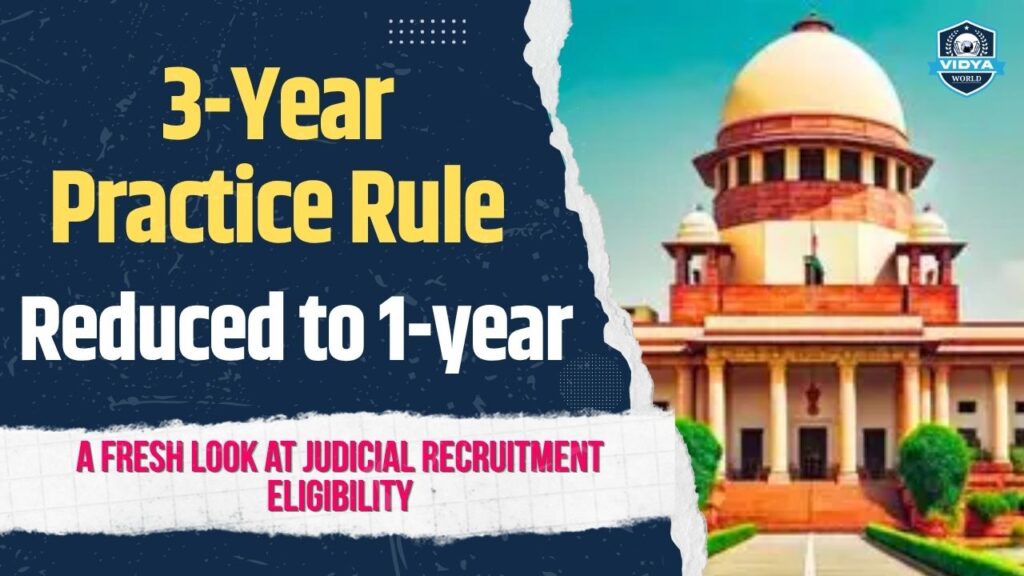
The debate over whether fresh law graduates should be allowed to sit for entry-level judicial service examinations has taken a decisive turn. On August 21, 2026, a three-judge bench of the Supreme Court, led by Chief Justice Surya Kant along with Justices Augustine George Masih and K. Vinod Chandran, modified its own earlier ruling and brought down the mandatory legal practice requirement for Civil Judge (Junior Division) aspirants from three years to just one year. The decision came in a batch of review petitions arising out of the Court’s judgment in Bhumika Trust v. Union of India, and it effectively rewrites the eligibility roadmap for thousands of law graduates across the country who dream of joining the judiciary straight after law school.
The May 2025 Verdict: 3-Year Practice Rule
To understand why this modification matters so much, it helps to revisit where the controversy began. On May 20, 2025, a bench comprising then Chief Justice B.R. Gavai and Justice Augustine George Masih had ruled that fresh law graduates could not appear for judicial service examinations at all. The Court held that a minimum of three years of legal practice was mandatory before a candidate could even sit for the entry-level Civil Judge exam. The reasoning was straightforward and, on its face, sensible: practical courtroom exposure was seen as essential for judicial competence, and multiple High Courts had flagged difficulties with young, inexperienced judges struggling to handle real litigation. Several state judicial service rules were still allowing fresh graduates directly into the system, and the Court felt this needed to be corrected uniformly across India.
This 2025 ruling was in itself a course correction of sorts. For years, the position under a 2002 judgment had allowed fresh graduates to enter judicial service without prior practice, and various High Courts, including Madhya Pradesh, had gone back and forth trying to reinstate practice requirements through their own rules. The May 2025 verdict was meant to settle the matter once and for all by making three years of bar practice compulsory nationwide.
But the ruling did not sit well with everyone. Almost immediately, review petitions started pouring in. Law graduates argued that the sudden imposition of a three-year bar practice requirement, without adequate transitional arrangements, would derail the career plans of an entire generation of students who had already begun preparing for these exams under the old rules. Some petitioners, including serving judicial officers, sought clarifications on how prior experience such as clerkships would be counted. The Supreme Court had earlier refused to budge, even remarking in August 2025 that reopening the issue would open a “Pandora’s box.” Yet the pressure from the legal fraternity, students, and various state bar associations kept building, eventually leading to a full review being taken up.
What the Court Has Now Decided
In its August 21, 2026 judgment, the Supreme Court chose what it called a middle path rather than scrapping the practice requirement altogether or retaining the full three-year mandate. The Court held that three years of conventional bar practice was not the only way for a young lawyer to gain meaningful courtroom exposure, and it devised a fresh, layered scheme to balance both concerns.
Under the new framework, candidates will now need only one year of actual legal practice before they become eligible to appear for the Civil Judge (Junior Division) examination. However, this reduction does not mean the training component has been diluted. Once selected, candidates will have to undergo one full year of intensive training at the concerned State Judicial Academy. This will be followed by a structured one-year clerkship, split into two six-month segments, one under a District and Sessions Judge or a member of the Higher Judicial Service, and the other under a sitting judge of the relevant High Court. Put together, the total exposure a candidate will now receive, combining bar practice, academy training, and clerkship, effectively substitutes for the two years that have been shaved off the original bar practice requirement.
The Court has also built in a generous transitional cushion for candidates who are already in the middle of their preparation. Anyone appearing for judicial service examinations notified between May 25, 2025 and March 31, 2027 will be eligible regardless of how many years of practice they actually have, meaning even fresh graduates can apply during this window. It is only for recruitment processes notified on or after April 1, 2027 that the fresh one-year practice requirement will strictly apply.
Importantly, the Court did not present this scheme as set in stone. The bench clarified that the new framework will remain in force for five years, after which it will come back before the Supreme Court for a review based on actual empirical data about how well the scheme has worked on the ground. This is a significant departure from the rigidity of the earlier ruling and signals that the judiciary is willing to treat this as a living, evolving policy rather than a fixed rule.
The Dissent That Matters
The judgment was not unanimous. Justice K. Vinod Chandran dissented, and his reasoning is worth noting because it captures the philosophical tension at the heart of this entire debate. He held that there was no real ground to revisit a well-considered judgment and maintained that the three-year requirement was necessary before lawyers should be allowed into judicial service. In his words, the forensic and analytical skills of an adjudicator are better learnt by observing what happens in courts, not necessarily by controlling proceedings as a presiding officer but by being a keen and eager student of law, with the courtroom itself serving as the most profound classroom of all. He expressed his disagreement “with profound respect and intense regret,” underlining that this was a genuine difference of judicial philosophy rather than a mere technical dispute.
What This Means Going Forward
For law students and recent graduates, this judgment brings welcome clarity and a more realistic pathway into judicial service. The one-year practice requirement is far more achievable for someone fresh out of a five-year law programme than the earlier three-year mandate, which many argued disproportionately disadvantaged young graduates without established family or professional networks at the bar. At the same time, the Court has ensured that the judiciary does not compromise on courtroom exposure by embedding structured training and clerkship into the selection process itself.
For state judicial academies and High Courts, the ruling also creates fresh administrative responsibility. They will now need to design and operationalise year-long training modules and clerkship rotations, a task that will require coordination, funding, and institutional planning on a scale not previously required.
Ultimately, this judgment reflects the Supreme Court’s attempt to reconcile two competing concerns that have run through this entire saga since 2002: the need to keep judicial service accessible to talented young graduates, and the equally important need to ensure that those who become judges are equipped with real, practical understanding of how courts function. Whether this five-year experiment succeeds will depend heavily on how sincerely state judicial academies and High Courts implement the training and clerkship components, and the Supreme Court has left the door open to revisit the entire scheme once that evidence is in.