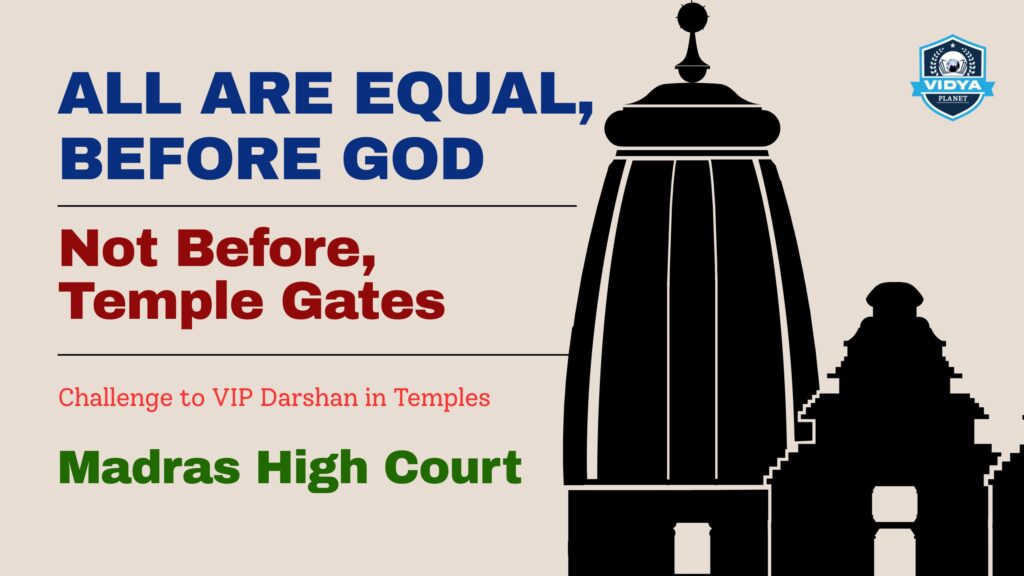
On May 29, 2026, in a surprising acknowledgment of constitutional egalitarianism, the Madras High Court issued scathing oral observations questioning the basic premise of VIP and paid darshan systems prevalent in temples across Tamil Nadu. The Division Bench of Justice G.R. Swaminathan and Justice V. Lakshminarayanan, while hearing a Public Interest Litigation (PIL) filed by P. Chockalingam, President of the Vishwa Hindu Parishad (VHP), stated that all devotees are equal before God, and that no temple should force ordinary devotees to wait in long lines while those with money or political influence have priority access. The Court also noted that no analogous system of preferential access exists in churches or mosques, making the Hindu temple practice stand out. These words, while not a binding order at this time, have reignited a critical constitutional and jurisprudential discussion at the nexus of religious practice, administrative law, and the right to equality.
Background
The appeal before the Court seeks the entire eradication of special, paid, and VIP darshan arrangements in the approximately 36,000 temples managed by Tamil Nadu’s Hindu Religious and Charitable Endowments (HR&CE) Department. The petition asserts that the current grouping of devotees into “VIP,” “Special,” and “General” categories is essentially discriminatory and has no basis in Hindu scriptures or established temple history. As the petitioner emphasized, “Money cannot be the barrier or tool to determine how to meet one’s maker.”
The petition attacked the practice of charging devotees between ₹300 and ₹500 for expedited access to the shrine, while those without financial means have to wait for hours. The petitioner claimed that this method commodifies an act of faith, diminishes commitment to a commercial transaction, and marginalizes economically disadvantaged members of society. However, the petition made a few exceptions, demanding that special darshan be kept for senior folks, the disabled, pregnant women, and artists who visit temples as part of their cultural practice. The greater demand, however, was for the elimination of paid and politicized VIP access.
The HR&CE Department’s Justification and Its Legal Challenge
The HR&CE Department’s purported justification has been a source of contention throughout these proceedings. The Department purportedly attempted to defend the paid darshan framework under the banner of “Dravida Dharma”.” Counsel for the petitioner strongly objected to this categorization, claiming that the idea, as utilized in this administrative context, had no grounding in Hindu scriptures or ancient temple tradition. This argument raises a deeper constitutional question: whether a State instrumentality in charge of regulating religious institutions can use a culturally or ideologically loaded phrase to legitimize a policy that essentially creates class-based tiers in spiritual access.
From a statutory basis, the petition presents a persuasive ultra vires case. The petitioner claims that neither the HR&CE Act nor the Temple Entry Authorization Act expressly authorize the State to adopt a system in which financial status impacts the speed or ease of access to the deity. If this argument is successful, the entire paid darshan framework will collapse, not just on constitutional grounds, but also on the technical premise that the administrative authority has simply surpassed its statutory mission.
Constitutional Dimensions: Article 14 and the Right to Equality
The constitutional challenge in this case is mainly based on Article 14 of India’s Constitution, which guarantees equality before the law and equal protection under the law to all citizens. When considered through the perspective of Article 14, the division of devotees into paying and non-paying categories must pass the twin tests of intelligible differentia and reasonable connection with the goal intended to be achieved. The petitioner contends that differentiating adherents based on their ability to pay violates both prongs of this test. A devotee’s spiritual sincerity, devotion, or constitutional right to exercise religion cannot be reasonably based on their economic status.
The Court’s oral observation that “ministers and MLAs should not think that they can walk into a temple any time and that God would be waiting for them” strongly resonates with the fundamental prohibition against arbitrary state action. When state resources, namely publicly managed temple infrastructure, are utilized to grant accelerated access to politically prominent individuals, it may be considered an unconstitutional conferral of privilege that lacks legal justification.
Article 25 also ensures the right of all people to freely profess, practise, and promote their faith. The privilege to darshan, or beholding the deity, is fundamental to Hindu religious practice. Any administrative procedure that requires the exercise of this right to be paid for or based on the individual’s political position may violate this fundamental promise.
Judicial Oversight: Scope and Limitations
Courts in India have traditionally exercised caution when it comes to intervening with the internal management of religious institutions, relying on the principle of separation of religious doctrine and secular administration. However, the Supreme Court has consistently concluded that when administrative actions made by state-managed religious groups violate basic rights, judicial review is not only permissible but required.
By sending a notice to the HR&CE Department and the Department of Tourism for comprehensive responses, the Madras High Court has signaled its intention to investigate whether the current temple access framework is constitutionally sound. The Court’s insistence that the state provide a reasoned answer shows that the judiciary views the arguments raised as justiciable and presenting significant problems.
Broader Implications: Temple Management, Revenue, and Equity
The practical implications of this litigation go well beyond queue management. Tamil Nadu’s 36,000 state-managed temples attract millions of devotees each year. The paid darshan system has become a substantial source of cash for temple administrations, which is used to pay maintenance, priest employment, and other religious activities. A broad judicial judgment prohibiting paid darshan may force a thorough reassessment of how temples generate revenue, possibly necessitating legislative intervention or alternative administrative methods.
At the same time, the case poses an essential matter about social equality that must be addressed. The average devotee — a daily-wage worker, a farmer, a student — who travels hundreds of kilometres to attend a revered shrine only to spend hours standing in a general queue while others pass through via paid passages feels a profound feeling of institutional prejudice. This lived reality provides the petition with moral and legal urgency.
Conclusion
The Madras High Court’s oral remarks on VIP and paid darshan systems are both topical and constitutionally significant. By asking the fundamental question, “Why do we need VIP darshan at all?” the Court has highlighted the discrepancy between India’s constitutional promise of equality and the administrative reality that exists in state-managed religious institutions. The Court’s decision to issue a binding order will be based on the State’s response and the strength of both sides’ arguments. However, the procedures have already accomplished something significant: they have documented the judiciary’s dissatisfaction with a system that, in the words of the petitioner, places money between a devotee and their creator. As the case develops, it will serve as a vital benchmark for how constitutional democracy balances administrative expediency with every citizen’s intrinsic right to stand equal before God, regardless of wealth or political status.