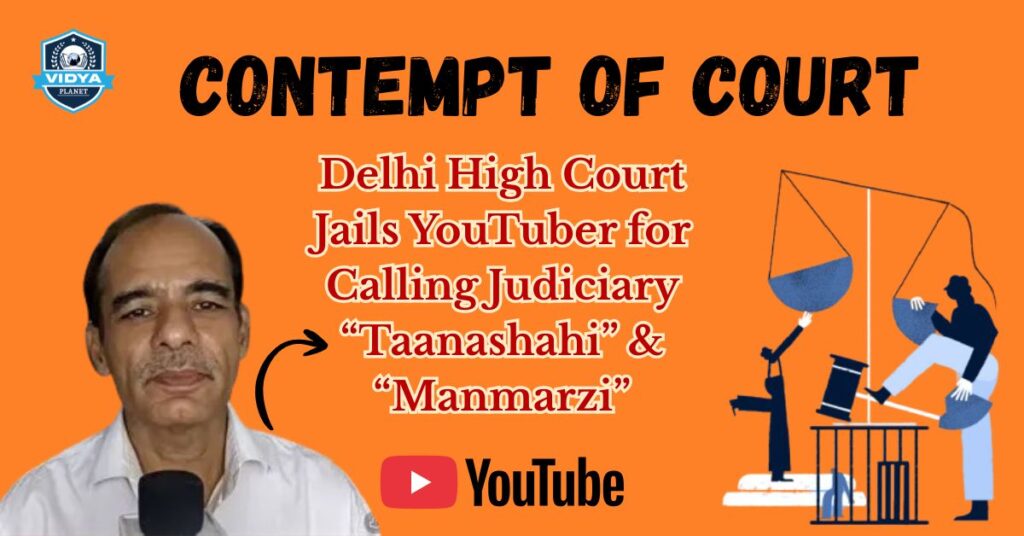
Gulshan Pahuja, a YouTuber and advocate, was recently sentenced to six months in prison for criminal contempt. This verdict has revived the fundamental debate between the dignity of the judiciary and freedom of speech. The decision has attracted national interest because it involves criticism of the judicial system conveyed via internet platforms such as YouTube and social media.
The Court ruled that the YouTuber’s comments describing the judiciary as “taanashahi” (dictatorship) and “manmarzi” (arbitrary functioning) went beyond the permissible limits of fair criticism and constituted criminal contempt by scandalizing the judiciary and undermining public trust in the administration of justice.
This case poses serious constitutional and legal issues. What are the limitations on free expression under Article 19(1)(a)? Can criticizing judges amount to contempt of court? Does social media influence the scope and impact of such criticism? Most significantly, where should the line be drawn between judicial responsibility and the protection of judicial authority?
Background of the Case
The contempt proceedings arose from videos posted on a YouTube channel called “Fight 4 Judicial Reforms,” which was reportedly run by Gulshan Pahuja. The videos included comments, interviews, banners, and commentary aimed at specific judicial authorities and the judiciary as a whole. According to the Court, the text contained broad charges against judges that lacked factual verification or legal support.
A Division Bench, consisting of Justice Navin Chawla and Justice Ravinder Dudeja, heard the petition. The Bench noted that the respondent not only attacked judicial functioning, but also attempted to instill distrust and sensationalism in the system. The Court stated that viewers were allegedly led to believe that justice could not be expected from certain judges, directly damaging judicial legitimacy.
The High Court distinguished between constructive criticism and intentional attempts to scandalize courts. It underlined that pushing for reforms such as audio-video recording of court hearings is legal and protected in a democracy. However, baseless attacks on judges cannot be justified as free speech.
The Court convicted Pahuja of criminal contempt under Section 2(c) of the Contempt of Courts Act, 1971, and sentenced him to six months’ simple jail and a ₹2,000 fine in each case. The sentences were ordered to run consecutively.
Understanding Criminal Contempt in India.
The Contempt of Courts Act of 1971 governs contempt of court in India. Section 2(c) defines criminal contempt as the publication or act that:
- Contend to undermine a court’s authority,
- Disrupt judicial proceedings, or
- Obstruct justice administration.
The phrase “scandalising the court” has long been controversial since it may limit criticism of judges and judicial institutions. Nonetheless, Indian courts have consistently held that contempt jurisdiction is required to maintain public trust in the administration of justice.
The judiciary obtains its authority not from military or governmental power, but from popular trust and constitutional legitimacy. As a result, courts have regularly ruled that reckless charges against judges can undermine institutional trust and impede justice delivery.
At the same time, courts have acknowledged that legitimate criticism of decisions and judicial behavior is permissible in a democratic society. The balance between criticism and contempt has been a major difficulty in contempt law.
Constitutional Perspective: Article 19 and Reasonable Restrictions
Article 19(1)(a) of the Constitution ensures free speech and expression. However, Article 19(2) allows for reasonable restrictions in the purpose of avoiding contempt of court, among other reasons.
The Supreme Court has often stated that criticism of the court is not banned just because it is harsh or disagreeable. Contempt jurisdiction may be brought when criticism develops into malicious attacks aimed at undermining judicial authority.
In this case, the Delhi High Court determined that the remarks were not genuine criticism aimed at improvement but rather intended to mock and scandalize the institution. The Court further noted that the contemnor exhibited no contrition and continued to make scandalous arguments throughout the proceedings.
Therefore, the ruling represents the judiciary’s view that free speech cannot be used as a tool to weaken constitutional institutions by making false accusations.
Landmark Decisions on Contempt and Free Speech
The current dispute is better understood in light of earlier major cases.
E.M.S. Namboodiripad v. T. Nambiar (1970)
In this case, the Supreme Court ruled that charges that judges are class-biased can amount to contempt if they hinder public trust in the courts. The Court emphasized that criticism must be rational and responsible.
Re: Arundhati Roy (2002)
A writer and activist was convicted of criminal contempt after expressing statements about the judiciary. The Supreme Court ruled that freedom of expression does not include the right to scandalize courts or lower judicial authorities.
Prashant Bhushan Contempt Case (2020)
The Supreme Court instituted contempt proceedings against an advocate for tweets insulting the court and the Chief Justice of India. The Court found him guilty but imposed a ₹1 fine. The case triggered heated debates about judicial accountability and free expression in constitutional democracies.
The Pahuja case looks tighter since the Court discovered a consistent practice of targeted attacks via films and banners, as opposed to single criticism or opinion.
Social Media and the Expanding Reach of Contempt
One of the most significant aspects of this case is the influence of digital media. Previously, disrespectful statements were typically limited to newspapers, speeches, or media with limited circulation. Today, platforms like YouTube, Instagram, X, and Facebook provide quick distribution to millions of viewers.
The Court was especially concerned about the potential impact of such movies on public trust in judicial systems. Viral content, provocative thumbnails, and sensational commentary can quickly change public perception.
This trend poses a larger legal question: Should courts adopt stronger criteria for online contempt due to its increased reach, or should they be more tolerant in the age of digital democracy?
Critics believe that India’s contempt legislation is still overly broad, which may hinder reasonable investigation of judicial functioning. Supporters of strong contempt action argue that unrestrained attacks on judges might erode constitutional institutions and spread falsehoods.
Judicial Accountability Vs Judicial Dignity
The debate also highlights a greater issue in constitutional governance: combining judicial responsibility with judicial independence.
Judges have vast constitutional powers, including the authority to overturn laws, review executive actions, and penalize for contempt. As a result, public scrutiny of judicial operations is critical in a democracy.
Judges, unlike politicians or celebrities, are typically unable to defend themselves publicly against claims because judicial ethics require restraint and impartiality. As a result, contempt jurisdiction is considered as a protective device for institutional dignity.
The Delhi High Court underlined that criticism must be substantiated by credible evidence rather than sensational charges. The Bench emphasized that unsubstantiated attacks undermine judges’ ability to work “without fear or favour.”
Thus, the decision tries to strengthen the concept that judicial accountability must adhere to constitutional and legal bounds.
Was six months of imprisonment justified?
The Contempt of judges Act allows judges to impose imprisonment for up to six months, a fine, or both. In this case, the High Court imposed the maximum sentence allowable by the statute.
The Court supported the sentencing on the grounds that the defendant showed neither remorse nor corrective behavior. It also found that tolerance may encourage the repetition of similar conduct in the future.
Supporters of the ruling claim that purposeful attempts to undermine trust in the judiciary require robust action, especially when carried out repeatedly via mass media channels.
Critics may see the punishment as excessive, arguing that democratic institutions should permit even harsh criticism unless there is a demonstrable obstruction to justice.
Conclusion
The Gulshan Pahuja contempt case is a watershed point in India’s changing interplay between constitutional free expression and judicial power in the internet age. The Delhi High Court’s decision sends a clear message that, while judicial reforms and criticism are valid, irresponsible attacks on courts will not be allowed under Article 19(1)(a).
At the same time, the case reignites a critical constitutional debate over the reach of contempt law in a modern democracy. As social media increasingly influences public discourse, courts, citizens, journalists, lawyers, and digital innovators must all strike a delicate balance between criticism and institutional respect.
Finally, democracy survives not only via free expression, but also through responsible expression based on facts, constitutional ideals, and respect for institutions.
READ THE ORDER HERE: