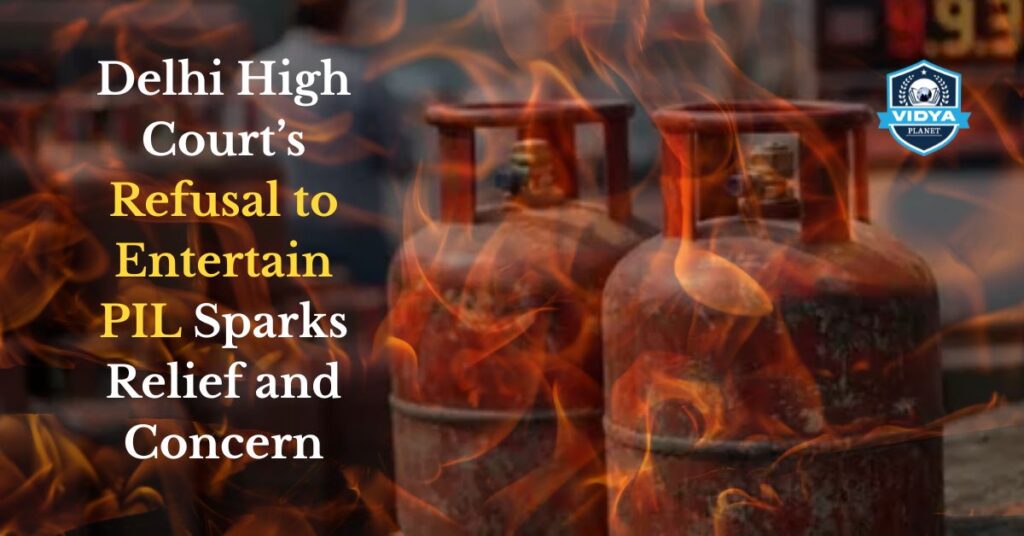
The recent decision of the Delhi High Court to decline to hear a Public Interest Litigation (PIL) regarding the purported shortage of Liquefied Petroleum Gas (LPG) is a significant reaffirmation of the constitutional doctrine of separation of powers. The Court’s decision emphasizes the importance of judicial restraint in economic policy and resource allocation matters, highlighting that these matters are entirely within the executive’s jurisdiction. The case not only underscores the judiciary’s limitations under writ jurisdiction but also poses critical questions about the scope of PILs in India, governance, and accountability.
Background of the case
The PIL was submitted in response to an alleged “acute shortage” of domestic LPG cylinders in various regions of the country, including Delhi. The petitioner argued that the scarcity had led to widespread hardship, with reports of black marketing in which cylinders were purportedly sold at exorbitant prices, reaching up to ₹5,000.
In an effort to secure judicial intervention, the petitioner pursued numerous avenues, including:
- The regulation of the supply of LPG;
- Export restrictions for LPG;
- Establishment of a judicial committee to supervise distribution;
- Prompt measures to prevent the proliferation of illicit marketing.
The plea essentially characterized the issue as a failure of the State to ensure equitable distribution of an essential commodity, thereby invoking the Court’s jurisdiction under Article 226 of the Constitution.
Observations of the Court
The petition was declined by a Division Bench consisting of Chief Justice D.K. Upadhyaya and Justice Tushar Rao Gedela. The bench made several critical observations that are the fundamental basis of this judgment.
Economic Policy and Executive Domain
The Court unequivocally declared that the executive exclusively controls matters concerning the supply, distribution, and pricing of LPG. It was noted that economic policy decisions, including the decision to export or import LPG, the management of supply chains, and the response to shortages, are beyond the reach of courts to resolve.
The Court made a noteworthy statement as it questioned:
“Are we running a government?” We do not intervene in such matters.
This statement is indicative of an unambiguous judicial posture against the encroachment on the policy-making functions that are constitutionally the responsibility of the executive.
The Influence of Global Factors
The Court recognized that the LPG shortage was not a solitary domestic issue, but rather a result of broader geopolitical developments, particularly the ongoing conflict in West Asia. The availability of LPG has been considerably affected by the disruption of global energy supply chains, particularly through critical routes such as the Strait of Hormuz.
Consequently, the Court acknowledged the intricacy of the matter, which encompasses economic considerations, logistics, and international commerce that are beyond the scope of judicial review.
Absence of Mandamus in Policy Matters
In cases where the State’s obligations are contingent upon available resources and policy considerations, the Court declined to issue a writ of mandamus, highlighting that such directives are not permissible. It compared the petitioner’s request to requesting that the Court issue directives that are comparable to “eradicating poverty,” a task that is beyond the scope of judicial authority.
This is consistent with the established jurisprudence that states are unable to be compelled by the courts to perform functions that are inherently policy-driven and resource-dependent.
Absence of Concrete Evidence
The petitioner’s claims were also dismissed due to the absence of concrete data. The Court observed that the petition did not contain credible evidence regarding LPG exports or systemic failures in distribution.
The Court’s emphasis on empirical substantiation serves as a reminder that PILs must be founded on verifiable data rather than speculative assertions.
Alternative Treatments
Instead of judicial intervention, the Court recommended that the petitioner submit representations to the appropriate governmental authorities. It also stipulated that the relevant authorities should appropriately evaluate any such representations that are submitted.
This is indicative of the principle that administrative remedies should be pursued before constitutional courts’ extraordinary jurisdiction is invoked.
Legal Framework
The case indirectly implicates numerous constitutional and statutory provisions:
Article 226 of the Indian Constitution
Article 226 authorizes High Courts to issue writs to enforce fundamental rights and other legal rights. Nevertheless, this authority is discretionary and is subject to self-imposed restrictions, particularly in the context of policy decisions.
The Essential Commodities Act of 1955
The Central Government is authorized to regulate the production, supply, and distribution of essential commodities, such as LPG, under the Essential Commodities Act, 1955. The Court observed that the government had already issued orders under this Act to address the situation.
The Doctrine of Separation of Powers
The doctrine is a fundamental component of the Constitution, as acknowledged in Kesavananda Bharati v. State of Kerala, 1973 despite not being explicitly codified. The current case serves as an illustration of the judicial commitment to this doctrine by refraining from interfering with executive functions.
Judicial Precedents Used:
The Court’s reasoning is in accordance with the established jurisprudence:
The Supreme Court of India ruled in BALCO Employees’ Union v. Union of India 2001, that economic policy decisions should not be interfered with unless they are arbitrary or unconstitutional.
The Court underscored the importance of judicial restraint in policy matters that involve technical and economic considerations in Narmada Bachao Andolan v. Union of India, 2000.
In the same vein, courts have consistently maintained that PIL jurisdiction should not be abused to contest policy decisions unless there is a clear violation of fundamental rights or statutory provisions.
Governance and Judicial Restraint Analysis
The judgment serves to underscore the principle that courts should not assume the role of super-administrators. Although PILs have historically been instrumental in enhancing access to justice and resolving systemic issues in India, their misuse in policy domains poses a threat to institutional equilibrium.
The Boundaries of PIL Jurisdiction
Judicial overreach has occasionally resulted from the expansion of PIL jurisdiction. This case functions as a corrective, underscoring that not all public grievances necessitate judicial intervention, particularly when they require intricate policy decisions.
Separation of Powers vs. Accountability
The executive apparatus is the appropriate forum for addressing the petitioner’s legitimate concerns regarding black marketing and shortage. Administrative decision-making cannot be replaced by courts; however, they can guarantee accountability.
Practical Restrictions
The Court correctly observed that the government’s obligations are contingent upon the availability of resources. A logistical challenge that necessitates administrative expertise, rather than judicial directives, is the assuring of uniform LPG supply in a country as vast and diverse as India.
Social and Economic Setting
The LPG shortage has resulted in adverse consequences, such as disruptions to daily life and institutional operations. For instance, the Delhi High Court’s lawyers’ canteen was reportedly operationally challenged as a result of a paucity of LPG supply.
Furthermore, the interconnectedness of energy markets has been underscored by global factors, including geopolitical conflicts, which have exacerbated supply constraints.
Judgment Critique
Although the judgment is doctrinally sound, it poses certain concerns.
- Access to Justice: The rejection of public interest litigation (PILs) at the threshold may serve as an incentive for public-spirited litigation in legitimate cases.
- Administrative Inaction: The assumption of efficient governance is predicated on the use of executive remedies, which may not always be the case.
- Monitoring: In instances where essential commodities are involved, it may be necessary to exercise limited judicial oversight in order to prevent exploitation.
Nevertheless, these apprehensions must be reconciled with the potential for judicial overreach.
Conclusion
The Delhi High Court’s refusal to consider the PIL regarding the LPG deficit is a confirmation of judicial discipline and constitutional boundaries. The Court has reaffirmed the doctrine of separation of powers and the limitations of judicial review under Article 226 by emphasizing that economic policy and resource allocation are within the executive’s domain.
The judgment serves as a reminder that, despite the critical role that courts play in protecting rights, they must also adhere to institutional competencies. When it comes to matters that involve intricate economic and geopolitical factors, the judiciary’s responsibility is not to govern, but rather to guarantee that governance is conducted within the realm of the law.
In conclusion, the case emphasizes a fundamental principle of constitutional law: judicial intervention must be informed not only by the existence of a grievance but also by the appropriateness of the forum.