Introduction
In a landmark move that reinforces judicial discipline in Public Interest Litigation (PIL) jurisprudence, the Supreme Court of India recently refused to hear 25 PILs filed by a single counsel, sending a clear message: “Concentrate on your profession.”
The Court’s concerns extend beyond every aspect of the case to address a rising concern: the exploitation of PIL jurisdiction for publicity, experimentation, or indiscriminate litigation, undermining the fundamental purpose.
Factual Background and Proceedings
The case came before a Bench chaired by Justice Surya Kant, where a counsel filed 25 distinct PILs on various and frequently unrelated public issues.
During the hearing, the Court expressed serious dissatisfaction with the sheer volume and lack of concentrated legal basis in these petitions. The Bench subsequently declined to hear the PILs, allowing the petitioner to withdraw while cautioning him against similar actions.
The court emphasized:
- Public Interest Litigation jurisdiction is not intended for casual invocation.
- Courts should not be considered as the first-instance forum for every complaint.
- Petitioners must first contact the proper administrative authorities.
Key remarks by the Supreme Court.
The hearing was full of sharp and honest remarks that showed how frustrated the judges were with the growing number of unnecessary PILs:
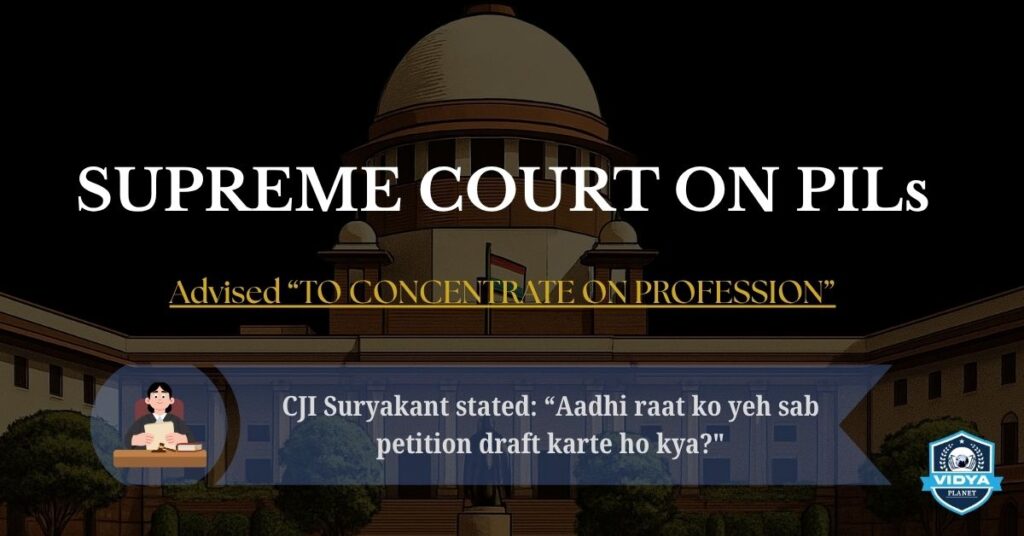
During the March 26 hearing, CJI Kant stated:
“Aadhi raat ko yeh sab petition draft karte ho kya?”
(Do you draft these petitions at midnight?)
The Bench condemned the growing practice of “PIL shops,” which refers to those who routinely file PILs without conducting appropriate research or a real public cause.
The Court directed the attorney to:
- “Concentrate on the profession”
- Approach authorities to “make them wiser” before seeking writ jurisdiction.
These comments highlight the Court’s concern that PIL practice is being devalued, transforming a constitutional remedy into a standard litigation technique.
Constitutional and Legal Framework of the Public Interest Litigation.
Public Interest Litigation gain validity from:
- Article 32: Right to constitutional remedies before the Supreme Court.
- Article 226: Writ jurisdiction of High Courts
The Court relaxed locus standi through judicial innovation, permitting public-spirited individuals to represent underprivileged groups in court. However, this liberalization comes with rigorous anti-abuse precautions.
Judicial Principles Regarding Misuse of PIL
In key decisions, the Supreme Court has frequently warned against frivolous Public Interest Litigation.
- Hussainara Khatoon vs State of Bihar AIR 1979
- This case established and expanded PIL, providing access to justice for undertrial convicts and setting the groundwork for liberal locus standi.
- State of Uttaranchal vs Balwant Singh Chaufal AIR 2010 SC 2550
The Court issued detailed guidelines to control Public Interest Litigation, including:
- Verification of the petitioner’s credentials.
- Ensure genuine public interest.
- The imposition of costs for frivolous litigation
- Ashok Kumar Pandey vs. State of West Bengal (2004) 3 SCC 349
- The Court ruled that Public Interest Litigation is a “weapon that must be used with great care and circumspection,” not for public or private purposes.
- Dattaraj Nathuji Thaware vs. State of Maharashtra (2005) 1 SCC 590
- The Court ordered exemplary costs for the misuse of PIL and warned against abusing the court process.
The doctrine of exhaustion of alternative remedies
A key issue emphasized in this decision is that petitioners must seek other remedies before approaching constitutional courts.
The Court’s directive to contact authorities reflects:
- Respect for the institutional hierarchy.
- Avoiding premature judicial intervention.
- Ensuring the courts serve as the last resort
Professional Responsibility and Ethical Concerns
The Court’s remark, “concentrate on the profession”, also emphasizes ethical responsibility of advocates under
- Advocates Act of 1961 (Section 35) – Professional misconduct
- Bar Council of India Rules: Duty to uphold dignity and integrity.
Filing several unresearched PILs may:
- Undermines the credibility of the legal profession.
- Waste judicial time.
- Seek disciplinary action.
The Court tacitly warned against the emergence of “PIL tourism,” which involves litigation pursued without depth, effort, or meaningful public cause.
Judicial Concern: The Rise of “PIL Shops”
One of the most noteworthy observations in this case is the Court’s usage of the phrase “PIL shops” to designate frequent plaintiffs who file several PILs.
- This phenomenon causes considerable worries.
- Judicial backlog is increased.
- Genuine litigants are sidelined.
- PIL loses its transformational nature.
The Court’s harsh phrasing suggests a trend toward more stringent scrutiny and potential deterrent actions in future cases.
Critical Analysis
The Court’s approach strikes a balance between two competing values.
- Access to justice.
Public Interest Litigation remains an effective tool for:
- Social justice
- Environmental protection.
- Protection of fundamental rights.
- Judicial Discipline
However, unchecked PIL filing results in:
- Frivolous litigation
- Institutional inefficiency
- Erosion of judicial credibility
By refusing to hear the petitions while permitting withdrawal, the Court used a corrective, not punitive, approach, providing the advocate a chance to change.
Conclusion
The Supreme Court’s ruling serves as a timely reminder that Public Interest Litigation is a fundamental right rather than a conventional remedy. The forceful remarks, questioning midnight drafting, denouncing “PIL shops,” and emphasizing professional responsibility, demonstrate a clear judicial attitude against abuse.
The verdict reinforces that.
- Sincerity, rather than frequency, defines a legitimate PIL.
- Courts should be approached with preparedness and purpose.
- The legal profession requires discipline, diligence, and integrity.
Finally, the message is unequivocal:
“Public Interest Litigation must remain an instrument for justice, not a shortcut to visibility.”