Introduction
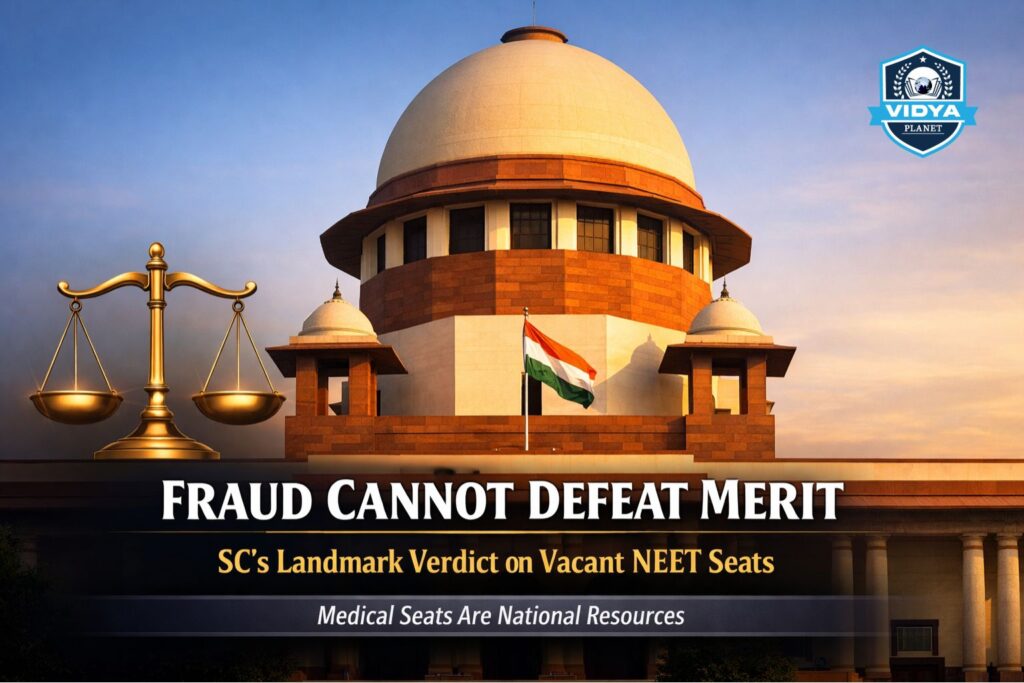
The National Eligibility and Entrance Test (NEET) has been the foundation of medical admissions in India, assuring a consistent, merit-based selection procedure. In a landmark decision, the Supreme Court of India maintained that medical seats are “national resources” that cannot be wasted due to fraud or administrative delays. It ruled that a seat left vacant owing to fraud must be given to the next eligible applicant on the merit list, even if it means extending procedural timelines.
This decision is based on constitutional values of equality, fairness, and educational opportunity, rather than just admission.
Facts of the Case:
The disagreement began during the NEET-UG 2022 admission cycle, when a candidate obtained admission with a fraudulent marksheet. Admission was terminated upon its discovery, resulting in the seat remaining vacant.
A deserving candidate, next in line, approached the authorities to request allotment. However, the request was declined because the deadline for admission had gone. Despite prompt contact by relevant authorities, regulatory inaction resulted in admission denials.
The case eventually reached the Supreme Court, stressing fundamental issues of merit against procedural strictness.
Legal Issue
“Whether a medical seat vacated by fraud can be allowed to lapse due to strict deadline adherence, or if it must be transferred to the next deserving candidate on the merit list?”
Constitutional Dimensions
The Court’s reasoning was deeply rooted in constitutional guarantees:
- Article 14: Right to Equality.
Denial of admission to a meritorious candidate while a fraudulent candidate initially got the seat constitutes arbitrariness and unequal treatment. The Court underlined that:
- State action must be fair, unbiased, and merit-based.
- Denying the rightful candidate violates equal protection of the law.
- Article 21: Right to Life and Dignity.
The right to seek professional education, particularly in professions such as medicine, has been included in Article 21 as part of the right to live with dignity. The Court acknowledged that:
- Arbitrary refusal of admission has an influence on a student’s career, dignity, and future chances.
- Procedural formalities cannot trump genuine justice.
Key Supreme Court Observations:
- Medical Seats as National Resources.
The Court found that:
- Medical seats are limited public assets.
- They must be used in the greater public interest, not wasted due to fraud or delay.
This is consistent with the theory of public trust, in which the state keeps resources for the benefit of society.
- Merit must prevail.
The Court clearly ruled:
- When a seat becomes vacant due to fraud, it must be offered to the next eligible contender.
- Any other strategy will jeopardize the credibility of NEET.
- Admission deadlines are not absolute.
While recognizing the significance of promptness, the Court clarified:
- In rare circumstances, admission schedules are not mandatory; they are only directories.
- Courts may relax deadlines in cases involving fraud or injustice in order to maintain fairness.
- Administrative Delays Cannot Defeat Rights.
The Court condemned the inaction of authorities.
- Bureaucratic delay cannot be used to deny a valid claim.
- The State and its agencies have a positive obligation to be efficient.
Key precedents:
- Asha v. Pt. B.D. Sharma, University of Health Sciences AIR 2012 (7) SCC 389
In this case, a deserving candidate was denied admission due to administrative oversights. The Supreme Court ruled:
- In extraordinary instances, courts may order admissions even after the cut-off date.
- Merit cannot be surrendered for technological or procedural faults.
- The Court stated that tight timeframes must not destroy justice, especially where the candidate is not at fault.
- Krishna Sradha vs. State of Andhra Pradesh AIR 2020 SC 47
This landmark judgment broadened the scope of remedy.
- The Court held that if admission cannot be granted in the same academic year, courts may order creation of a supernumerary seat in the next year.
- It acknowledged that denial of admission for no fault of the candidate creates irreparable harm.
This notion was critical in the NEET case, in which the Court ensured that the candidate did not suffer as a result of institutional failure.
3. Chandigarh Administration vs. Jasmine Kaur AIR 2015 SC 34
Here, the Court chose a harsher approach.
- It stressed sticking to admission schedules to ensure certainty.
- However, it accepted that exceptions may occur in rare and unusual circumstances.
- The current decision harmonizes this approach by treating fraud as an extraordinary occurrence that requires judicial action.
Relief granted by the Supreme Court
- Upheld the High Court’s decision to admit the candidate.
- It was directed that, if necessary, an additional seat be created to accommodate the contender.
This assured that:
- The candidate’s rights were preserved.
- The admissions process’s integrity was maintained.
Broader implications
- Reinforcement of fairness
The decision improves the foundation of NEET by guaranteeing that eligible candidates are not disqualified owing to fraud or delay.
- A strong deterrent to fraud
By mandating prompt seat reallocation, the verdict discourages:
- Use of fake documents
- Manipulation of admission procedures
- Increased accountability for authorities
Regulatory authorities, such as the National Medical Commission, are now under additional obligation to:
- Act swiftly.
- Ensure the verification mechanisms.
- Avoid unnecessary delays.
- Optimal use of national resources.
In a country where medical professionals are in short supply, leaving seats unfilled is detrimental to the public interest. The decision ensures that existing educational infrastructure is used to its full potential.
Critical Evaluation
The decision represents a step forward toward substantive justice rather than procedural rigidity. It finds a careful balance.
- It does not diminish the significance of timelines.
- However, it keeps those timelines from becoming tools of injustice.
However, the example highlights systemic issues:
- Weak verification procedures during counselling.
- Lack of real-time fraud detection.
- Delayed administrative responses.
Addressing these problems through regulatory changes and digital verification mechanisms is critical to preventing recurrence.
Conclusion
The Supreme Court’s verdict represents a fundamental shift in NEET jurisprudence. By recognizing medical seats as national resources and emphasizing the constitutional ideals of equality and justice, the Court has underlined that merit must remain the foundation of medical admissions.
It conveys a clear and forceful message that;
“Fraud will not be rewarded, administrative delays will not be accepted, and qualified candidates will not be denied their fair opportunity.”