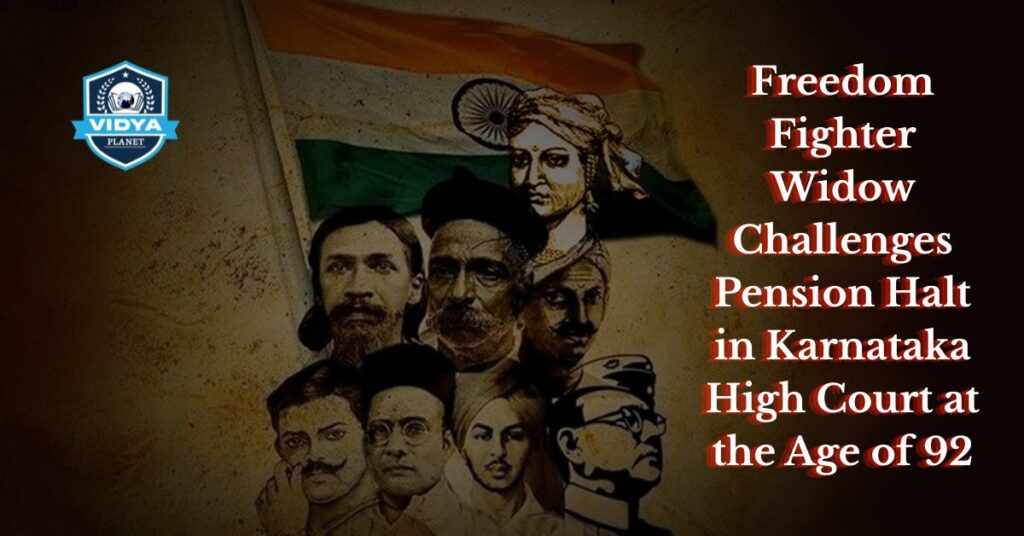
In the constitutional and moral imagination of the nation, the freedom fighters of India hold an unparalleled position of honor. To honor their sacrifices, the Union and State governments established pension programs for freedom fighters and, in many cases, their surviving wives. However, in a worrying instance exposing bureaucratic delay and administrative insensitivity, a 92-year-old widow has sued the Karnataka High Court following the cessation of the Central freedom fighter family pension that had been provided in memory of her late husband. The Court has requested comments from the Central Government, State Governments, and the Union Bank of India.
The case is not just about pension arrears. It addresses bigger constitutional problems such as the dignity of senior individuals, the state’s welfare obligations, administrative justice, and the treatment of those associated with India’s independence movement.
Background to the Case
The petitioner, Sonnamma, is the widow of the late G. Ramaiah, a well-known freedom warrior. Ramaiah supposedly received the Tamra Patra in 1972 in appreciation of his contributions to India’s liberation movement. In 1973, the Government of India granted him a freedom fighter pension. Following his death in 2000, his wife continued to receive the pension as a family pension.
According to the petition, Sonnamma received both Central and State pension components till February 2019. However, beginning in March 2019, the Central pension was unexpectedly terminated without any legal order, explanation, or prior notice. The state government allegedly continued to release its share.
The petition further argues that repeated representations had no effective results. In July 2019, the District Treasury Officer allegedly notified authorities that the pension book had been missing and demanded a copy. Between 2019 and 2022, discussions apparently persisted between government ministries and the Union Bank of India, but the pension remained unfunded.
After receiving a legal notice in September 2025, the Central Government reportedly directed the bank to release the pension funds. However, arrears were not credited, prompting the widow to approach the Karnataka High Court.
Proceedings before the Karnataka High Court.
The Karnataka High Court’s Justice Sachin Shankar Magadum heard the case. The Court provided notice to:
- Union of India,
- Karnataka State Government,
- Union Bank of India.
and requested their responses.
During the court, counsel for the State apparently explained that the State had continued to pay its half of the pension, and that the stoppage only affected the Central component.
Relevant Pension Scheme Framework
1. Swatantrata Sainik Samman Pension Scheme.
The Central Government runs programs to honor independence warriors and qualifying dependents, including widows. Such schemes, first launched in 1972 and then expanded, seek to acknowledge the sacrifices made during the independence movement.
These pensions are not charity; they are expressions of national gratitude.
2. Family Pension Rights.
Following the death of a qualifying freedom warrior, the spouse may continue to receive pension payments, subject to eligibility and paperwork requirements. Once granted and routinely dispensed, abrupt termination without notice creates major legal difficulties.
Constitutional Dimensions
Article 14: Equality Before Law
Administrative arbitrariness contradicts Article 14. If a pension is terminated without cause, notification, or hearing, it may be considered arbitrary state action.
Article 21: Right to Life and Dignity.
The Supreme Court has consistently construed Article 21 liberally, including dignity, livelihood, and humane treatment. Stopping payments has a direct impact on the dignity of life of a bedridden 92-year-old widow who relies on her pension.
Article 41: Directive Principle
Within its capability, the state must provide efficient public assistance in the areas of old age, sickness, and disability. Though non-justiciable, Article 41 substantially influences welfare interpretation.
Article 300A: Right to Property
Pensions, once legally vested, are frequently viewed as precious rights that cannot be taken away unless by legal authority.
Landmark Case Law on Pension Rights
1. D.S. Nakara v. Union of India (1983), 1 SCC 305.
In a major decision, the Supreme Court ruled that a pension is a valuable entitlement rather than a bonus provided at the government’s discretion. This case had a significant impact on Indian pension law.
Its principle strongly defends retirees who face arbitrary deprivation.
2. State of Jharkhand vs. Jitendra Kumar Srivastava (2013) 12 SCC 210.
The Supreme Court ruled that pensions and gratuities cannot be withheld without statutory permission. Executive orders alone cannot strip a person of pension benefits.
3. Deokinandan Prasad v. State of Bihar (1971), 2 SCC 330.
The Court recognized pension as a legally enforceable right, rather than a matter of grace.
4. Olga Tellis v. Bombay Municipal Corporation (1985), 3 SCC 545.
Regarding livelihood, the decision enlarged Article 21 and confirmed that deprivation impacting survival must meet constitutional fairness standards.
Administrative Law Issues in this Case:
1. No Prior Notice
Natural justice principles would be violated if a pension was terminated without notice.
2. Delays and Red Tape
Even after years of interdepartmental correspondence, no relief was offered. Courts frequently take delays in welfare proceedings involving senior individuals very seriously.
3. Missing Pension Book
Loss of records by authorities cannot be used to punish beneficiaries.
4. Failure to Implement Directions
If the Centre instructed release in 2025 but arrears were not credited, it raises doubts about implementing agencies’ accountability.
Human Rights Perspective
This is not a simple procedural issue. It involves a 92-year-old bedridden widow who apparently has no dependents. Courts are increasingly acknowledging that welfare management must be humanitarian, particularly for:
- Senior citizens.
- Widows
- Disabled people
- Dependents of National Service Contributors
A nations thanks to freedom fighters must go beyond ceremonial speeches to include prompt assistance for surviving families.
Reliefs that the Court may consider
The High Court may consider issuing directions as follows:
- Immediate restoration of the Central Family Pension.
- Release of arrears beginning March 2019.
- Time-bound cooperation by authorities.
- Interest on delayed payments.
- Personal accountability for unexplained delays.
- Simplified documentation for senior recipients.
Why This Case Matters Nationally
Many seniors across India are experiencing stoppages due to:
- Aadhaar mismatch
- Bank KYC issues
- Lost service records.
- Treasury errors
- Lack of digital literacy.
- Death certificate or succession delays.
This case could reaffirm that pension management should prioritize beneficiaries over paperwork.
The Function of Courts in Welfare Governance
Indian constitutional courts frequently intervene when administrative procedures fail disadvantaged populations. Such intervention does not constitute judicial governance; rather, it ensures that lawful claims are not denied due to carelessness.
When a 92-year-old widow has petitioned the High Court for pension restoration, it highlights institutional flaws that must be addressed.
Broader policy reforms are needed.
- Automatic continuation of sanctioned family pensions
- Dedicated senior citizen grievance cells.
- Doorstep verification for bedridden pensioners.
- Digital and offline support systems
Accountability for unjust halt. - Monthly audits of dormant pension accounts.
- Special supervision of freedom fighter pension plans.
Moral and Historical Significance
India’s freedom was gained by the sacrifices of numerous renowned and nameless heroes. Where the State has publicly acknowledged such contributions through Tamra Patra and pension awards, the cessation of family pensions without explanation sends an unsettling message.
The widow of a freedom fighter should not have to spend her last years navigating bureaucracy.
Conclusion
The Karnataka High Court’s intervention in the petition brought by the 92-year-old widow of freedom fighter G. Ramaiah is a powerful reminder that constitutional governance must be compassionate. Pension is not handouts, favors, or administrative discretion; it is a legally and morally binding responsibility once established.
This case will most certainly put India’s treatment of individuals who once gave all for the country to the test, as well as those who survived them. Timely justice would not only pay off debts, but would also restore faith in the Republic’s promise of gratitude, dignity, and fairness.