
Introduction
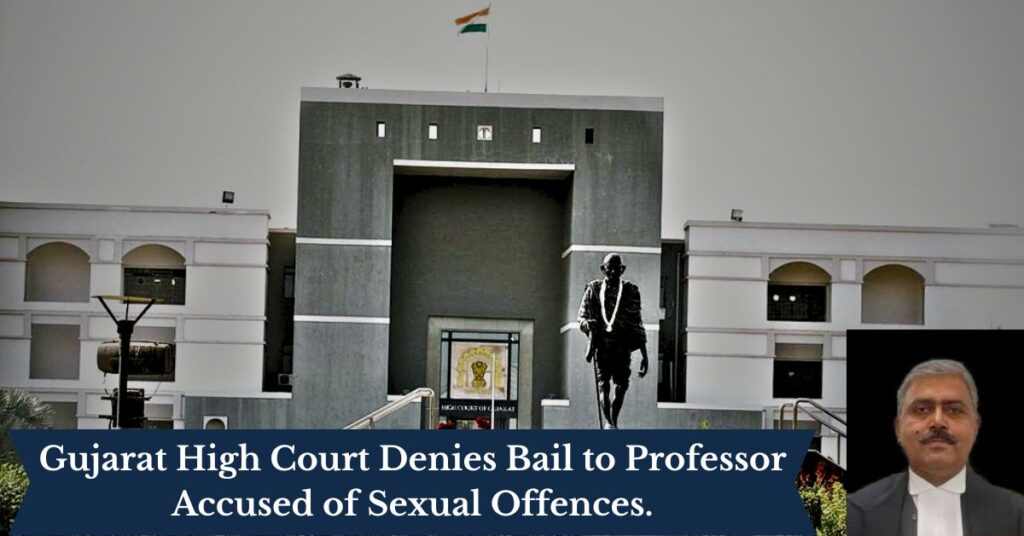
In a landmark and socially relevant decision, the Gujarat High Court denied bail to a college professor accused of sexually assaulting a student and seeking sexual favors. The decision demonstrates the judiciary’s firm stance against academic misconduct, particularly in situations when there is an obvious imbalance in power. It reaffirms the notion that positions of trust, particularly in educational institutions, involve increased obligations, and any abuse of such authority would be severely punished.
Factual Background
The lawsuit began from accusations made by a female student against her college professor. The prosecution claims that the accused acted in an inappropriate and coercive manner on a regular basis. Such as:
- Sending inappropriate and offensive WhatsApp messages.
- Repeatedly calling the student to his chamber under questionable pretexts.
- Pressuring her to start a personal relationship.
- Explicitly requesting sexual favours
The prosecution mostly relied on documentary and technological evidence. Notably, WhatsApp conversations between the accused and the victim were an important part of the case record. Furthermore, the professor’s apologetic letter to the college administration, in which he purportedly admitted to “inappropriate behaviour,” supported the charges.
Additionally, the investigation revealed that this was not an isolated incident. There were signs that the accused may have acted similarly with another student, implying a pattern of misbehavior rather than a single incidence.
Legal Framework
The accused was charged under applicable provisions of the Bharatiya Nyaya Sanhita (BNS), including:
- Section 75(2): Sexual Harassment.
- Section 78(1): Stalking
Furthermore, the victim’s statement was recorded under section 183 of the Bharatiya Nagarik Suraksha Sanhita (BNSS), which is important in criminal procedures because it preserves the victim’s evidence early on.
The case demonstrates the changing significance of digital evidence in criminal law, where electronic communications such as chats, emails, and messages are becoming increasingly important in determining intent and conduct.
Arguments of the Defence
The defence requested bail on numerous grounds:
- Hostile Witness Argument: It was argued that the complainant became hostile throughout the trial, hurting the prosecution’s case.
- Lack of Direct Academic Control: The defence claimed that the accused was not personally instructing the complainant, meaning that she was not subjected to academic pressure or coercive authority.
- General Plea for Bail: The defence, as is customary in bail applications, highlighted the idea of personal liberty and contended that prolonged imprisonment was unjust.
Observations of The Court Regarding Sexual Offences in Institutions.
The Court, however, wasn’t convinced by these comments and made many significant observations while denying the bail application:
- The presence of strong prima facie evidence: The Court remarked that there was substantial evidence on the record indicating inappropriate behavior. The WhatsApp conversations and apology letter were very important in building a prima facie case against the defendants. At the bail hearing, the Court is not obligated to conduct a detailed trial, but rather to determine if there is sufficient evidence to sustain continuing incarceration. In this scenario, the threshold was definitely exceeded.
- Abusing a Position of Trust: The Court’s reasoning included a recognition of the power dynamics inherent in a teacher-student relationship. Even if the accused did not directly educate the complainant, he maintained a position of responsibility inside the school. The Court highlighted that such authority should not be utilized for personal or sexual advantage. The decision represents a greater judicial awareness that pressure in such circumstances is frequently subtle and psychological, rather than blatantly aggressive.
- The victim’s testimony is substantially intact: While the defence contended that the complainant had become antagonistic, the Court found that her testimony, taken as a whole, corroborated the basic claims of harassment. Minor inconsistencies or partial deviations may not always undermine the prosecution’s case, especially if supported by documented proof.
- Pattern of Conduct: The Court took the accusation that the offender had behaved similarly with another student very seriously. This implied that the behavior was not random or isolated, but rather part of a larger pattern, which strengthened the case against providing bail.
- Progression of Trial: The Court further stated that the trial had already begun and was moving without excessive delay. In such cases, providing bail could interrupt the proceedings or influence witnesses. As a result, the argument for long-term detention failed.
Legal Principles Reinforced
This decision reaffirms numerous well-established concepts of criminal law:
Bail is not obligatory in major crimes, especially where there is substantial prima facie evidence and the allegations contain moral turpitude and abuse of authority.
Stricter ethical standards are demanded of those in positions of power, such as teachers and doctors.
Digital evidence is critical where courts are increasingly depending on electronic records to determine conduct and intent.
Hostile witnesses are not decisive, case does not fail just because a witness deviates from previous statements; courts consider the entire evidence value.
Broader social and institutional implications
- Safeguarding Educational Spaces: The verdict sends a clear message that educational institutions must continue to provide safe conditions for students. Any sort of exploitation, particularly by those in positions of authority, will be subject to intense judicial scrutiny.
- Recognizing Power Imbalance: The verdict acknowledges kids’ inherent vulnerability in hierarchical institutions. Consent in such circumstances is frequently muddled by fear, pressure, or reliance, and must thus be carefully scrutinized.
- Encouraging Reporting of Misconduct: By treating claims seriously and relying on digital evidence, the judiciary creates a more welcoming climate for victims to speak up. This is especially critical in cases of sexual harassment, which are frequently underreported due to shame and fear.
- Institutional Accountability: The case also emphasizes the importance of strong internal processes within schools and universities to address harassment accusations in a timely and effective manner, in accordance with legal obligations such as the POSH Framework.
Conclusion
The Gujarat High Court’s decision to deny bail in this instance is a clear endorsement of the idea that power cannot be abused for one’s own benefit. The decision shows a careful balance between individual liberty, community interest, and the necessity to protect vulnerable people from exploitation.
In an era where digital traces are progressively exposing malfeasance and societal awareness of harassment is rising, such court interventions are critical in strengthening accountability. The verdict ultimately emphasizes an important message:
Positions of power come with responsibilities, and any divergence from ethical behavior, particularly in settings intended for learning and growth, will result in severe legal penalties.
Read the full Judgement: