Table of Contents
ToggleIntroduction
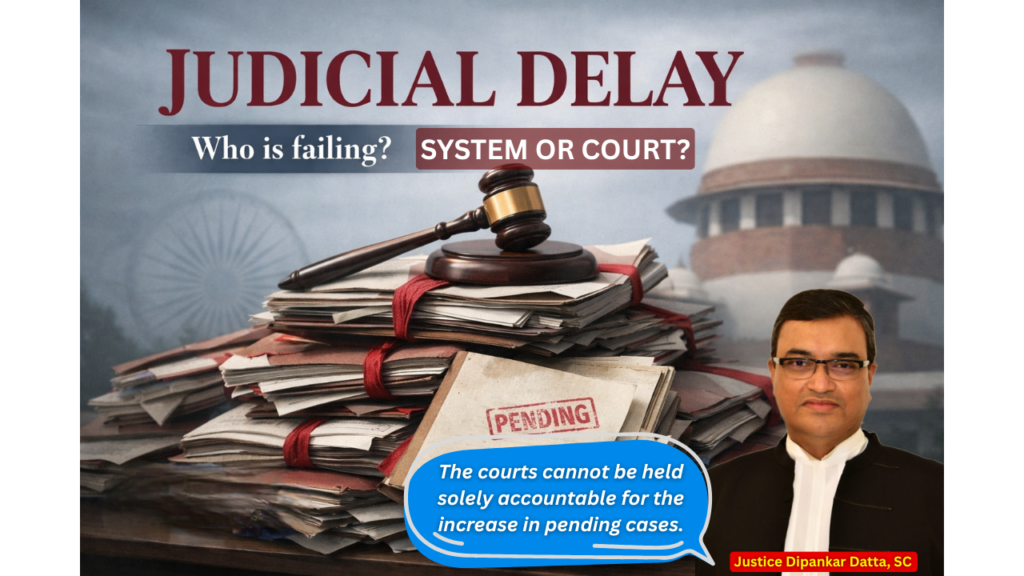
The dilemma of judicial delay in India has long been a source of public concern, frequently leading to criticism of the judiciary as ineffective or overworked. But as Justice Dipankar Datta pointed out, the courts cannot be held solely accountable for the increase in pending cases.
The administrative branch, the legislature, the legal profession, and even litigants are all involved in the systemic problem of judicial delay. The problem is largely structural, and any attempt to address it must go beyond simply blaming the courts.
The Scale of Judicial Pendency
India is now dealing with a massive backlog of cases. There are more than 5 crore cases pending in courts at different levels. Nearly 85% of these are concentrated in subordinate courts, with the Supreme Court and High Courts making up a smaller but significant portion.
with approximately 4.6–4.8 crore cases in subordinate courts, over 63 lakhs in High Courts, and more than 90,000 cases in the Supreme Court. This enormous backlog is the outcome of decades of systemic inefficiency rather than a sudden occurrence.
These figures make it very evident that the judiciary is under tremendous pressure. They do, however, also imply that factors other than courtroom operations contribute to delays. A system that consistently produces more cases than it can resolve points to deeper institutional failures.
Executive Responsibility: Vacancies and Infrastructure One of the biggest causes of court delays is a lack of judges and inadequate infrastructure, both of which fall under the purview of the administration. In comparison to other countries, India’s judge-to-population ratio is still very low, with approximately 21 judges per million people.
The judiciary’s ability to operate effectively is significantly hampered by protracted vacancies, delayed judicial nominations, and inadequate courtroom facilities. Without the requisite personnel and material resources, courts are unable to resolve issues in an efficient manner.
Justice Datta’s statement is especially pertinent in this case: the judiciary cannot be trusted to
clear the backlog on its own without prompt executive action.
Government as the Largest Litigant
The government itself is a significant factor in judicial delays. It is frequently referred to as India’s greatest litigant, responsible for roughly half of all pending cases. Government departments frequently engage in unneeded litigation as a result of poor decision-making, lack of accountability, and a refusal to settle conflicts administratively.
The court system is clogged by this excessive litigation, which also takes up important court time. Reducing pendency will remain a long way off unless the government implements a more prudent litigation policy.
Legislative Shortcomings and Procedural Delays
Another important factor in the continuation of judicial delay is the legislature. Outdated laws and convoluted procedures make the litigation process time-consuming and inefficient. Multiple adjournments are permitted by procedural regulations including the Code of Civil Procedure and the Bharatiya Nagrik Suraksha Sanhita, 2023 (earlier Code of Criminal Procedure), but they are frequently violated.
The Supreme Court underlined the necessity of maintaining procedural discipline and controlling adjournments in Salem Advocate Bar Association v. Union of India. Nevertheless, delays still exist in the absence of strict legislative changes and efficient execution.
Role of the Legal Profession
Another significant actor in this systemic problem is the legal profession. Case pendency is largely caused by advocates’ deliberate delays, frequent adjournments, and lack of preparedness.
Delay is occasionally employed as a strategy to favor one side over another in an adversarial system.
In Hussainara Khatoon v. State of Bihar, the Supreme Court acknowledged the right to a prompt trial as a fundamental constitutional right under Article 21. In spite of this, the justice delivery system is nevertheless weakened by delays brought on by procedural abuse.
Investigation and Prosecution Failures
Delays in criminal proceedings can start long before the case is heard in court. Trials are greatly slowed down by poor investigations, delayed charge sheet filing, and a lack of cooperation between the police and the prosecution.
These shortcomings directly affect the effectiveness of the judiciary and are under the purview of the government. Because of this, a large number of undertrial inmates are detained for years, which raises grave questions regarding justice and human rights.
Technological and Administrative Constraints
While initiatives such as digitization and e-courts have increased transparency, technology integration has been unequal across the country. Adequate digital infrastructure and qualified staff are still lacking in many courts.
Artificial intelligence, full digitalization, and effective case management systems might all greatly cut down on delays. However, concerted efforts and ongoing funding are needed for these reforms.
Societal Factors and Rising Litigation
Judicial delays are also affected by broader socioeconomic causes. Litigation has increased due to a number of factors, including population growth, increased rights awareness, and an increase in business disputes. Arbitration and mediation are examples of alternative dispute resolution (ADR) processes that are underutilized.
Promoting alternative dispute resolution (ADR) may lessen the load on courts, but this calls for a change in the way conflicts are settled.
Judicial Observations on Systemic Failure
Judges themselves have acknowledged that there is a systematic problem with court delay. Observations from the Supreme and High Courts consistently identify structural flaws rather than isolated inefficiencies.
The judiciary has consistently underlined that significant reform is impossible without the backing of the legislative and executive branches.
Consequences of Judicial Delay
Judicial delays have far-reaching effects outside of the courtroom. It disproportionately impacts underprivileged communities, undermines public confidence in the justice system, and deters financial investment.
Delayed justice essentially means denied justice for a lot of people. Extended litigation erodes the rule of law, raises expenses, and creates emotional suffering.
The Way Forward: A Collective Responsibility
- A comprehensive and well-coordinated strategy is needed to address judicial delay:
- Improved infrastructure and prompt judge appointments.
- Reducing government litigation by implementing policy changes.
- Modifications to the law to streamline processes and reduce adjournments.
- ADR mechanism promotion.
- Using modern technology in court administration.
This dilemma cannot be solved by a single institution. It requires all parties involved to work together and take responsibility.
Conclusion
In India, judicial delays are a reflection of systemic flaws in all government processes rather than just a failure of the courts. As Justice Dipankar Datta correctly said, accountability needs to be shared. The larger institutional factors that contribute to delay are ignored when the judiciary is only blamed.
Collective action is the only way to create a justice delivery system that is efficient and reformed. Until then, judicial delay will continue to be a problem that threatens India’s basic justice system.