
Introduction
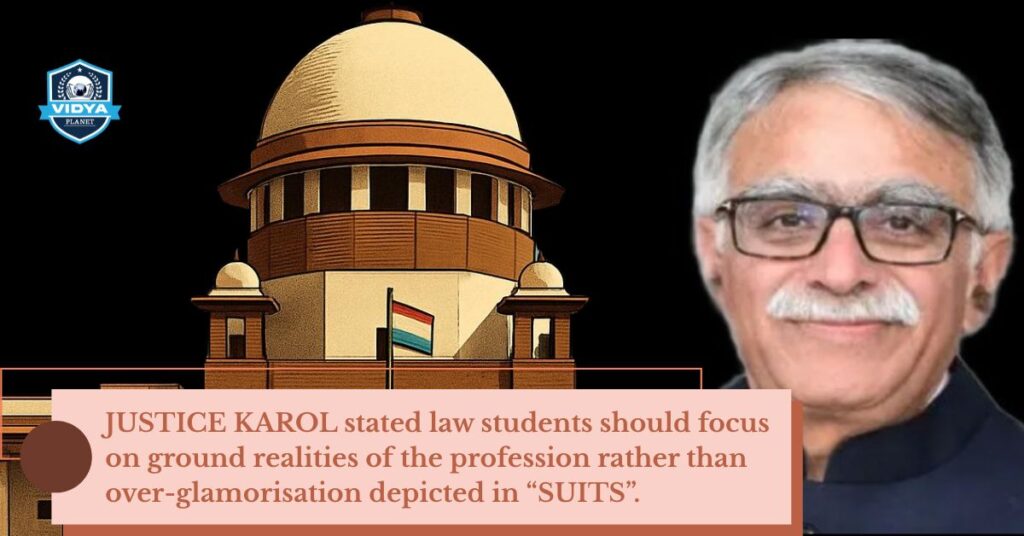
Justice Sanjay Karol of the Supreme Court of India recently brought this issue of the legal profession that, it has been shaped not only by laws and precedents but also by beliefs, many of which are increasingly impacted by pop culture. to light, observing that students at National Law Universities (NLUs) aspire to be lawyers like those portrayed in the American web series Suits, rather than the more grounded and realistic depiction seen in the Indian series Mamla Legal Hain. This observation sparks a broader discussion about the changing nature of legal education, professional goals, and the true role of attorneys in society.
The Background of Justice Karol’s Statement
Justice Karol delivered these statements while addressing students at an event hosted by the National Law Institute University in Bhopal. He expressed concern that legal education in India is increasingly viewed as a path to wealthy corporate careers rather than a means to serve justice at local levels.
He noted that many students aspire to the glamorous, high-stakes corporate legal world depicted in Suits, which features elite law firms, high-profile deals, and charismatic lawyers working in a fast-paced environment. However, while entertaining, this portrayal is far from the daily realities of the Indian legal system.
A Difference in Legal Reality between “Suits” and “Mamla Legal Hain”
Justice Karol made a symbolic and educational analogy.
Suits represents a sophisticated, corporate-centric legal culture in which success is defined by prosperity, status, and winning high-value cases.
Mamla Legal Hain, on the other hand, depicts the actual reality of Indian courts, including procedural delays, infrastructure issues, and the struggles of common litigants.
Justice Karol said that the Indian justice system is much more complicated and often “delay-ridden” and “confusing,” which are rarely shown in textbooks or praised in the media.
This contrast demonstrates a growing gap between law students’ expectations and the realities they will face in practice.
The Issue of Glamourization in Law Schools
One of Justice Karol’s main concerns is the over-glamorization of the legal profession. According to him, many students are drawn to law not because of a desire for justice, but because of the allure of high pay and social status.
This shift in motivation has important implications:
- Neglect of Grassroots Litigation – Legal assistance, criminal defense, and public interest litigation frequently receive less attention.
- Urban-Centric Practice – Students prefer corporate legal firms in major cities, leaving rural and suburban areas neglected.
- Erosion of Professional Ethics – The search of recognition and validation can overwhelm the profession’s ethical responsibilities.
Justice Karol stressed that the goal of law is not self-promotion but rather service to society and the administration of justice.
Re-emphasizing the Constitutional Ethos
A key highlight of Justice Karol’s speech was his call to “live the Constitution every day.” He encouraged children to acquire the principles reflected in
- Part III: Fundamental Rights
- Part IV outlines state policy directives,
- Part IV-A covers fundamental duties.
He referred to these fundamental principles as a “holy scripture” that should govern not only professional behavior but also daily life.
This emphasis highlights the need for legal education to promote a strong commitment to social justice and constitutional morality in addition to technical knowledge.
Bridging the Gap Between Aspirations and Reality.
Justice Karol’s comments show how important it is to bridge the gap between what people think and what really happens in legal profession. This can be accomplished using a variety of measures:
- Curriculum Reform: Law schools must combine practical training, clinical legal education, and trial court experience to provide students with a realistic grasp of the profession.
- Encouraging judicial internships: Justice Karol stated that over 250 students had interned in his Supreme Court chambers in the last three years, emphasizing the value of hands-on learning.
- Promoting Public Service: Institutions should actively encourage students to participate in legal aid, pro bono, and community service programs.
- Responsible Media Consumption: While courtroom dramas might inspire, students must critically examine their portrayals and distinguish between fiction and truth.
The Broader Implications for The Legal Profession.
Justice Karol’s remarks are more than just about student preferences; they reveal a deeper systemic flaw inside the legal ecosystem. If future lawyers are trained with unreasonable expectations, this could lead to:
- Disillusioned with the profession
- Reduced commitment to public service.
- Imbalanced distribution of legal talent
In contrast, matching ambitions with realities helps strengthen the justice delivery system and guarantee that it stays accessible, equitable, and effective.
Conclusion
Justice Sanjay Karol’s critique is a timely reminder that the legal profession is not a stage for glamour, but rather a platform for justice. While series like Suits can inspire aspiration, the practical realities presented in Mamla Legal Hain better reflect the trials and obligations of practicing law in India.
The message to law students is clear: success in law is measured not only by corporate status, but also by the ability to protect constitutional ideals, serve society, and make a significant difference in people’s lives.
Future attorneys can realign their aspirations from the allure of fiction to the fulfillment of justice, which is the genuine ethos of the legal profession.