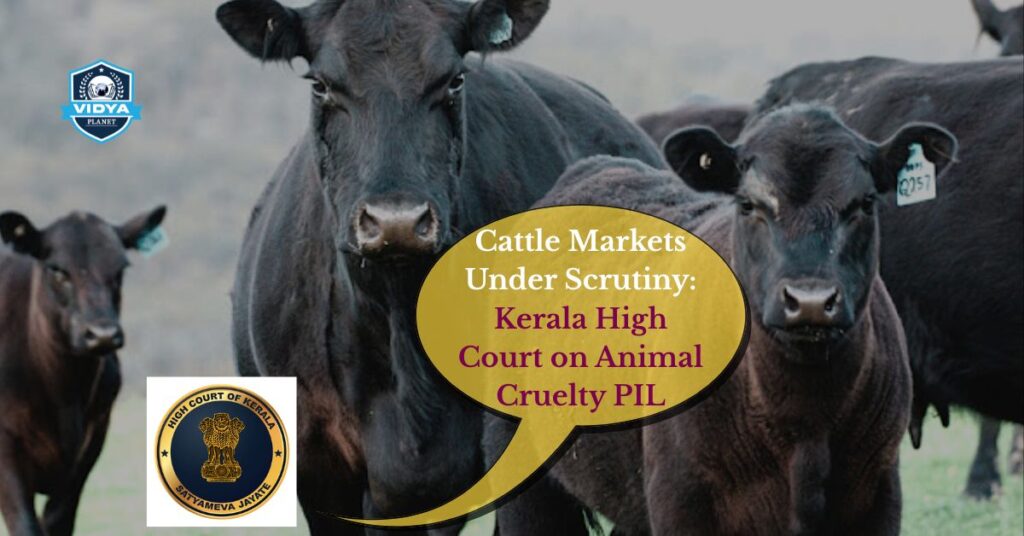
In India, the issue of animal welfare has remained at the intersection of constitutional morality, statutory mandates, and socio-economic realities. The Kerala High Court has recently acknowledged a Public Interest Litigation (PIL) that alleges widespread animal cruelty in animal markets throughout the State of Kerala. The Court has once again emphasized the critical need to reconcile customary practices with changing standards of animal protection law by sending notice to both the State Government and the Union Government.
This article critically evaluates the legal aspects of the case, the statutory framework that regulates animal welfare in India, and the pertinent judicial precedents that influence the discourse on animal maltreatment.
Background of the Case
The PIL was submitted to emphasize the terrible conditions that exist in cattle markets throughout Kerala. Systemic violations of animal welfare norms, such as overcrowding, inadequate veterinary care, improper transportation, and physical abuse of cattle, were alleged by the petitioner. The petition claimed that such practices are not only unethical, but also violate existing statutory provisions intended to protect animals from cruelty.
After considering these allegations, the Kerala High Court sent notices to the State of Kerala and the Central Government, requesting their responses. The Court’s intervention demonstrates its willingness to investigate administrative inaction and ensure the enforcement of animal welfare laws.
Issues Before the Kerala High Court
The PIL poses a number of critical legal questions:
- Whether the conditions in cattle markets are in violation of the PCA Act and its associated regulations.
- Whether the State has neglected its obligation to enforce the current animal welfare laws.
- Is the operation of cattle markets without appropriate regulation unconstitutional?
The Court’s decision to request responses suggests that it believes these concerns have a prima facie basis.
Animal Welfare Statutory Framework
The legal framework in India for the protection of animals is well-developed; however, its enforcement is frequently inconsistent. The Prevention of Cruelty to Animals Act, 1960 (PCA Act) is the primary legislation in this domain.
Prevention of Cruelty to Animals Act, 1960.
The PCA Act is the foundation of Indian animal welfare law. Several provisions of this Act have direct relevance to the current case:
- Section 3: Imposes a responsibility on all individuals who are responsible for an animal to guarantee its welfare and prevent unwarranted pain or suffering.
- Section 11: Lists a variety of behaviors that qualify as cruelty, such as failing to provide sufficient food, water, or sanctuary, beating, overloading, or confining animals in inadequate spaces.
- Section 22: Governs the training and exhibition of animals that perform.
- Section 38: Grants the Central Government the authority to establish regulations in order to implement the Act’s objectives.
The allegations in the PIL indicate clear violations of Section 11, particularly clauses dealing with confinement, transportation, and neglect.
The Transport of Animals Rules of 1978
These regulations, which are enacted under the PCA Act, establish elaborate guidelines for the transportation of animals. They require:
- Sufficient capacity for transit.
- Provision of food and water.
- Veterinary certification prior to transport.
The Public Interest Litigation (PIL) asserts that cattle markets consistently disregard these provisions, resulting in animals experiencing severe distress.
Regulation of Livestock Markets (Prevention of Cruelty to Animals) Rules, 2017
The purpose of this regulations was to regulate the operation of livestock markets and prevent the sale of animals for slaughter in unregulated conditions. The following are the primary provisions:
- The establishment of animal market committees.
- Market registration is mandatory.
- The selling of animals for slaughter is prohibited in specific circumstances.
Although controversial and partially diluted in response to political backlash, these regulations continue to be pertinent when evaluating the legality of cattle market operations.
Constitutional Perspective
In India, animal welfare is not only a statutory obligation, but also a constitutional mandate.
According to Article 48 (Directive Principles of State Policy), the State is required to implement measures to safeguard and enhance breeds, as well as to prohibit the slaughter of cows and calves.
The protection and enhancement of the environment, as well as the preservation of forests and fauna, are mandated by Article 48A.
Article 51A(g) imposes a fundamental duty on citizens to be compassionate toward living creatures.
The Supreme Court has interpreted these provisions in a broad sense to enhance animal rights within the constitutional framework.
Important judicial precedents.
The current PIL must be understood in light of landmark judgments that have shaped Indian animal welfare law.
Animal Welfare Board of India v. A. Nagaraja (2014)
The practice of Jallikattu was prohibited by the Supreme Court of India in this seminal case, as it was determined to be in violation of the PCA Act. The Court recognized that animals possess intrinsic value and are entitled to equitable treatment and dignity.
The judgment introduced the concept of the “five freedoms” of animals, which includes the freedom to express natural behavior, freedom from hunger, discomfort, pain, and terror. The Court determined that any action that infringed upon these liberties would constitute maltreatment.
This case is directly germane to the Kerala PIL, as the conditions described in cattle markets appear to violate these freedoms.
State of Gujarat v. Mirzapur Moti Kureshi Kassab Jamat (2005)
The Supreme Court upheld the constitutionality of laws that prohibit the slaughter of cows in this instance. The Court underscored the significance of animal preservation from an ecological, economic, and religious perspective.
Union of India v. People for Ethical Treatment of Animals (PETA) India 2023
The significance of enforcing the PCA Act and regulating activities that cause damage to animals has been consistently underscored by this series of cases.
Administrative Accountability and State Responsibility
Administrative failure is one of the primary themes of the PIL. Despite the existence of exhaustive laws, their implementation is frequently impeded by the following:
- Failure to implement monitoring mechanisms.
- Inadequate veterinary infrastructure.
- Traders are subjected to economic duress.
- The absence of severe penalties.
The judiciary has consistently maintained that the mere existence of laws is insufficient; effective enforcement is equally important. The State may be required to demonstrate compliance with statutory obligations as a result of the Kerala High Court’s intervention.
Maintaining a Balance Between Economic Interests and Animal Welfare
Thousands of farmers, merchants, and transporters rely on cattle markets for their livelihoods, which are a critical component of the rural economy. Consequently, any regulatory intervention must achieve a balance between:
- Ensuring the welfare of animals.
- Guaranteeing economic sustainability.
In A. Nagaraja, the Supreme Court clarified that economic necessity cannot be used as an excuse for maltreatment. Adjudicating the current matter, the Kerala High Court is expected to adhere to this principle.
Comparative Analysis
Animal welfare legislation has undergone substantial development on a global scale. The livestock markets of countries such as the United Kingdom and members of the European Union are subject to rigorous regulations, which include:
- Inspections that are mandatory.
- Stringent transportation regulations.
- Violations are subject to severe penalties.
In principle, India’s legal framework is comparable; however, enforcement is inadequate. The necessity of bridging this divide is underscored by the current situation.
Implications and Potential Outcomes
There are numerous strategies that the Kerala High Court may implement:
- Directions: The Court has the authority to issue directives to the State to ensure that existing laws are rigorously enforced and that monitoring mechanisms are established.
- Committee Structure: In order to evaluate cattle markets and propose modifications, it may be necessary to establish expert committees.
- Policy Reforms: The Court may advocate for the implementation of revised guidelines or the modification of existing regulations.
- Judicial Oversight: Periodic reports may be mandated to ensure continuous monitoring.
The outcome of this case has the potential to establish a precedent for other states, with far-reaching implications.
Conclusion
The Kerala High Court’s decision to request the State’s response to allegations of animal maltreatment in cattle markets is a significant development in the animal welfare jurisprudence in India. The case emphasizes the judiciary’s function as a protector of constitutional and statutory rights and the persistent discrepancy between law and practice.
The PIL presents a compelling case for reform by referencing the Prevention of Cruelty to Animals Act, constitutional mandates, and established judicial precedents. The Court’s ultimate decision will not only determine the future of cattle market regulation in Kerala but also potentially impact the broader trajectory of animal rights in India.
This case serves as a reminder that compassion toward animals is not merely a moral obligation, but a constitutional imperative, as the legal landscape continues to evolve.