Introduction
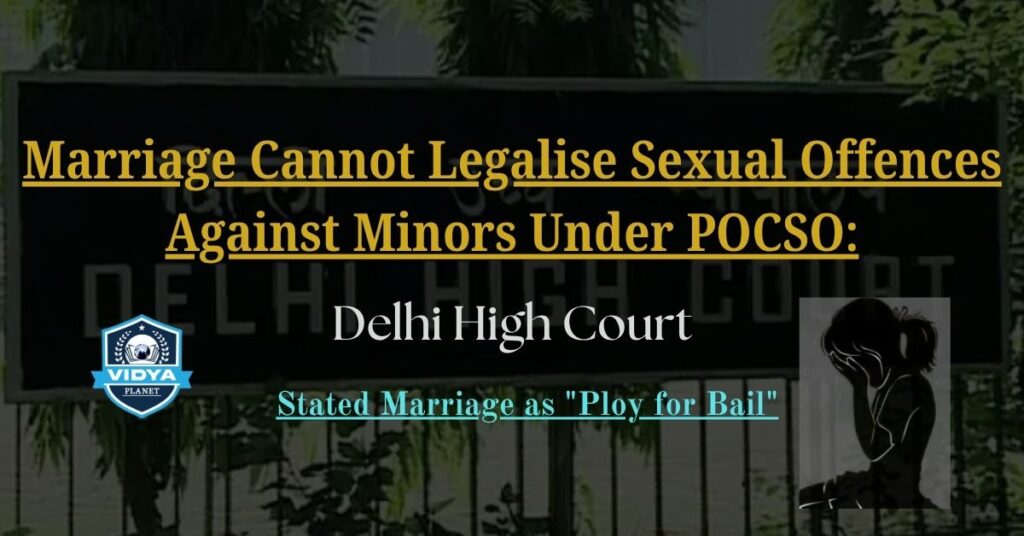
In a landmark reaffirmation of child protection jurisprudence, the Delhi High Court ruled unambiguously that marriage between the accused and the minor victim does not discharge criminal culpability under The Protection of Children from Sexual Offences Act of 2012 (POCSO Act). This decision comes at a time when courts are increasingly dealing with cases in which accused people try to use marriage as a strategy to diminish or avoid prosecution.
The verdict emphasizes an important legal principle: statutory protection for children cannot be superseded by private arrangements such as marriage, especially when the offense itself violates a child’s dignity and physical autonomy.
Factual Background of the Case
The case contained allegations that the accused had regularly engaged in sexual relations with a teenage girl (about 16 years old) under the false promise of marriage. The accused then sought relief by emphasizing that he had married the victim, attempting to downplay the gravity of the offense.
The Court, however, rejected this argument, emphasizing that such a marriage does not absolve the criminality of crimes committed while the victim was a juvenile.
Core Legal Issue
The main question before the Court was:
“Whether a marriage between the accused and a juvenile victim eliminate or decrease culpability under POCSO and similar penal provisions?”
The Court’s answer was a clear NO.
Key Observations of the Court
- Marriage does not erase past offences.
The Court ruled that later marriage cannot relieve the accused of the crime of rape committed when the victim was minor.
- POCSO is a strict liability framework.
The verdict reiterates that a minor’s consent is legally irrelevant, and any sexual conduct with a person under the age of 18 constitutes an offense in itself.
- Marriage as “Ploy for Bail”
In relevant observations reported throughout proceedings, the Court stated that accused persons frequently exploit marriage as a tactic to win bail or sympathy, which must be allowed to undermine the purpose of the legislation.
- Protection of children is paramount.
The Court emphasized that the POCSO Act is welfare law aimed at protecting children, and private settlements cannot undermine its objective.
Relevant Legal Provisions
The Protection of Children from Sexual Offences Act, 2012.
- Section 3: Penetrative Sexual Assault.
Defines sexual activities involving penetration of a minor.
- Section 5 & 6: Aggravated Penetrative Sexual Assault
Covers repeat offenses and allows for harsher penalty.
- Section 29: Presumption of Guilt
Unless shown differently, courts will presume the accused guilty.
- Section 30: Presumption of Culpable Mental State.
Shifts the burden of proof for intent on the accused.
These regulations, taken together, form a strict framework in which prosecution is not readily thwarted by subsequent circumstances such as marriage.
Indian Penal Code (IPC) (currently known as Bharatiya Nyaya Sanhita)
- Section 375: Rape
Includes sexual intercourse with a minor, regardless of permission.
- Section 376: Punishment for Rape.
Provides punishment for the offense.
The Court reaffirmed that raping a kid is a serious crime against society, not just an individual wrong.
Prohibition of Child Marriage Act of 2006
- Child marriages are declared voidable and discouraged from being validated.
- Reaffirms that marriage involving a juvenile cannot be used to justify criminal behaviour.
Judicial Reasoning: Why Marriage is Irrelevant.
The Court’s argument is based on three fundamental principles:
- Statutory Supremacy Over Social Arrangements
- Courts cannot accept informal agreements, such as marriage, to trump specific law prohibitions.
- Irrelevance of Minor Consent
- Even if the connection looked to be voluntary, the law considers minors incapable of providing meaningful consent.
- Preventing Legal Misuse.
Accepting marriage as a defence would mean:
- Encourage forced or compelled marriage.
- Undermine deterrence.
- Normalize the exploitation of minors
The Court cautioned that such an approach would convey a harmful message that sexual offenses against children can be “regularised” through marriage.
Comparative Judicial Trends
In comparable cases, Indian courts have taken a mixed response.
- In some previous cases, courts have been kind when parties later married and settled.
- However, recent jurisprudence, including this case, demonstrates a definite shift toward stricter enforcement of POCSO.
The current judgment is consistent with the idea that:
“The command of the statute is stronger than the pull of equity.”
Implications of the judgment
- Strengthening Child Protection
It emphasizes that POCSO is non-negotiable and uncompromising.
- Limiting the Misuse of Marriage as a Defence
Sends a strong message that marriage should not be used as a legal retreat.
- Impact on Bail Jurisprudence.
Courts are likely to investigate allegations of marriage more closely, particularly when used to get bail.
- Societal Message
Affirms that sexual offenses against kids are societal crimes that cannot be resolved privately.
Conclusion
The Delhi High Court verdict is a significant step toward ensuring the integrity of India’s child protection laws. The Court’s decision that marriage cannot relieve an accused of rape under POCSO underlined that justice cannot be mediated through social structures.
In a legal landscape frequently complicated by socio-cultural issues, this decision serves as a reminder that:
“A child’s dignity, autonomy, and protection come first, and no subsequent act, even marriage, can erase the crime committed against them.”