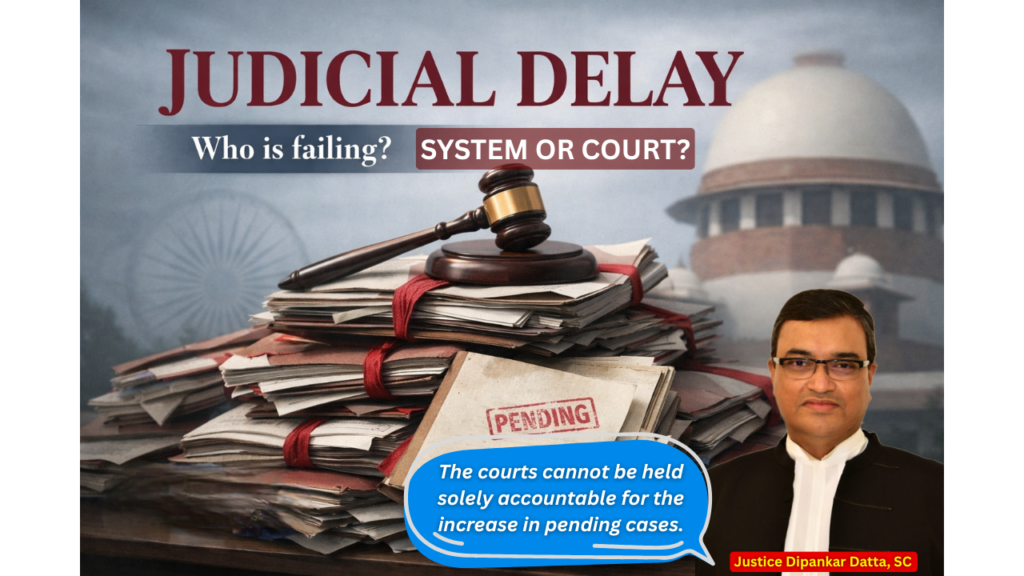
One of the most important factors that determines the integrity of judicial administration is the preservation of court documents and the correct treatment of those records. In an important case, the Allahabad High Court reaffirmed that the misplacement of judicial files is not merely an administrative oversight but rather a serious misbehavior that strikes at the very core of the process of providing justice. Disciplinary action against a court clerk was upheld by the Court, which serves to reaffirm the principle that negligence within the judicial system is not something that can be allowed lightly.
Facts of the Case
In the court of the Chief Judicial Magistrate in Rampur, judicial files were reported missing, which led to the initiation of this case. The concerned clerk, who was responsible for handling the file, fell short of providing an explanation for its whereabouts despite the fact that there were multiple opportunities and investigation procedures.
As a result of an investigation conducted by the department, the clerk was found to be in violation of the agency’s policies and was punished by having four annual increments with cumulative effect withheld from them.
After being dissatisfied with the disciplinary action that was taken, the clerk filed a petition with the Allahabad High Court in accordance with Article 226 of the Constitution. In the petition, he contested both the results of the investigation and the proportionality of the punishment.
Issues Before the Court
- Whether or if the act of misplacing judicial files constitutes serious misconduct that calls for disciplinary action to be taken.
- Whether or not the High Court, in the exercise of its writ jurisdiction, has the authority to intervene with the findings and punishments of the department.
- Whether the punishment that was handed down was considered to be arbitrary or disproportionate.
Court’s Observations
The writ petition was denied by Justice Anish Kumar Gupta, who made some profound observations regarding the gravity of the misbehavior. As the court decided:
“It is a highly severe claim that judicial files have been misplaced or lost, and it is essential to be dealt with iron rod.”
The Court underlined that judicial records constitute the foundation upon which adjudication is built. Any loss or misplacement has a direct impact on the rights of litigants and undermines public faith in the judicial system.
Further, it was mentioned that:
- During the course of the investigation, the petitioner was provided with sufficient opportunities to defend himself.
- Neither the norms of natural justice nor their principles were violated.
- The sentence that was handed down was within the bounds of what is considered acceptable for disciplinary authorities.
Legal principles involved
The scope of Judicial Review in Service Matters
The idea that judicial review under Article 226 is restricted was reaffirmed by the Court, which is a well-established principle. When it comes to investigating departmental matters, the courts do not serve as appellate authorities.
The Supreme Court of India issued a significant decision in the case of B.C. Chaturvedi v. Union of India (1995) 6 SCC 749, in which it said that courts are only able to intervene in cases where the following conditions are met:
- The principles of natural justice have been contravened.
- According to the findings, the punishment is grossly disproportionate, or the findings are twisted.
It was determined that none of these grounds were valid in this particular instance.
Misconduct and Negligence in the Public Service
According to the principles of service jurisprudence, the act of misplacing official judicial files or records has always been considered a serious breach of conduct.
In a number of previously established cases involving missing court records, the courts have made the observation that “judicial files just cannot go missing,” and that blame must be assigned to the people who are responsible for the matter.
In a similar vein, according to the Uttar Pradesh Government Servant Conduct Rules, 1956, negligence that results in the loss of official records is considered to be misconduct that warrants disciplinary action.
The significance of judicial files or records
It is important to note that judicial files are not merely records; rather, they are crucial tools for adjudication.
In accordance with Section 151 of the Code of Civil Procedure, 1908, the judicial system possesses the inherent authority to recreate lost records; however, this recourse should be reserved for the very last resort and should be employed with extreme caution.
On multiple occasions, the courts have emphasized that reconstruction cannot serve as a substitute for the integrity of original records and must not be detrimental to any participating party.
Duty of Care in Judicial Administration
In the case of V. Safarullah v. Gracy Josephine Lambie, which was heard in the Kerala High Court, it was decided that any records that were missing must be notified immediately and searched thoroughly, and that any gap in this process will be taken very seriously.
The Allahabad High Court has taken a definitive approach in this particular instance, which is consistent with this concept.
Analysis
Specifically, the judgment draws attention to the accountability of court officials, which is an essential component of judicial administration. The administrative machinery guarantees that justice is both accessible and efficient, while the judges themselves are responsible for delivering justice.
The harsh language used by the Court, which is “handled with iron rod,” indicates that there is no tolerance for negligence that interferes with the functioning of the judicial system.
Additionally, the decision reaffirms this:
- Court employees are the guardians of the tools that are used to provide justice for the administration of justice.
- Integrity of the institution: The loss of records can cause delays or even derail the justice system.
- In order to maintain public faith in the judicial system, it is necessary to have an effective record management system.
The fact that the court did not reduce the severity of the punishment is significant because it demonstrates that even non-malicious ignorance can result in severe repercussions when it has an effect on the judicial process.
Criticism
Despite the fact that the Court’s stringent approach is absolutely warranted, it does raise questions about systemic difficulties such as the following:
Overworked staff, inadequate record keeping infrastructure in subordinate courts, and a lack of digitization are all contributing factors.
In order to prevent such situations from occurring in the future, it is equally necessary to address these systemic inadequacies.
Individual accountability, on the other hand, continues to be essential since systemic weaknesses cannot justify neglect in the management of sensitive judicial data.
Final Thoughts
The decision made by the Allahabad High Court establishes a solid precedent that demonstrates that the misplacement of judicial files or record is a serious breach of conduct that has significant repercussions for the administration of justice. The Court confirmed the limited scope of judicial review in service concerns and stressed the importance of strict accountability within the judicial system by sustaining the disciplinary action that was taken against the clerk.
A strong message is conveyed by the judgment, which is that the protection of judicial files or records is not only a procedural obligation but rather a constitutional responsibility that is an essential component of the rule of law.