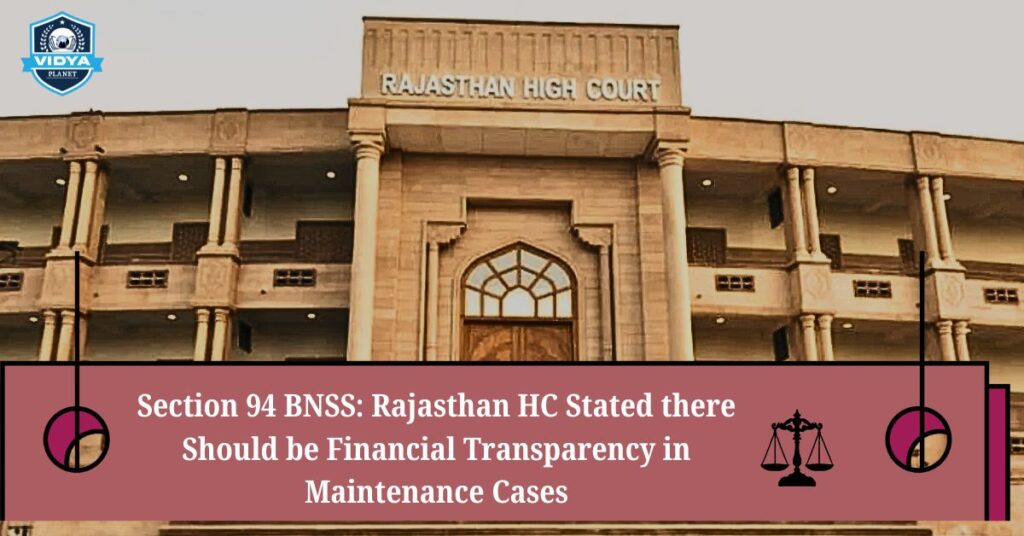
The development of maintenance law in India has constantly emphasized fairness, equity, and financial transparency among spouses. The Rajasthan High Court’s recent ruling in Arvind Kumar v. Smt. Namita (2026) is a crucial step toward reinforcing these principles under the Bharatiya Nagarik Suraksha Sanhita, 2023 (BNSS). The Court ruled that under Section 94 BNSS, a husband has the right to request the presentation of his wife’s employment and wage documents in order to fight a maintenance claim. This decision not only explains the procedural scope of Section 94, but it also supports the demand for full and honest financial disclosure established in Rajnesh v. Neha (2020). The decision emphasizes that maintenance cannot be assessed in isolation from both parties’ true earning capacity, and that concealing of income harms the justice delivery system
Introduction
Maintenance proceedings play an important role in family law because they seek to give financial assistance to a dependent spouse. Historically, such processes were frequently seen as benefiting the woman, based on the assumption of economic dependency. However, changing socioeconomic realities, particularly growing female workforce involvement, need a more balanced and evidence-based approach.
In this context, the Rajasthan High Court’s recent decision is significant. By allowing a husband to use Section 94 BNSS to get his wife’s job data, the Court supported the idea that maintenance should be determined based on actual financial situation rather than presumptions.
Factual Background of the Case
The case arose from a maintenance proceeding that was underway in Jodhpur’s Family Court. The husband said that his wife, who had filed for maintenance, worked as a nurse at a private hospital and earned around ₹80,000 per month. However, she had not reported this information to the court.
The spouse attempted to obtain her work information directly from the hospital, but the request was denied owing to privacy issues. As a result, he filed an application under Section 94 BNSS asking the court to summon the wife’s employment records.
The Family Court denied this application because the husband did not provide supporting papers. The spouse challenged this verdict in the Rajasthan High Court.
Legal Framework: Section 94 BNSS.
Section 94 of the Bharatiya Nagarik Suraksha Sanhita, 2023, succeeds Section 91 of the Code of Criminal Procedure, 1973. It authorizes courts to issue summonses or written orders requiring the production of papers or other items required for an investigation, inquiry, or trial.
The provision states in substance that:
- The court can request documents deemed “necessary or desirable” for adjudication from anyone.
- This rule is critical in ensuring that justice is not denied simply because important evidence is unavailable to a party.
Key Issues before the Court
- Whether a husband can use Section 94 BNSS to obtain his wife’s job records during maintenance proceedings.
- Whether the trial court’s refusal of such a request was legally justified.
- Whether a spouse’s concealing of income impacts maintenance adjudication.
Observations by the Rajasthan High Court
While granting the petition, Justice Baljinder Singh Sandhu made several key observations.
The relevance and necessity of documents
The Court concluded that the wife’s employment and wage records were directly relevant to the maintenance proceedings and required for a fair judgment.
It noted that:
- Documents with a direct impact on the outcome must be made available to ensure justice.
Improper Rejection by the Trial Court
The High Court considered the Family Court’s rationale to be untenable. It clarified that:
- If the husband previously has access to the records, there is no need to use Section 94 BNSS.
- Denying the application due to a lack of prior evidence undermines the whole purpose of the provision.
Right to Fair Defence
- The Court stressed that a party has the right to adequately defend itself, including the right to get documents in the opposing party’s possession.
Duty of Full Financial Disclosure
Based on the Supreme Court’s historic decision in Rajnesh v. Neha (2020), the Court reaffirmed that:
- Both parties must disclose their income, assets, and liabilities truthfully.
- Concealing income impairs the fairness of support proceedings.
The Court’s Power to Access Private Records
- The Court acknowledged that when records are held by private entities (such as employers), parties may have practical obstacles in acquiring them. In such instances, judicial intervention is necessary.
Judgement and Directions
Rajasthan High Court:
- Set aside the Family Court’s order that denied the husband’s application;
- Allowed the application under Section 94 BNSS.
- Directed the trial court to get the wife’s work and salary data from the hospital.
This guaranteed that the maintenance claim was decided based on reliable financial information.
Interplay with the Maintenance Law
Section 125 CrPC (now the u/s 144 BNSS)
Section 125 CrPC requires maintenance depending on:
- The husband’s financial capacity;
- The wife’s inability to support herself.
However, this case demonstrates that “inability” cannot be presumed and must be proven by evidence.
The significance of the judgment
- Shift to Gender-Neutral Justice
The ruling emphasizes that maintenance law is not one-sided. It recognizes that:
Courts must objectively assess a working wife’s financial independence when determining maintenance eligibility.
- Improving Evidentiary Fairness
By permitting document production, the Court ensures:
Verified financial data is used to make decisions, ensuring no party receives an unfair advantage through concealment
- Clarification on Section 94 BNSS
The judgment clarifies that:
Section 94 can be utilized to secure relevant evidence in maintenance actions, not just criminal trials.
- Compliance with Supreme Court jurisprudence.
This ruling is consistent with:
In Rajnesh v. Neha (2020), financial disclosure is mandatory, however in State of Orissa v. Debendra Nath Padhi, papers are relevant based on their necessity and stage of proceedings.
Critical Analysis
While the decision promotes fairness, it highlights critical considerations:
Privacy versus Transparency
- Employee records are intrinsically private. However, the Court mitigated this worry by:
- Limiting disclosure to judicial processes.
- Before summoning records, ensure that they are relevant and necessary.
Burden of Proof
Traditionally, the claimant has been responsible for proving his or her claims to maintenance. This judgment:
- Recognizes realistic restrictions in accessing evidence and allows courts to help gather pertinent documents.
Preventing Misuse of Maintenance Law.
This choice serves as a precaution against:
- Inflated or false claims,
- Concealment of wealth by either party.
Comparative Perspective
Interestingly, courts have taken identical positions in reverse instances. For example, in maintenance proceedings, the Allahabad High Court has ordered husbands to provide income details when requested by wives, highlighting financial transparency as a universal demand.
This demonstrates a constant judicial trend:
Maintenance proceedings must be based on truthful financial disclosure from both parties.
Conclusion
The Rajasthan High Court’s finding on Section 94 BNSS is a positive step toward guaranteeing fairness and transparency in maintenance procedures. The Court’s decision to enable a husband to get his wife’s job data reaffirms that insufficient or obscured financial information cannot jeopardize justice.
The verdict underlines three fundamental principles:
Equal before the law – Both spouses are subject to the same disclosure requirements.
Evidentiary fairness requires courts to make important records more accessible.
Substantive justice requires that maintenance take into account actual financial circumstances.
As maintenance conflicts emerge in modern India, this decision serves as a guiding precedent, ensuring that legal outcomes are based on facts rather than assumptions.