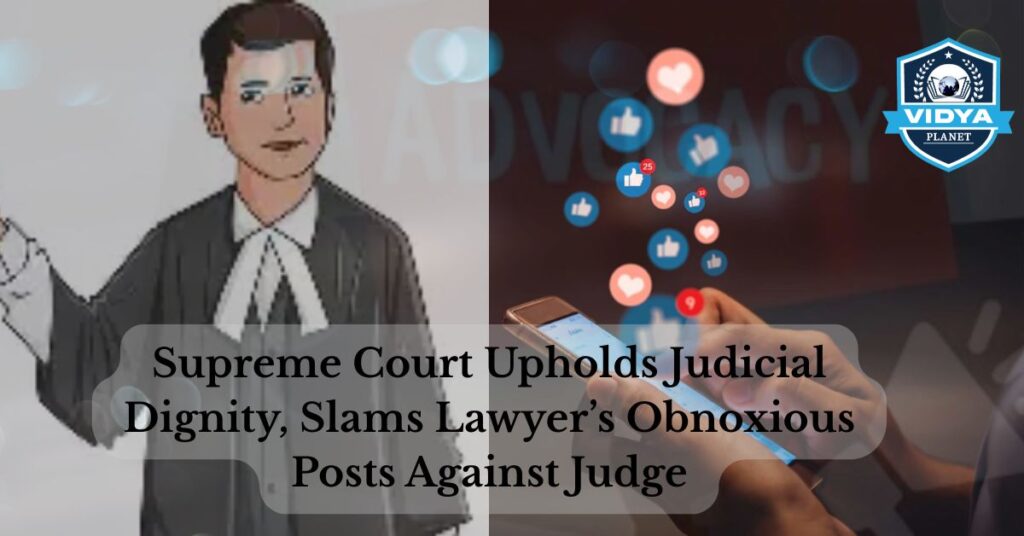
The dignity of the judiciary is one of the foundations of constitutional democracy. Courts gain their authority not from force, but from public trust, institutional integrity, and respect to the rule of law. In a recent event, the Supreme Court of India sharply criticized a lawyer for allegedly launching an abusive and scandalous social media campaign against a retired judge who leads a court-appointed committee. The Court stated that it would not open its doors to anybody who “misused black robes.”
The remarks were made during the hearings of Paritosh Trivedi & Ors v. Bar Council of India, in which several lawyers contested their disqualification from contesting the Madhya Pradesh State Bar Council elections due to altered eligibility standards. However, the hearing took a severe turn when the Bench noted that one of the petitioners had made unpleasant posts against the body in charge of Bar Council elections.
Background to the Case
A bench comprising Chief Justice Surya Kant and Justice Joymalya Bagchi heard the case. The Court was hearing petitions from advocates who had been found ineligible to run for Bar Council elections after failing to meet new standards.
During the hearing, the Bench was informed that one of the individuals involved in the litigation reportedly used social media sites to make false, scandalous, and abusive charges against Justice Sudhanshu Dhulia, who led the commission tasked with overseeing the elections.
Observations by the Supreme Court.
The Court reacted harshly, stating that such conduct by members of the legal profession cannot be condoned. It stated that the person in question did not deserve the Court’s compassion after engaging in rude campaigning and making unfounded claims.
According to reports, the Bench stated that advocates who abuse the legal profession’s privileges and their black robes will not be protected by the Court. It even pondered filing criminal contempt charges against the lawyer and questioned why immediate action was not taken.
The Chief Justice also noted that some people believe they are “over smart” and can take the law into their own hands, but the Court is well aware of such techniques.
The Role of Advocates and Professional Responsibility
The black robe worn by advocates is more than just ceremonial apparel. It symbolizes:
- Duty to Justice
- Respect for institutions.
- Professional Discipline
- Ethical advocacy
- Responsibility towards the court and society
When a lawyer utilizes public platforms like social media to scandalize judges or spread lies, it undermines the administration of justice. Lawyers are court officers, and their actions are meant to support, not undermine, the integrity of legal institutions.
Relevant constitutional and statutory provisions
1. Article 129 of the Constitution of India
The Supreme Court is declared a Court of Record under Article 129 of the Indian Constitution, and it has the authority to punish itself for contempt.
This provision allows the Court to act when conduct undermines the judiciary’s authority.
2. Article 142 of the Constitution of India
Article 142 of the Indian Constitution authorizes the Supreme Court to issue any decision or order required to ensure perfect justice.
This power is frequently used when institutional integrity must be safeguarded.
3. The Contempt of Courts Act, 1971
It defines both civil and criminal contempt.
Section 2(c): Criminal Contempt contains:
- Publication that scandalizes the court
- Lowers the authority of any court.
- Interferes with judicial proceedings.
- Obstructs the administration of justice.
- False social media attacks on judges may come under this category.
4. The Advocates Act of 1961
It governs the professional behavior of advocates.
Section 35
- Allows State Bar Councils to take disciplinary action for professional misconduct.
- If an advocate participates in unethical public conduct, they may face disciplinary action.
Important Case Laws
1. E.M.S. Namboodiripad v. T.N. Nambiar, 1970.
The Supreme Court ruled that while criticism is acceptable, attacks on court credibility may constitute contempt.
2. In re Arundhati Roy (2002)
The Court emphasized that freedom of speech does not include the right to scandalise courts.
3. Prashant Bhushan, In Re. (2020).
The Supreme Court ruled that tweets capable of damaging public trust in the institution may result in contempt proceedings.
4. Brahma Prakash Sharma v. State of Uttar Pradesh, 1953.
The Court stated that imputations against judges that undermine public faith in justice delivery may constitute contempt.
Social media and judicial institutions
The digital era has altered expression. While social media promotes involvement and responsibility, it also facilitates the quick spread of disinformation. Allegations made without evidence can have immediate negative consequences for reputations.
Judges rarely respond publicly to personal assaults. As a result, reckless campaigns against them produce asymmetry: allegations spread widely, while judicial restraint inhibits reply.
This is why courts take scandalous behavior seriously, especially when perpetrated by advocates who understand the legal ramifications.
Freedom of Speech vs. Responsibility
Article 19(1)(a) of the Indian Constitution ensures free speech. However, it is subject to reasonable constraints under Article 19(2) of the Indian Constitution, which include contempt of court.
Therefore:
- Fair criticism of rulings is permissible.
- Academic disagreement is lawful.
- Calls for reform are lawful
- False personal assaults and scandalous claims do not constitute protected speech.
What happened procedurally?
Senior Advocate Meenakshi Arora informed the Court that the person who uttered the unpleasant statements was no longer among the petitioners. Another barrister contended that people should not bear vicarious culpability. However, the Court denied relief and rejected the applications.
The Bench further highlighted that comparable limits existed in numerous states, and there was no justification to offer a particular exception for the Madhya Pradesh elections.
Why Does This Case Matter?
This is important for five reasons:
- It restores courtroom respect in the era of viral abuse.
- It reminds lawyers that professional privilege entails accountability.
- It clarifies that courts may take action against digital scandals.
- It enforces ethical boundaries in bar politics.
- It protects the public’s trust in fair justice.
Conclusion
The Supreme Court’s strong response sends a clear message: advocating is a noble profession, not a license to intimidate or defame others. Black robes indicate justice, discipline, and respect for institutions. When they are misused for personal vendetta or reckless publicity, the legal system must step in.
Healthy criticism helps democracy; obnoxious attacks weaken it. Falsehood becomes strategy, and the boundary between dissent and devastation is crossed. The Court’s observations serve as a reminder to the Bar that credibility is gained via legal arguments rather than social media abuse.