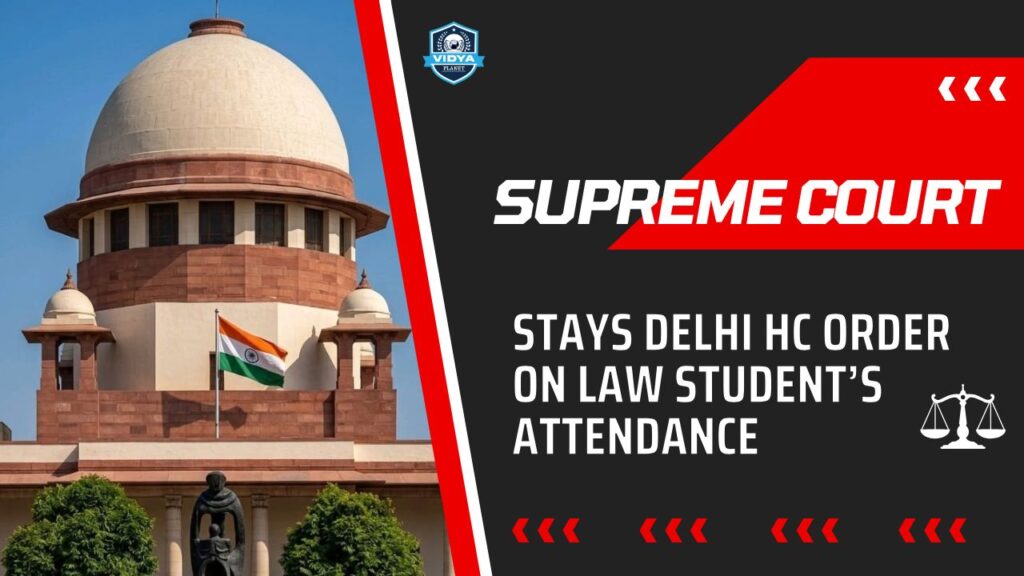
On May 26, 2026, in a significant intervention impacting the heart of legal education in India, the Supreme Court stayed a Delhi High Court order prohibiting law colleges and universities from barring students from taking exams due to insufficient attendance. The stay, issued by a bench of Justice Vikram Nath and Justice Sandeep Mehta, has sparked a debate at the nexus of academic discipline, institutional autonomy, student welfare, and judicial overreach. The Supreme Court’s strong statement that the Delhi High Court had “legislated literally” encapsulates the constitutional and jurisprudential conflict at the heart of this debate.
Background: The Sushant Rohilla Tragedy and the Delhi HC’s Suo Motu Intervention
This legal story began with the tragic suicide of Sushant Rohilla, a third-year law student at Amity University, on August 10, 2016. Rohilla, who was reportedly prevented from taking his semester exams due to a lack of attendance, left behind a message expressing feelings of failure and hopelessness. The episode, which raised severe concerns about institutional harassment and the mental health consequences of strict attendance enforcement, prompted the Supreme Court to launch a suo motu proceeding, which was later transferred to and resolved by the Delhi High Court.
In its November 2025 judgment, The Delhi High Court made broad orders in paragraph 249 of its ruling. The court ruled that no student enrolled in any recognized law college, university, or institution in India shall be barred from taking exams or progressing academically purely because of a failure to meet the minimum attendance requirements. The court ruled that attendance standards, no matter how well-intentioned, could not be imposed so strict that they caused emotional trauma or, worse, endangered a student’s life. The court also ruled that law colleges could not impose attendance standards that exceeded the minimal percentage set by the Bar Council of India (BCI) under the Legal Education Rules, and it urged the BCI to conduct a thorough re-evaluation of required attendance criteria.
The High Court also envisaged a series of remedial measures to be implemented while the BCI’s consultations were ongoing, including weekly online attendance notification, monthly notification to parents or guardians, extra classes for students who fell behind, home assignments in lieu of attendance, and certified practical work at legal aid clinics. If a student still fell short at the conclusion of a semester, the court allowed institutions to impose a mild grade reduction (up to 5% of marks or 0.33% of CGPA) rather than complete debarment.
The Supreme Court’s Intervention: Key Observations
Despite the delay, the BCI subsequently filed an appeal with the Supreme Court disputing paragraph 249 of the Delhi High Court’s decision. On May 26, 2026, a bench of Justice Vikram Nath and Justice Sandeep Mehta issued a notice in the BCI’s plea and stopped the implementation of the controversial directive. The stay was directed to have prospective effect, which means that students who had previously benefited from the HC’s guidance would not be immediately harmed. The case has been scheduled for a subsequent hearing on July 21, 2026.
The Supreme Court’s comments during the hearing were pointed and noteworthy. The bench expressed concern that the High Court’s decision would have a negative impact on National Law Universities across the country, with students becoming increasingly resistive to compelled attendance.
Justice Sandeep Mehta questioned the rationale of the High Court’s reasoning, noting that the decision did not prohibit students from attending lectures; and, in that case, wondering why students had sought admission at all. Justice Vikram Nath questioned the function of professors if pupils opted not to attend.
Senior Advocate Mukul Rohatgi, representing NMIMS College, argued that the High Court’s decision rewarded indiscipline and failure to attend courses. The bench responded that the High Court had effectively legislated in the sphere of educational regulation, which is properly the responsibility of the government and the regulator, rather than just adjudicating the issue before it.
The bench also noted that additional writ petitions, including those challenging two BCI circulars demanding criminal background checks, biometric attendance systems, and CCTV surveillance in classrooms, had already been filed before it. These have now been tagged together for complete review.
Notably, the Court stressed that its stay and the current status of these petitions would not preclude other High Courts from independently considering comparable problems about attendance requirements in matters pending before them.
The Legal Regulatory Framework: BCI and Attendance Norms
In India, legal education is primarily governed by the Advocates Act of 1961 and the Bar Council of India’s Legal Education Rules of 2008. Under these norms, the BCI establishes minimum attendance criteria; often set at 70% of total classes held; as a prerequisite for students to be qualified to take university examinations. This is more than just an administrative formality; it is a substantial academic requirement designed to ensure that future legal practitioners get enough classroom exposure to law, legal reasoning, and advocacy abilities.
The reason for imposing a minimum attendance requirement is well established. Law is a discipline that necessitates careful examination of theory, case law, and ethics, all of which are best developed through structured academic interaction. Classroom discussions, moot court exercises, client counselling simulations, and seminars are the foundations of a good legal education, especially in the five-year integrated BA LLB and three-year LLB programs. Allowing students to sit for examinations without meeting these conditions, as the Supreme Court appears to have agreed, risks lowering the quality of legal professionals entering the bar.
The Conflict Between Judicial Compassion and Institutional Discipline
The Delhi High Court’s November 2025 directives emerged from genuine concern for students facing mental health issues, personal problems, and the catastrophic implications of institutional rigidity. Sushant Rohilla’s tragedy is more than just a statistic; it exemplifies the human cost of a system that, at its worst, treats attendance as an inflexible aim rather than an instructional means. The High Court was correct in recognizing that any policy governing attendance enforcement must prioritize students’ mental health and well-being.
However, there is a significant difference between improving attendance enforcement tools and fully divorcing attendance from exam eligibility. The former, which the High Court addressed in its directions on grievance redressal committees, parental notice, and extra classes, is a valid use of judicial authority in the face of regulatory inertia. The latter, as the Supreme Court appears to have determined, enters the realm of policymaking, which is best left to the legislators and regulators.
The statement that the High Court “legislated literally” expresses concern about the separation of powers. Courts are authorized to interpret the law and fill gaps where basic rights are at stake; but, they are not often authorized to substitute their judgment for that of educational regulators on academic policy issues. The BCI has the institutional mandate, technical expertise, and constitutional ability to set and alter attendance standards. Directing that those norms have no repercussions for examination eligibility — even temporarily — effectively nullifies the regulatory structure by judicial fiat.
The Divergence Among High Courts and the Need for Uniformity
The disparity of view among the several High Courts on the issue of law student attendance complicates matters. While the Delhi High Court took the liberal view that no student should be barred from examinations solely on the basis of attendance, the Uttarakhand High Court, around the same time, observed that allowing law students to appear in exams despite failing to meet minimum attendance requirements may be “counterproductive.” This divergence in court judgment across forums causes uncertainty for students, institutions, and regulators alike, emphasizing the significance of the Supreme Court providing authoritative advice on the topic.
The Supreme Court has taken a positive step toward resolving this ambiguity by suspending the Delhi High Court’s order and scheduling a common hearing for all linked issues. The July 21 hearing will provide an important chance for all stakeholders, including the BCI, university associations, student bodies, and the Union government, to offer thorough arguments about what an appropriate and compassionate attendance policy for law students should look like.
Conclusion
The Supreme Court’s stay of the Delhi High Court’s order is fundamentally an assertion that academic standards and institutional discipline are not diametrically opposed to student welfare, but rather complementary. The legal profession has a special public trust. Society relies on lawyers who are not only smart, but also disciplined and professionally accountable. The required attendance requirement is one of the fundamental mechanisms by which legal education assures that its graduates are truly equipped for the demands of the bar.
This does not imply that the concerns that motivated the Delhi High Court’s ruling were unfounded. The need for effective grievance redressal processes, parental communication channels, mental health support, and flexible alternatives to strict attendance enforcement remains pressing and urgent.
The Supreme Court tends to indicate, however, that these problems must be addressed through the right regulatory and legislative procedures, rather than through a judicial order that effectively suspends the execution of the BCI’s Legal Education Rules nationally.
As the case moves forward to a full hearing, the hope is that the Supreme Court will issue guidance that protects both the integrity of legal education and the dignity and well-being of the students who pursue it — a balance that would honor Sushant Rohilla’s memory far more meaningfully than any single judicial directive could.