Introduction
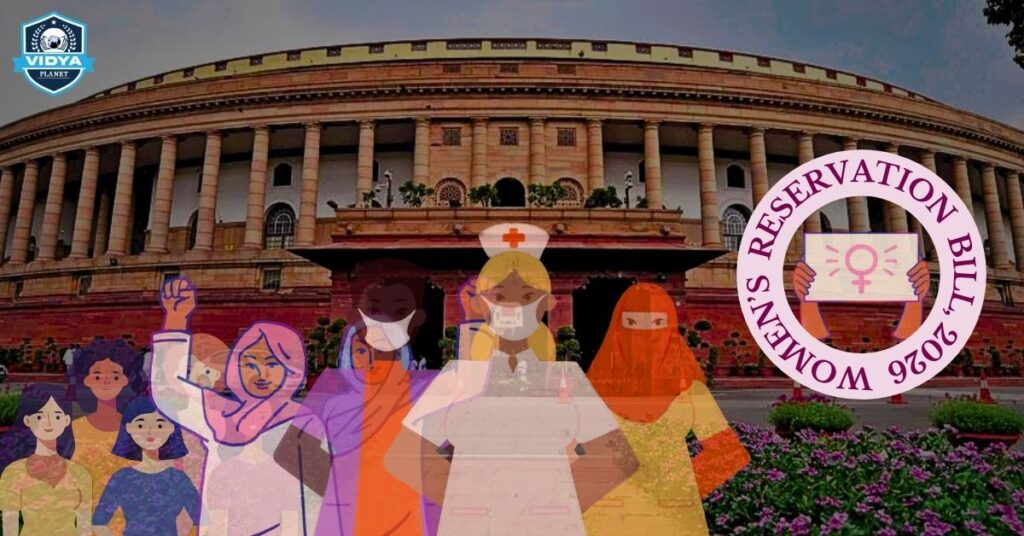
The Union Government has notified the long-awaited Women’s Reservation bill, formally bringing into action the Constitution (106th Amendment) Act, 2023, also known as the Nari Shakti Vandan Adhiniyam. This bill aims to reserve one-third (33%) of seats in the Lok Sabha and State Legislative Assemblies for women, a significant step toward gender equality in political representation.
However, the notification of the law is a sign of progress; its actual implementation depends upon the completion of two critical processes: the next Census and a subsequent delimitation exercise. This conditional framework has provoked intense legal, political, and constitutional debate, raising concerns about the reform’s urgency and effectiveness.
Historical context of Women’s Reservation Laws.
Women’s legislative reservation is not a new demand. It has been the focus of political and scholarly debate since the 1990s. The first significant attempt was made in 1996 with the Constitution (81st Amendment) Bill, which failed due to a lack of consensus. Subsequent efforts in 1998, 1999, and 2008 also failed to enact as legislation.
Despite these failures, the notion gained traction, particularly given the success of reservations for women in local self-government institutions under the 73rd and 74th Constitutional Amendments. These reforms, which require 33% reservation for women in Panchayats and Municipalities, demonstrated that greater engagement by women leads to more inclusive governance.
The eventual approval of the Women’s Reservation Bill in 2023 during a special session of Parliament was viewed as a watershed moment, representing decades of activism and political struggle.
Key Features of Women’s Reservation Law
The notified law includes several major elements aimed at increasing women’s representation:
Reservation for Seats:
The Act mandates 33% reservation for women in the Lok Sabha and State Legislative Assemblies. This includes seats allocated for Scheduled Castes (SCs) and Scheduled Tribes (STs), ensuring that women from underserved communities benefit from the provision.
Rotational Mechanism:
The reserved seats will be rotated following each delimitation operation. This guarantees that the benefits of reservation are dispersed over time among diverse constituencies, avoiding reserved seats from becoming concentrated in specific regions.
Duration of Reservation:
The reserve is expected to last 15 years from the date of adoption. However, Parliament has the ability to extend this period if required.
Constitutional Validity
By putting the provision into the Constitution, the law gains greater legal validity and protection, making it less likely to be repealed or diluted by ordinary legislation.
Notification of Law: A Step Forward
On April 16, 2026, the Union Government officially notified the Women’s Reservation Law, bringing the constitutional amendment into action. This notice is a critical procedural step because a constitutional amendment becomes effective only after such formal notification.
However, the announcement reiterates that the reservation will not take effect until the delimitation process is completed using current population statistics. Thus, while the law is now part of the Constitution, its actual execution is postponed.
Understanding Delimitation and its Role
Delimitation is the process of redrawing electoral constituency borders to reflect changes in population. It is carried out by a Delimitation Commission, which works independently to promote justice and openness.
In India, delimitation exercises have always occurred after the Census. However, constitutional modifications have frozen delimitation until after the first Census conducted after 2026. This freeze was implemented to maintain a balance of representation among states, particularly those with higher and lower population growth rates.
- The Women’s Reservation Law specifically relates its implementation to the subsequent delimitation process. This means that:
- First, perform a census, update population data, then redraw constituencies through delimitation.
- Only after these stages are accomplished will the reservation for women become effective.
Concerns Over Delayed Implementation
The conditional nature of the law has sparked criticism from a variety of sources. Critics contend that coupling implementation and delimitation effectively delays the attainment of women’s representation in legislatures.
- Uncertain timeline.
Given that the Census has already been delayed, and delimitation is a time-consuming procedure, the reserve is unlikely to be enforced before the next general election. This generates ambiguity about the timing for enforcement.
- Symbolic Vs. Substantive Reform
Some critics have characterized the bill as more symbolic than substantive, claiming that a reform without quick implementation fails to overcome the current gender imbalance in political representation.
- Political Strategy
There are also charges that the delayed implementation allows the government to take credit for adopting a progressive law while avoiding the political challenges of enforcing it in the short term.
Opposition and Political Reaction
The notification has sparked significant reactions from opposition parties, with many criticizing the Centre’s stance.
Demand for Immediate Implementation: Opposition leaders have suggested that the reservation may be implemented within the existing constituency framework rather than waiting for delimitation.
Concerns about Delimitation: There is concern that delimitation will shift the balance of political power among states, disproportionately affecting southern states with lower population growth.
Call for Transparency: Several parties have urged clarity on the Census and delimitation timelines to ensure that the statute does not become inert indefinitely.
The Delimitation Bill Controversy
Recent legislative developments have complicated the broader argument over delimitation. Proposals to increase the strength of the Lok Sabha to 850 seats and enable delimitation were introduced but failed to get through Parliament. Consequently, these legislations were withdrawn.
This development has added another degree of uncertainty, as the extension of parliamentary seats was viewed as a prelude to a comprehensive delimitation process. Without such reforms, the implementation of women’s reservations may be further delayed.
Constitutional and Legal Analysis
From a constitutional basis, the Women’s Reservation Law constitutes a substantial step toward substantive equality.
- Equality and affirmative action.
The law is consistent with Articles 14 and 15 of the Constitution, which allow affirmative action to remedy historical disadvantages. The bill aims to address women’s chronic underrepresentation in legislative bodies by allocating seats for them.
- Democratic Representation.
The idea of representative democracy compels legislative bodies to reflect the diversity of society. Given that women account for roughly half of India’s population, their minimal representation in legislatures violates this premise.
- Conditional legislation.
However, conditional implementation calls into question the nature of constitutional demands. A legislation based on unpredictable future events may be condemned for lacking immediacy and enforceability.
Comparative Perspective
Globally, numerous countries have implemented procedures to increase women’s political engagement. This includes:
Legislative Quotas: Rwanda and Nepal have constitutional provisions requiring a minimum percentage of women in legislatures.
Party Quotas: Several European countries require political parties to present a specific number of female candidates.
India’s strategy is unusual since it blends constitutional reservation with structural election reforms such as delimitation. While this offers a thorough foundation, it also creates delays that other models may not have.
Implications for Governance and Society
The introduction of women’s reservations has the potential to change India’s political and social landscape.
- Inclusive Policymaking
Increased representation of women is expected to result in more inclusive policies, notably in health, education, and social welfare.
- Empowerment and Role Model
Women’s increased political participation can encourage future generations while also challenging traditional gender roles.
- Strengthening democracy
A more representative legislature increases the credibility and efficacy of democratic institutions.
However, these advantages can only be achieved if the law is efficiently applied.
The Way Forward
To guarantee that the Women’s Reservation law achieves its intended goals, various procedures must be taken:
- Expediting Census
The administration must prioritize conducting the Census, which is the first step toward delimitation.
- Transparent Delimitation Process.
The delimitation process must be transparent and inclusive, considering the concerns of all parties.
- Exploring Interim Measures
Policymakers may adopt temporary measures to improve female representation, such as party-level quotas or incentives.
- Judicial oversight.
If delays persist, the judiciary may be asked to investigate whether the conditional implementation violates constitutional norms.
Conclusion
The Women’s Reservation law’s enactment marks a watershed moment in India’s quest for gender equality in politics. It represents a long-overdue recognition of the need to empower women within a democratic framework.
However, the law’s reliance on delimitation for execution raises serious concerns regarding its timeliness and effectiveness. The constitutional promise has been made, but its fulfilment is questionable.
To advance the law beyond symbolic and into substantive impact, the government must ensure that the Census and delimitation processes are completed on schedule. Only then can the aim of a more inclusive and representative democracy be realized, changing gender equality from a constitutional aspiration to a lived experience.
READ THE OFFICIAL NOTIFICATION HERE: