Introduction
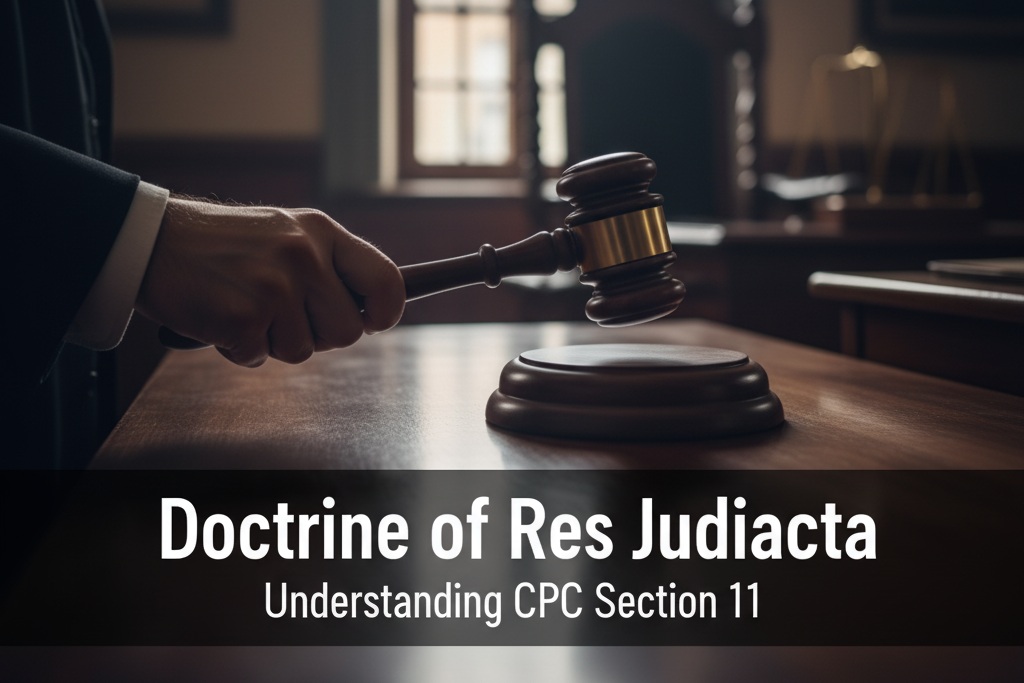
Section 11 of the Code of Civil Procedure, 1908 represents the doctrine of res-judicata or the rule of conclusiveness of judgment, as to the points determined earlier of fact, or of law, or of law and fact and in every consecutive suit between the identical parties. It legislates that once the matter is finally settled by a competent Court, no party can be allowed to reopen it in a subsequent litigation. In absence of such a rule there will be no end to litigation, and the parties would be put to non-stop dilemma, harassment and expenses.
Definition of Res Judicata
According to Spencer Bower
“Res Judicata is a rule of universal law pervading every well-regulated system of jurisprudence, that a final judicial decision pronounced by a judicial tribunal having competent jurisdiction over the cause or matter in litigation shall set at rest the controversy between the parties and their privies, and conclusively determine their respective rights as to the subject-matter of the litigation, so that they cannot afterwards be re-litigated before the same or any other tribunal.”
According to Justice Das Gupta
“The principle of res judicata is based on the need of giving finality to judicial decisions. What it says is that once a res is judicata, it shall not be adjudged again. The principle applies not only to what was decided but also to what could have been decided in that proceeding.”
Principles of Res Judicata
The doctrine of Res Judicata, embodied in Section 11 of the CPC, means that a matter once finally decided by a competent court cannot be re-litigated between the same parties.
It is based on the Latin maxim “Res judicata pro veritate accipitur” — a thing adjudged is accepted as true.
The principles of Res Judicata are:
- Finality of Decisions:
Once a competent court has decided an issue finally, the same issue cannot be raised again in another proceeding between the same parties. - Same Parties and Same Title:
The rule applies only when both the earlier and subsequent suits involve the same parties or their representatives, and they are litigating under the same legal capacity or title. - Same Matter Directly and Substantially in Issue:
The matter in the second suit must be directly and substantially the same as that in the first suit, not merely incidental or collateral. - Competent Jurisdiction:
The earlier decision must be given by a court of competent jurisdiction — one that had authority to decide the issue. - Heard and Finally Decided:
The matter must have been heard and finally decided, not merely dismissed for default or on technical grounds. - Constructive Res Judicata:
Under Explanation IV to Section 11, any matter that might and ought to have been raised in the earlier suit is deemed to have been decided, preventing parties from splitting claims or withholding issues.
Conditions to impose Res Judicata
- Same Parties or Claimants: The doctrine applies only if the parties involved in the current suit are identical to those in the earlier suit or claim under the same title.
- Same Issue: The matter in dispute must be substantially identical in both the previous and subsequent suits.
- Competent Court: The former suit must have been adjudicated by a court competent to decide the matter.
- Final Decision: The issue must have been conclusively decided in the earlier proceedings.
Exceptions to the Principle of Res Judicata
- Judgment Obtained by Fraud or Collusion
One of the most significant exceptions to Res Judicata is when a judgment has been obtained by fraud, misrepresentation, or collusion. Fraud vitiates all judicial acts and proceedings. A judgment based on deceit cannot be considered valid and does not bind the parties in subsequent litigation.
- Lack of Jurisdiction
If the earlier decision was delivered by a court that lacked jurisdiction — whether territorial, pecuniary, or subject-matter jurisdiction — such a decision is void and cannot operate as Res Judicata. A court without jurisdiction cannot render a binding judgment.
- Fraud on the Court or Abuse of Process
If the earlier decision was obtained by misleading the court or by an abuse of judicial process, Res Judicata will not bar subsequent proceedings. Courts will not allow their process to be used as an instrument of injustice.
- Habeas Corpus Petitions
The rule of Res Judicata is not strictly applicable to writs of habeas corpus, as these concern the right to personal liberty. Each fresh violation or new circumstance gives rise to a new cause of action.
- Change in Law or Circumstances
Where the law has been altered or there are material changes in the circumstances since the earlier decision, the doctrine of Res Judicata will not apply. Courts recognize that justice demands flexibility when the legal or factual situation has changed significantly.
When the court fails to apply Res Judicata.
The doctrine of Res Judicata, embodied in Section 11 of the CPC, ensures finality of judicial decisions. It prevents the same issue from being re-litigated between the same parties once it has been finally decided by a competent court. However, courts sometimes fail to apply this doctrine properly, leading to injustice or repetitive litigation. A court fails to apply Res Judicata when any of the essential conditions under Section 11 are not satisfied — for example, when the matter in issue is not the same, or when the earlier decision was not by a competent court. Similarly, if the earlier case was dismissed for default or was not heard and finally decided, the doctrine cannot apply.
Res Judicata also does not apply where the earlier judgment was obtained by fraud, misrepresentation, or collusion (S.P. Chengalvaraya Naidu v. Jagannath, AIR 1994 SC 853), or when the earlier court lacked jurisdiction (Kiran Singh v. Chaman Paswan, AIR 1954 SC 340).
Further, courts fail to apply the doctrine correctly when they ignore exceptions such as change in law or circumstances (State of West Bengal v. Hemant Kumar, AIR 1966 SC 1061), or when dealing with pure questions of law, which can be re-examined (Mathura Prasad v. Dossibai, AIR 1971 SC 2355).
In Satyadhyan Ghosal v. Deorajin Debi (AIR 1960 SC 941), Justice Das Gupta clarified that Res Judicata must be applied only to matters “heard and finally decided.”
Landmark Cases on Res Judicata
- Daryao v. State of UP (1961): In this case, the Supreme Court held that Res Judicata applies to writ petitions under Articles 32 and 226 of the Constitution, reinforcing the principle that parties cannot bypass the doctrine by invoking different jurisdictions. The Court emphasized that the doctrine serves as a barrier to relitigating issues that have been previously adjudicated, regardless of the forum in which they are raised.
- Satyadhyan Ghosal v. Deorajin Debi (1960): This landmark case clarified that the doctrine of Res Judicata is not merely a procedural technicality but a fundamental principle of public policy. The Supreme Court held that the doctrine applies to both civil and criminal proceedings, reflecting its broad applicability and importance in maintaining the finality of judicial decisions.
- Lal Chand v. Radha Kishan (1977): The Court elucidated that for Res Judicata to apply, the matter must have been “directly and substantially” in issue. The case emphasized that the doctrine does not extend to every incidental issue but applies only to core issues that were actually decided in the previous suit.
- D.R. Mangal v. Union of India (1998): The Supreme Court examined the concept of “same title” and affirmed that the doctrine applies even when parties are in different capacities but under the same title. This case highlighted the flexibility of Res Judicata in accommodating various scenarios where the core issues remain the same.
Challenges and Criticisms
Critics argue that the doctrine may sometimes lead to injustice, particularly in cases where new evidence or changes in circumstances arise that could affect the outcome of the case. Some challenges include:
- Rigid Application: The strict application of Res Judicata can sometimes prevent parties from addressing new or significant evidence that emerges after the initial judgment. This rigidity can potentially lead to unfair outcomes in cases where substantive justice is compromised.
- Procedural Complexities: Determining whether a matter is “directly and substantially” the same in subsequent suits can be complex and may require detailed analysis. This procedural complexity can create challenges for both litigants and courts.
- Impact on Access to Justice: In certain instances, the doctrine may restrict access to justice for parties who may have legitimate claims but are barred from bringing them due to previous judgments. This impact on access to justice is a concern that needs to be balanced against the benefits of finality and judicial efficiency.
Conclusion
The doctrine of Res Judicata, as embodied in Section 11 of the Civil Procedure Code, plays a pivotal role in the Indian legal system. It ensures the finality of judicial decisions, promotes judicial efficiency, and prevents the abuse of legal processes. By preventing the re-litigation of issues already decided by a competent court, Res Judicata fosters consistency and certainty in legal proceedings. However, the doctrine must be applied judiciously to address potential challenges and ensure that it serves its intended purpose of promoting justice and efficiency.

Satyendra Singh Thakur is a final-year LL.B. student at Devi Ahilya Vishwavidyalaya (DAVV)—a graduate in Science from Dr. Hari Singh Gour University —blending analytical reasoning with legal understanding. Dedicated and professional, Satyendra aims to excel academically and contribute effectively to the field of law.