Introduction:
The Constitution of India, the lengthiest written constitution in the world, is a monumental text, meticulously crafted by the Constituent Assembly over nearly three years. It was adopted on 26th November 1949 and came into effect on 26th January 1950. The constitution is the Grundnorm or the highest law from which all the other laws derive their authority. It is the supreme law of the land which determines the structure and functions of the principal organs of the government and their relationship with one another.
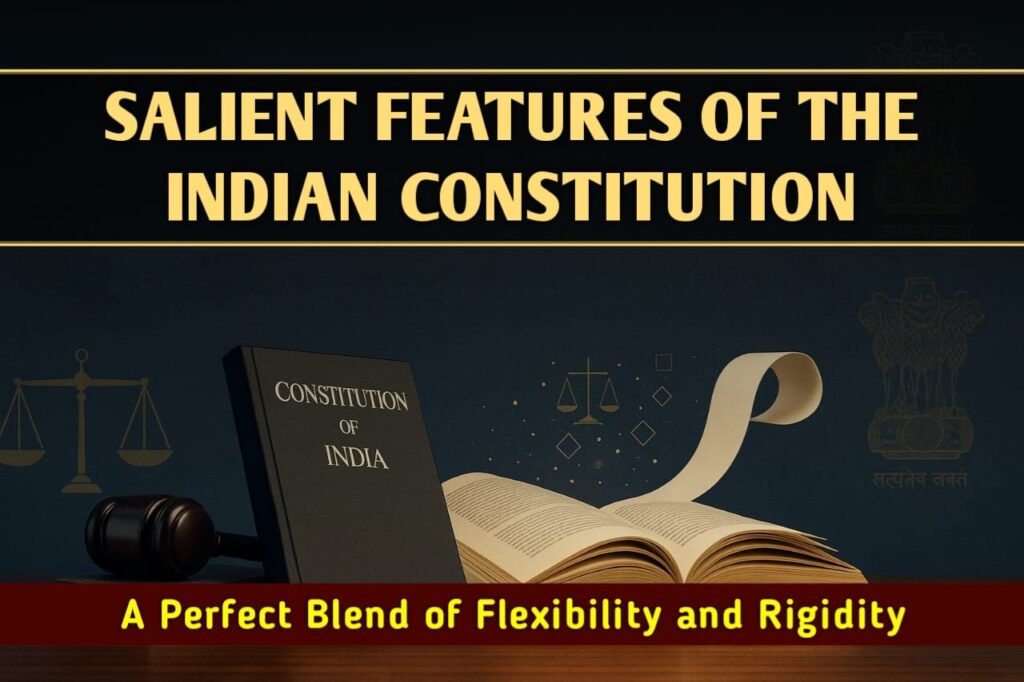
Sir Iver Jennings observes, “All constitutions are the heirs of the past as well as the testators of the future.” The Constitution of India is not just the product of the political revolution but also of the research and deliberations of all the eminent personalities involved the process of the formation of the constitution. The framers of the Constitution envisioned a document that could endure the test of time, being both a stable guide for the nation and an adaptable instrument for its progress. Therefore, the Indian Constitution represents a balancing synthesis of two constitutional theories that are poles apart. The Constitution is neither purely rigid like the American constitution, which makes amendments practically very difficult; nor is it as flexible as the British constitution, wherein Parliament can even alter it with the facility required to enact an ordinary law. This perfect combination of flexibility and rigidity represents the most striking feature in the form of balancing continuity and change.
Overview of Salient Features
Before entering into the mechanics of its adaptability, one must appreciate the broader landscape of the Indian Constitution’s characteristic features which collectively define its spirit.
- Drawn from Various Sources: The framers of the Indian Constitution gained experience from the working of all the known constitutions of the world. They sought to incorporate good provisions of those constitutions in order to avoid defects and loopholes that might come in the working of the Indian Constitution. They framed the chapter of the Fundamental rights on the model of the American Constitution, adopted the parliamentary system of government from the United Kingdom, took the idea of Directive Principles of State Policy from Ireland, and the idea of a federation with a strong centre from Canada.
- Parliamentary Form of Government: The Constitution of India establishes a parliamentary form of government both at the Centre and the States. The Constituion makers have followed the British model in toto. The essence of the parliamentary form of government is its responsibility to the legislature.
- Federal System with a Unitary Bias: The Constitution creates a dual system of government with a clear division of powers between the Centre and the States. However, it favors a strong central government. This is clear from features like a single constitution, single citizenship, all-India services, and the Centre’s overriding powers during emergencies. Many describe this system as “quasi-federal.”
- Fundamental Rights (Part III): The formal declaration of Fundamental Rights in Part III of the Constitution guarantees civil liberties and protects the citizens from the arbitrary use of power by the state. These rights are prohibitions against the state. The remedies again the violation of Fundamental Rights is given in the form of Writs enforceable by the Supreme court and Higher courts.
- Directive Principles of State Policy (Part IV): The DPSPs, contained in the part IV of the Constitution set out the aims and objectives to be taken up by the States in the governance of the country. They are non-enforceable, with the backdrop idea that the states should endeavor to implement them with a high sense of moral duty.
- Fundamental Duties (Part IV-A): The Constitution (42nd Amendment ) Act, 1976 introduced a code of ten “Fundamental Duties” for citizens which later increased to eleven duties by (86th Amendment) Act 2002 in order to require the citizens to observe certain basic norms of democratic conduct and behaviors.
- Independent Judiciary and Judicial Review: The Constitution sets up a unified and independent court system, with the Supreme Court at its apex. The courts have the authority of judicial review which allows them to strike down out any laws or government actions that go against the Constitution itself. It is the custodian of the rights of the citizens.
- Secularism, Socialism, and Democracy: The Preamble declares India a Sovereign, Socialist, Secular, and Democratic Republic, setting out the main objectives which the legislation is intended to achieve.
The Spectrum of Amendment: Flexibility and Rigidity
The Indian Constitution strikes a delicate balance between the need for permanence and the imperative of change. It manages to keep things stable while also allowing for necessary changes in a careful way. A strict constitution demands a special and sometimes complicated process to make any alterations, which helps maintain overall steadiness. A flexible constitution allows amendments to happen just like passing regular laws, so it can adjust without much hassle. The Indian Constitution blends these two approaches by setting up three separate methods for making changes.
- Amendment by Simple Majority of Parliament
Simple majority means that a majority of the members of each house are present and voting and is similar to the passing of an ordinary bill. It is the most flexible way of amending the constitution and several provisions of the constitution can be amended by simple majority. However, these amendments are not included in the purview of Article 368, the specific article of the constitution dealing with the amendments. Amending the constitution through simple majority allows for quick adjustments to the administrative and territorial arrangements with out any need to engage in complex constitutional provisions. The following provisions of the constitution can be amended through simple majority:
- Admission or establishment of new states and alteration of areas, boundaries, or names of existing states.
- Creation or abolition of legislative councils in states.
- Provisions related to citizenship, salaries and allowances of members of Parliament, and the rules of procedure in Parliament.
- Provisions concerning the number of judges in the Supreme Court.
- Amendment by Special Majority of Parliament
Article 368(2) specifies that the majority of constitutional provisions can be amended only by a “special majority.” To amend the constitution by special majority, the assent of a majority of the total membership of each House of Parliament, as well as a majority of not less than two-thirds of the members of each House present and voting is required. This mechanism introduces an element of rigidity in the amending process. This specific requirement ensures that the amendments are not made at the whims of the members of parliament or by a slight or momentary majority; instead the amendments are backed by a certain consensus or agreement within the legislature. The amendment to the core principles of the constitution such as the Fundamental Rights (Part III) and the Directive Principles of State Policy (Part IV), which are foundational to the Indian polity, is done by special majority.
- Amendment by Special Majority of Parliament and Ratification by States
This method of amending the constitution is the most rigid method and is specifically reserved for amending the provision that are related to the federal structure of the government as well as for the provisions affecting the rights and powers of the states. It demonstrates the fundamental of federal supremacy which guarantees that the Parliament or the central legislation cannot alter the basic federal structure. This method requires special majority in both the houses if the parliament as well as ratification of the amendment by the legislatures of at least half of the states by a simple majority. This stringent way of amending the federal features protects the autonomy of the states and reinforces the federal balance. The provisions that can be amended by this means include:
- The election and manner of election of the President.
- The extent of the executive power of the Union and the states.
- Provisions related to the Supreme Court and the High Courts.
- The distribution of legislative powers between the Union and the states (as detailed in the Seventh Schedule).
- The representation of states in Parliament.
- Article 368 itself, safeguarding the amendment procedure from being easily altered.
The Role of the Judiciary: The Doctrine of Basic Structure
The careful balance of flexibility and rigidity was strengthened by the Indian judiciary, which plays a key role as the guardian of the Constitution. The Supreme Court’s interpretation of Parliament’s ability to amend has added a layer of strict protection for the Constitution’s core. This judicial innovation is called the “Basic Structure” doctrine.
This doctrine evolved in response to legislative efforts to assert parliamentary supremacy over the Constitution. In early cases like Shankari Prasad v. Union of India (1951) and Sajjan Singh v. State of Rajasthan (1965), the Supreme Court took a literal view, stating that Parliament’s power to amend under Article 368 was absolute and could touch any part of the Constitution, including Fundamental Rights.
However, this stance changed dramatically in Golaknath v. State of Punjab (1967). The Court decided that Fundamental Rights were “transcendental and immutable” and that Parliament could not limit or take them away. This ruling set the stage for a major clash between the judiciary and the legislature.
The conflict peaked in the landmark case of Kesavananda Bharati v. State of Kerala (1973). In this important judgment, a 13-judge bench of the Supreme Court reversed the Golaknath decision and established the “Basic Structure” doctrine. It ruled that while Parliament’s power to amend the Constitution under Article 368 is broad, it is not limitless. Parliament can change, update, or repeal any provision, but it cannot alter the ‘basic structure’ or ‘framework’ of the Constitution. This doctrine confirmed that certain essential features of the Constitution are inviolable and beyond Parliament’s control. Over the years, the judiciary has identified several principles as part of this basic structure, including:
- The supremacy of the Constitution.
- The rule of law.
- The principle of separation of powers.
- The goals stated in the Preamble.
- Judicial review.
- Federalism, secularism, and the sovereign, democratic, republican nature of the polity.
- The principle of equality and the essence of the Fundamental Rights.
Conclusion
The Indian Constitution is an impressive document, not just for what it contains but also for its structural foresight. The framers, led by figures like Dr. B.R. Ambedkar, created an amendment process that carefully balances flexibility and rigidity. Its flexible provisions allow it to evolve with the changing socio-economic and political landscape of the country, avoiding stagnation that can come from too much rigidity. At the same time, its rigid elements, supported by the judiciary-crafted Basic Structure doctrine, protect its core principles, foundational ideals, and federal character from being undermined by temporary legislative majorities. This smart and practical blend ensures that the Constitution stays a living document—a dynamic yet stable framework that can guide the nation through its complex journey while preserving its core identity and democratic spirit.

Jyoti Bhojwani is a highly motivated first-year LLB student at Banaras Hindu University with a strong passion for clear and accurate legal communication. Leveraging prior experience in proofreading and content creation, Jyoti is committed to delivering well-researched and accessible legal analysis. She is dedicated to developing expertise in legal writing and contributing valuable content to the legal community.