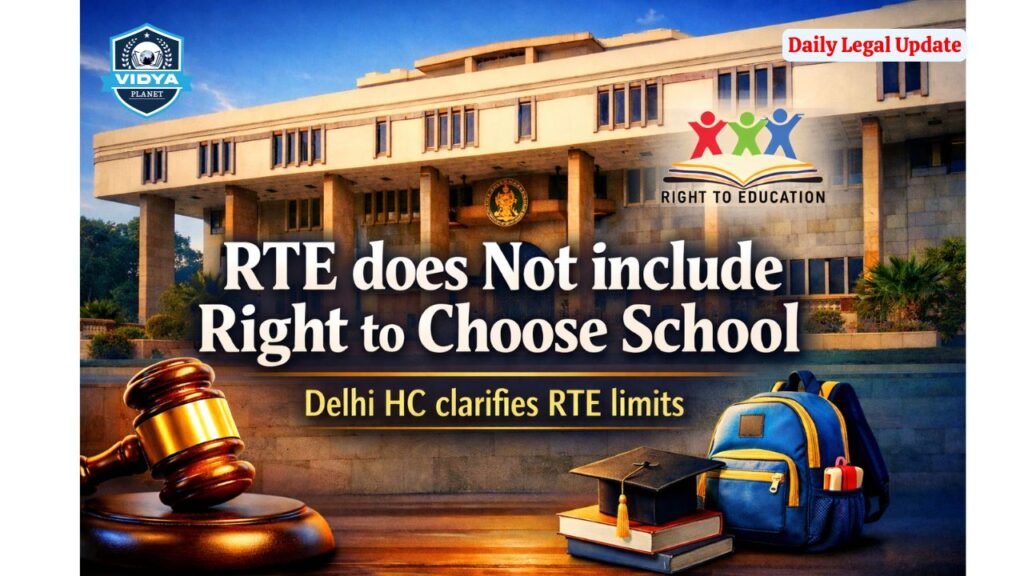
The Right to Education (RTE) in India guarantees children access to elementary education. Recently, the Delhi High Court made it clear that the State must provide education, but does not have to honour a student’s or parent’s choice of a particular school. This decision has renewed debate about what educational rights Article 21A actually covers.
Background and Facts of the Case
The Delhi High Court heard a case in which parents sought admission of their child to a specific private school under the Economically Weaker Section (EWS) quota, as provided under the Right of Children to Free and Compulsory Education Act, 2009 (RTE Act). They made this request even though much of the academic session had already passed.
The Directorate of Education (DoE) denied the request, explaining that RTE admissions use a centralised, computerised lottery system. After seats are assigned and deadlines have passed, parents cannot demand admission to a specific school. The parents then challenged this decision in the High Court.
Key Issue Before the Court
The main legal question was whether the Right to Education allows a child or their parents to demand admission to a school of their choice under the RTE rules.
Observations and Ruling of the Court
The Delhi High Court made it clear that Article 21A gives children the right to free and compulsory education, but not the right to choose a specific school. The Court stressed that:
- The RTE Act provides a mechanism for equitable distribution of seats through a lottery system.
- Allowing parents to insist on a specific school would disrupt the fairness and transparency of this system.
- Administrative feasibility and systemic integrity must be preserved to achieve the objective of universal education.
The Court also said that reopening or reallocating seats after the admission cycle ends, just to meet individual preferences, would cause confusion and weaken the rules set by law.
Legal Reasoning
The Court based its reasoning on a practical reading of Article 21A and the RTE Act. Article 21A promises free and compulsory education, but it does not say how or where this education must be given.
The RTE Act, especially Section 12(1)(c), requires private unaided schools to set aside 25% of their seats for children from disadvantaged backgrounds. But this is done through a set admission process, not by letting families choose any school they want.
The Court explained that the right is to education itself, not to a particular school. This is an important difference between having access and having a preference.
Relevant Judicial Precedents
The Delhi High Court’s decision matches the general approach the Supreme Court has taken on the right to education.
- In Mohini Jain v. State of Karnataka AIR 1992, the Supreme Court first recognised education as a fundamental right under Article 21, emphasising its role in ensuring dignity and development.
- This position was refined in Unni Krishnan v. State of Andhra Pradesh AIR 1993, where the Court limited the right to free education to children up to the age of 14, laying the foundation for Article 21A.
- Later, in Society for Unaided Private Schools of Rajasthan v. Union of India AIR 2012, the Supreme Court upheld the constitutional validity of the RTE Act, including the 25% reservation in private schools. However, the Court also acknowledged the need to balance individual rights with institutional autonomy and administrative efficiency.
Together, these earlier cases show that the State must provide access to education, but it can decide how to put this right into practice.
Policy and Practical Implications
The Delhi High Court’s decision has important effects for policymakers and others involved in education:
1. Reinforcement of Systemic Fairness
By supporting the lottery-based admission system, the Court ensures all eligible students have an equal chance and helps prevent favouritism or unfair practices.
2. Administrative Efficiency
The ruling helps avoid delays and interruptions to the school year that could happen if admissions were often challenged or changed.
3. Clarification of Rights
It gives clear guidance on what the RTE covers, making it clear that the right is to access education, not to choose a specific school.
4. Impact on Parental Expectations
Some parents may see the decision as limiting, especially if they want their children to attend well-known schools. This means their preferences cannot override the admissions process, which might cause disappointment. Still, the ruling shows that fundamental rights cannot be changed to accommodate individual wishes if doing so harms fairness for everyone.
Critical Analysis
While the judgment is legally sound and practical for administration, it raises questions about the quality of education. Some critics say that not all schools are equal, and not allowing choice could keep inequalities in learning outcomes.
On the other hand, some argue that the answer is not to let a few students into top schools, but to raise the quality of public education overall. The RTE Act aims to include everyone, not to be exclusive.
Also, if everyone could choose any school, most people might pick just a few schools, which would go against the goal of giving all students equal chances.
Conclusion
The Delhi High Court’s decision is an important step in clarifying what the Right to Education means. By stating that the right does not include choosing a specific school, the Court has shown that fundamental rights must operate within a fair and organised system.
The decision balances personal goals with the common good, ensuring the RTE Act is applied fairly and clearly. As India works to improve its schools, these court decisions help build a system that is both inclusive and lasting.
In the end, the right to education helps people and creates a more informed society. Its success depends not just on access, but on the State’s promise to provide quality education for everyone, no matter which school they attend.