This article is written by Navya Tiwari, a law student at ICFAI University, Dehradun, with a keen interest in Corporate Governance and Alternative Dispute Resolution (ADR).
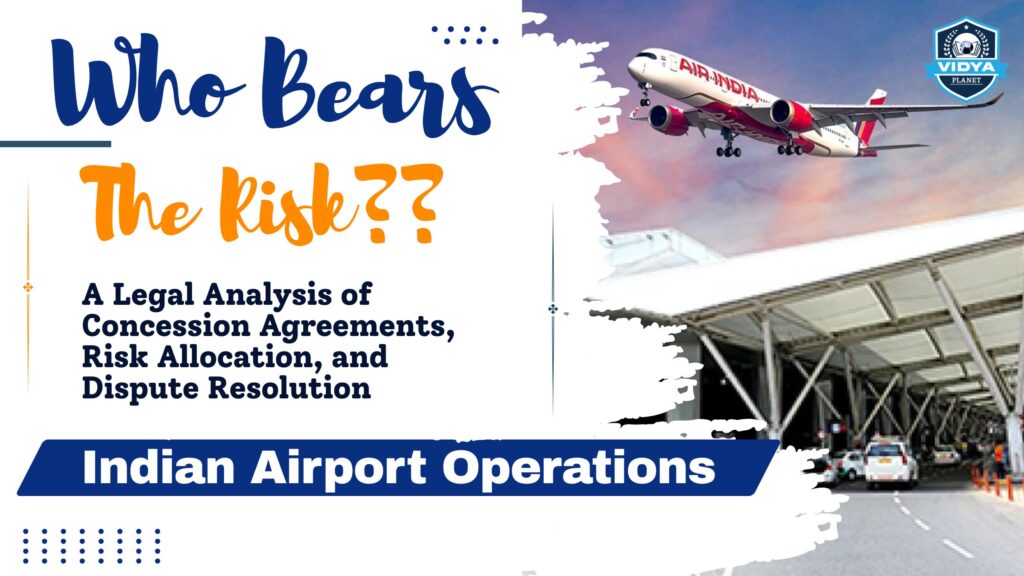
Airports, at present, are no longer considered mere transit terminals. Today’s airports constitute complicated commercial systems that connect individuals and corporations in addition to facilitating commerce. With the increasing growth in aviation traffic and improvements made to the infrastructure by the government, there has been substantial participation by the private sector in airport development and management in India. These developments would not have been possible without the assistance of concession arrangements, which form a part of the Public Private Partnership concept.
While these arrangements might have facilitated in making the airports technologically advanced, one pertinent legal issue has come up as a consequence: Who should be held responsible for any losses incurred due to any unforeseen event? The risk allocation provisions formed an essential aspect of all of the concession agreements discussed above.
While the success or failure of an airport PPP usually depends more on how risks are shared between the two parties rather than any profit sharing, this paper attempts to analyse the legal framework surrounding the issue of concession agreements made in the operation of airports in India, the distribution of risks involved, and possible mechanisms that can be used to solve disputes.
Concession agreements are essentially long-term contracts between the authorities and a concessionaire in which the former authorizes the latter to undertake projects in terms of constructing, operating, developing, and even extending the airport infrastructure within a specified period of time. As a result, the concessionaire provides the capital investments needed, manages operations on a day-to-day basis, and earns profits by way of fees and charges imposed on the users.
The Airports Authority of India (AAI) in India often collaborates with private firms through concessions for managing and operating airports. There are some notable cases like the privatization of the airport in large cities such as Delhi, Mumbai, Bengaluru, and Hyderabad.
Concession agreements have unique characteristics, unlike the typical business contract; it is a hybrid document Airports contribute significantly to public service, and therefore, while creating laws or agreement documents, policymakers must find a proper blend of their legal obligations and social The courts, therefore, view these types of agreements by considering administrative, constitutional, and public policy laws, ensuring that they are in compliance with all laws. In general, the primary objective of a concession agreement is to ensure proper risk allocation to the best entity. However, balancing everything in favour of one another in a concession agreement is always easier said than done.
The Concept of Risk Allocation
Risk allocation refers to allocation of uncertainty regarding the occurrence of certain future events via contractual agreements. Since infrastructure projects require large amounts of capital, involve long periods of time and depend on several other stakeholder groups, there will always be many risks inherent in them.
The main concept behind risk allocation in current concession agreements is that risks should be allocated to whichever party is better suited for managing, minimizing and bearing the risk.
Construction & Completion Risks Some examples of initial risks faced in airport projects include delays during construction, poor designs, overspending and procurement issues. These kinds of risks will be placed under the responsibility of the private concessionaire since it will have overall supervision of the entire project.
When legal difficulties arise due to delays caused by acquisition of land, delayed approvals and actions of the authorities, the common practice in concession agreements is granting extensions and other forms of compensation. Indian arbitration tribunals commonly encounter disputes over delayed completion of projects wherein the parties involved argue over who is responsible for the delays.
Regulatory and Policy Risks
Operating an airport entails many rules and regulations: prices, security checks, environmental regulations, and aviation-related laws all may significantly affect both cost and revenue
A change in governmental policy might have a very serious effect on the feasibility of any particular venture. That is why concession contracts usually contain “change in law” provisions for allocation of regulatory risk between the parties involved to avoid putting either of them at
The key point of law here is to distinguish situations when regulatory changes fall into the category of normal routine and do not require any compensation, and those when the changes are sufficiently unexpected and significant to justify adjustment of the contract.
Force Majeure Risks
Force majeure provisions refer to unforeseen events which are beyond anyone’s control, such as extreme weather events and epidemics like the current coronavirus pandemic.
Force majeure provisions generally provide for a postponement of one’s contractual obligations and can offer additional grace periods and financial relief to affected parties. It is vital to note that the concept of force majeure provisions has become very relevant today due to the COVID-19 pandemic and its disruptive effects on various sectors of the construction industry.
Legal Challenges in Risk Allocation
It is not an exaggeration to say that even the best concession agreements cannot allocate risks in an equitable manner. First, major infrastructure construction usually takes anywhere between twenty to fifty years. It would be impossible to predict everything that could occur during this time period. Secondly, the bargaining power of the governmental authorities and private concessionaires is rarely equal; one entity tends to have far more leverage than the other. Moreover, certain risks are simply passed down upon the concessionaire by default as per the terms of the standard concession agreement. It may raise many doubts regarding the equity and fairness of such an arrangement. Thirdly, some risks may be cumulative in nature, making them even riskier. In other words, delays may be due to governmental inefficiencies and inefficiencies of the private contractor. Thus, distinguishing between the two will prove to be rather challenging. The percentage of responsibility for different risks will become a subject of intense negotiations. In conclusion, the issue of allocating risks is rather complex and evolves over time. At times, it becomes necessary to resort to judicial intervention.
Arbitration as the Preferred Mechanism
Arbitration has become the primary and one of the most preferred means of resolving disputes over airport infrastructure in India. Typically, large concession agreements contain arbitration clauses subject to the provisions of the Arbitration and Conciliation Act, 1996.
Arbitration offers several advantages The technical expertise of arbitrators.
- Confidentiality of the proceedings.
- Flexibility in procedures.
Judicial Intervention
While arbitration is often the go-to choice, courts still step in to keep things in check and make sure everything’s fair in certain cases, Indian courts can step in to handle issues like appointing arbitrators, granting temporary relief, reviewing disputed arbitration decisions, or making sure awards are properly enforced.
Courts these days are leaning more toward supporting arbitration, stepping back to let the parties themselves drive the process trusting their choices and keeping things as streamlined as possible Courts have consistently made it clear that they shouldn’t go back and re-evaluate the actual merits of arbitral awards unless there’s a very good reason to do so.
Sometimes, when government agencies are involved, public law issues can get tangled up with regular contract disputes making it tricky to decide whether the case should be handled through standard arbitration or go through the courts instead. This often leads judges to step in and look more closely.
Emerging Trends and Future Challenges
Future airport concession agreements are expected to adopt more advanced methods for distributing risk.
Climate change is increasingly posing a challenge to airport infrastructure. Severe weather events could lead to greater operational disruptions and introduce new types of risk that standard concession agreements are not well-equipped to handle.
Moreover, there is increasing awareness that fixed risk distribution does not necessarily lead to fair results.
There is a gradual move away from merely assigning risks toward actively managing them across the entire project lifecycle.
Concession agreements are central to India’s airport privatization strategy. They raise a clear but important question: who is responsible if things go wrong? There isn’t a one-size-fits-all answer. The situation is complex and can change. Factors like construction risks, shifting market demand, changing laws, or unexpected events all need careful consideration in contracts. The goal is to match each risk with the party best suited to handle it.
Getting risk allocation right is not just about protecting businesses. It is also essential for keeping vital public services running smoothly and reliably. When risks are unevenly distributed or when it’s unclear who is responsible, disagreements are likely to arise. These disputes often lead to legal battles.
Arbitration has become the preferred method for resolving these issues. It offers a focused, business-friendly approach that works well for the challenges presented by large infrastructure projects. As airport operations continue to evolve, it’s crucial to regularly review contracts and update dispute resolution methods since what is effective now may not be suitable later.
Ultimately, India’s airport PPP model will not succeed by trying to eliminate all risks. It is about distributing them wisely, managing them effectively, and resolving any disagreements promptly and fairly. In the realm of airport concession deals, the question is not whether risks will arise, but whether the legal framework is robust enough to address them when they do.
Although concession agreements are designed to distribute risks fairly between public authorities and private operator, some critics argue that the negotiation power is often unequal between the two parties. In many instances, standard contracts provide limited flexibility, which can result in certain risks being unfairly placed on private companies. This has led to worries about fairness and the long term sustainability of these projects. An agreement that looks fair at first may become hard to handle if new issues emerge later.