This article is written by Arya Priya, a law student at ICFAI University, Dehradun, with a keen interest in Intellectual Property Rights (IPR) laws.
Introduction
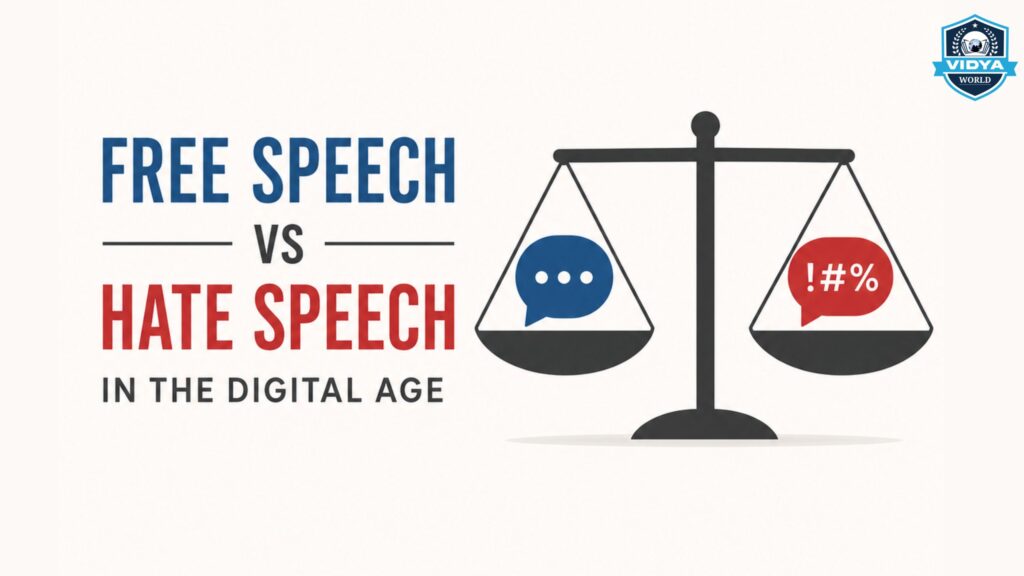
The revolution in technology has affected the way people communicate, exchange their ideas, and take part in public debates. The new technologies of social media, online news sites, blogs, and message applications have allowed people to express their views on anything instantly to millions of people around the world. Thus, modern technologies have made it possible to increase democratic participation in politics and to provide wider access to information. However, at the same time, the modern means of communication have become the source of disinformation and even abuse and discrimination. The issue is how to ensure freedom of expression but at the same time prevent its misusage to provoke violence or hatred.
Freedom of Speech and Expression
Freedom of speech and expression is one of the fundamental principles of a democratic society. It is essential for individuals to be able to speak out about their opinions, criticize the policies of the government, exchange ideas, and participate in debate. In India, it is a constitutionally protected right under Article 19(1)(a). This principle emphasizes the need for freedom of communication to help in maintaining democracy.
However, this freedom cannot exist in a vacuum. According to Article 19(2), restrictions can be placed by the state on this right in relation to the sovereignty and integrity of India, security of the state, friendly relations with foreign states, public order, decency, morality, contempt of court, defamation, and incitements to an offense. All these restrictions exist because at times, this freedom may jeopardize the peace of the society and infringe on the rights of other people in the society. Hence, it is necessary that even though this right requires constitutional protection, it should co-exist with the duty of respecting the dignity of society.
Understanding Hate Speech
While free speech constitutes legitimate forms of communication, hate speech denotes communication intended to promote hatred, discrimination, hostility, and violence towards a person or group of persons on account of attributes like religion, caste, race, ethnicity, nationality, gender, etc. Besides being aimed at particular individuals, hate speech has the capacity to cause disruption of peace and weaken social harmony.
There is no one definition of hate speech under Indian law. Different sections of the Bharatiya Nyaya Sanhita, 2023, have made various acts of promoting enmity between different classes of citizens, intentionally outraging the religious feelings of any class, community, or section of the citizens, and disturbing the communal harmony a criminal offense. Similarly, electoral laws make it illegal for a candidate to make his appeal on grounds of religion or caste. While it is true that these laws aim to control hate speech, the distinction between hate speech and legitimate criticism continues to be very hard to draw.
Hate Speech in the Digital Age
The introduction of social media platforms has amplified the presence and impact of hate speech significantly. An article, a video clip, or any such piece of content can go viral among millions of users in no time. Algorithms on social media usually favor content that elicits extreme emotions from users.
Anonymity is another factor that makes it difficult to deal with the problem. The creation of fake accounts, automated bots, and anonymous accounts allows people to engage in spreading hate speech anonymously. Fake information aimed at certain communities tends to come up during elections or communal crises and at times leads to violent outcomes.
The evolution of artificial intelligence has added another dimension to the problem of hate speech. Videos, photographs, and audio clips generated by artificial intelligence can be used to spread rumors and create disharmony among communities.
Judicial Approach in India
The judicial intervention in India has been important for maintaining a balance between free speech and restrictive laws.
One such case was Shreya Singhal v. Union of India (2015). In this case, the Supreme Court declared Section 66A of the IT Act, 2000, unconstitutional. It was held by the court that the said section was unconstitutional in as much as it imposed vague and undue restrictions on online speech. In this case, the distinction was drawn between discussion, advocacy, and incitement; only when there was incitement to violence can restrictions be justified.
In another case, namely, Pravasi Bhalai Sangathan v. Union of India (2014), the Supreme Court recognized the deleterious impact of hate speech but noted that existing laws can deal with several of these cases effectively enough.
One other important case is that of Amish Devgan v. Union of India (2020), where the Supreme Court has discussed the issue of hate speech in detail. The court noted that although free speech protects unpopular opinions, any speech that incites hatred or discrimination does not receive absolute protection under the Constitution. This shows the importance of ensuring that democratic freedoms and the dignity of minority groups are maintained.
It can be seen that Indian courts have always tried to ensure a balance between free expression and harmful speech.
International Perspective
There is no single method adopted by various countries in regulating the two kinds of speech. In the United States, there is wide-ranging protection through the First Amendment, whereby even the most offensive forms of speech are considered legal provided that the speaker does not actually incite imminent lawlessness.
European countries have, however, taken a much more restrictive path. Due to the history of Germany’s experiences during the Nazi regime, Germany considers several types of hate speech and Holocaust denial as criminal acts. In addition, the European Union has put in place measures aimed at enhancing regulation of illegal content and greater transparency on online platforms.
The international human rights law takes an intermediate stance in this matter. Article 19 of the ICCPR affords freedom of expression, whereas Article 20 obligates states to enact laws against the advocacy of national, racial, or religious hatred that constitutes incitement to discrimination, hostility, or violence.
Challenges in Regulation
Restriction of digital speech is one of the most significant issues that lawmakers and courts face. Firstly, it is rather complicated to define hate speech properly. If laws are too broad, freedom of speech may be restricted by them, while vague laws may not protect people from harmful speech.
The huge amount of information available on the Internet is also a challenge. Millions of posts are added every day, and it is impossible to control them manually. With the help of artificial intelligence, it becomes possible to filter out some types of content, but it is still difficult for computers to recognize regional dialects, sarcasm, or context, which results in unlawful restriction of content and absence of harmful content detection.
Another issue connected with jurisdiction is related to the international character of digital platforms. The content may be created in one country and be a violation of the law of another country.
Role of Social Media Platforms
Social media companies have emerged as important stakeholders in the regulation of speech on the Internet. Almost all the social media platforms have banned hate speech by virtue of their community standards and employ the use of artificial intelligence along with human moderators for enforcing such policies. Nevertheless, there are several criticisms pertaining to inconsistency in the enforcement of such policies, lack of transparency in the process, and insufficient options available for challenging the actions taken by the moderator.
The Information Technology (Intermediary Guidelines and Digital Media Ethics Code) Rules, 2021, in India, obligate intermediaries to exercise due diligence, provide redress for grievances, and cooperate with law-enforcing agencies. In spite of being an attempt to make intermediary guidelines more robust, this rule has generated many concerns related to privacy and freedom of expression.
The way forward
Free speech and hate speech must be balanced in a rights-based and all-encompassing manner. The drafting of laws governing online speech must be precise and well-defined to ensure that there are no unnecessary limitations imposed on freedom of speech. Consistency in enforcement of such laws is just as important as ensuring that such laws are not selectively applied.
Citizens must be taught how to verify sources of information and engage responsibly in online discussions. This will entail educational bodies, civic organizations, and tech firms working together to promote ethical behavior on the internet.
Courts should continue protecting constitutional freedoms by ensuring that any restrictions meet the criteria of necessity, proportionality, and reasonableness. More transparency in online moderation and collaboration in fighting transnational digital crime will help achieve this objective.
Conclusion
While the era of digital technology has opened new avenues for communication and political participation, it has also raised the danger of hate speech and cyberbullying. However, protecting the right to free speech is crucial in any democracy; however, this right must not be abused to express messages that may result in acts of aggression or discrimination towards marginalized social groups.
In its Constitution, India recognizes a constant quest for achieving balance between freedom and responsibility in accordance with such judicial cases as Shreya Singhal v. Union of India, Pravasi Bhalai Sangathan v. Union of India, and Amish Devgan v. Union of India. As technology develops further, relevant legislation, platform accountability, judicial review, and digital citizenship will be essential in maintaining the online environment as a medium of constructive discussion rather than controversy.