This article is written by Pratyush Pandey, a law student at ICFAI University, Dehradun, with a keen interest in Constitutional law.
Abstract
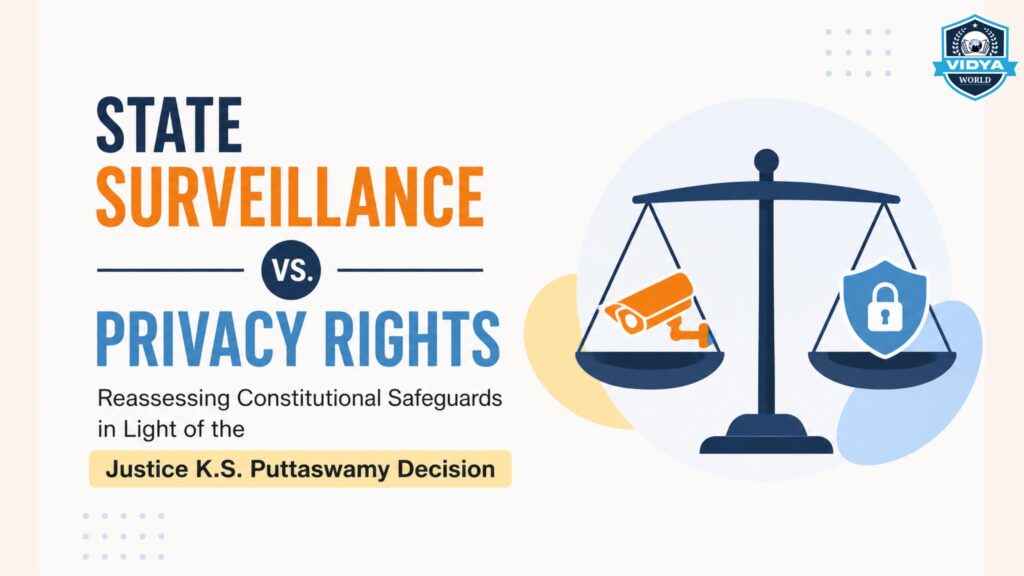
The state is watching people a lot nowadays because of the internet and this is a big problem for individual privacy. The important court decision in Justice K.S. Puttaswamy versus Union of India in 2017 changed everything by saying that people have a right to privacy under the Indian Constitution. This article looks at the problem between the state watching people and contemporary governance surveillance is a tool. It helps in maintaining security deterring crime and providing welfare. However uncontrolled surveillance directly threatens the autonomy and dignity of individuals.
Before the Supreme Court landmark ruling in K.S Puttaswamy the Indian constitution did not specifically recognize privacy as a right. This ruling required a reevaluation of monitoring methods. It was a paradigm change from the standpoint of morality.
A Landmark: The Puttaswamy Verdict
A landmark event in Indian constitutional law occurred in 2017 when the Supreme Court’s nine-judge Constitution Bench unanimously upheld the right to privacy as a basic right. This historic ruling made it clear that privacy is an essential component of the Constitution and not just a statutory benefit. The Court explained that the right to privacy is intricately linked to the right to life and personal liberty under Article 21 and stems from the protections of equality under Article 14 and the freedoms enshrined in Article 19.
By deciding this, the Court corrected a long-standing constitutional position by overturning its previous rulings that had denied the existence of such a right. The ruling highlighted how important privacy is to one’s dignity,
Puttaswamy Verdict: A Constitutional Landmark
In 2017 the nine-judge Constitution Bench of the Supreme Court unanimously held. They said that the right to privacy is a right. It is inherent in the right to life and personal liberty under article 21. It also flows from article 14 and 19. The Court reversed precedents. They held privacy to be an inalienable right. It is associated with dignity.
The Court concluded that privacy is not unqualified. It can be limited.. It must pass the three-fold test.
1) Legality: A law must already exist.
2) Aim: There must be an appropriate State Purpose.
3) Proportionality: The methods used must be the least restrictive. There must be a relationship.
This approach is now used as a benchmark. It is used for evaluating surveillance practices.
India’s State Surveillance: Overview and Difficulties
State surveillance is carried out in India. It uses a variety of legislative tools. These include monitoring systems, biometric data collecting and communications interception. Legislation such as the Information Technology Act and Telegraph Act are used. There are regimes for data collection.
The ruling made clear that privacy’s crucial. It is crucial to governance. It upholds autonomy and dignity.
Constitutional Analysis for Balancing Privacy and surveillance
The fundamental difficulty is striking a balance. The states need to uphold security must be balanced with each person’s right to privacy. According to Puttaswamy proportionality concept surveillance methods must be:
1) Required to accomplish a goal.
2)The least obtrusive.
3) Procedural safeguards must apply.
Judicial review is essential. It ensures that surveillance laws do not violate guarantees.. This equilibrium is threatened. It is threatened by the lack of an impartial oversight system.
Stronger Defenses Are Needed
Analyzing the Constitution to Balance Privacy and Surveillance
The biggest difficulty is striking a balance. The state’s duty to uphold security must be weighed against each person’s right to privacy. According to Puttaswamy’s proportionality theory, monitoring methods must be:
1) Required to accomplish a goal.
2) The least obvious.
3) Procedural safeguards are necessary.
Judicial review is essential. It ensures that legislation pertaining to monitoring do not breach guarantees. This equilibrium is in danger. It is threatened by the lack of an impartial oversight system.
Modifications are necessary. They are required to guarantee that monitoring techniques follow ethical guidelines.
- A thorough data protection law is required. It must provide approval and direction.More Robust Defenses Are Required
Constitutional Analysis to Balance Surveillance and Privacy
Finding a balance is the main challenge. Each person’s right to privacy must be balanced with the state’s obligation to maintain security. Puttaswamy’s proportionality idea states that surveillance techniques need to be:
1) Necessary to achieve an objective.
2) The least noticeable.
3) There must be procedural protections.
Judicial review is crucial. It makes sure that assurances are not violated by surveillance laws. This balance is under jeopardy. The absence of an unbiased oversight mechanism poses a threat to it.
Stronger Defenses Are Needed
Changes are required. They are necessary to ensure that monitoring methods adhere to moral standards.
- There must be a comprehensive data protection law. It needs to give consent and guidance.
Impacts and Possible Consequences
The Puttaswamy ruling reinforced privacy. It is a constitutional value. It influenced rulings. These were on LGBTQ+ rights, adultery and data protection. It has also intensified discussions. These are on Aadhaar, digital governance and emerging technologies like recognition and artificial intelligence.
As India transitions to an economy the tension, between privacy and surveillance will increase. Policymakers and courts must ensure that technological progress does not erode freedoms. peoples right, to privacy. It checks if the constitutional protections are working after the Justice K.S. Puttaswamy decision. Says that we need better rules to balance keeping the country safe with peoples freedoms. The state surveillance and privacy rights are still an issue and we need to find a way to make sure that state surveillance does not hurt peoples privacy rights
Conclusion
The law in India changed a lot when the court said that people have a right to privacy in the Puttaswamy case. The government has to follow strict rules when it is watching people even if it is necessary for safety and running the country. We need to be careful that the government does not have much control over people. Indian constitutional law and the right to privacy are very important to democracy. The government must not forget about freedom when it is trying to keep people safe. We need to make sure that the laws are strong that the government is accountable and that the Indian constitutional law and the right to privacy are protected. This is necessary for democracy to work properly. The right, to privacy and Indian constitutional law are very important.