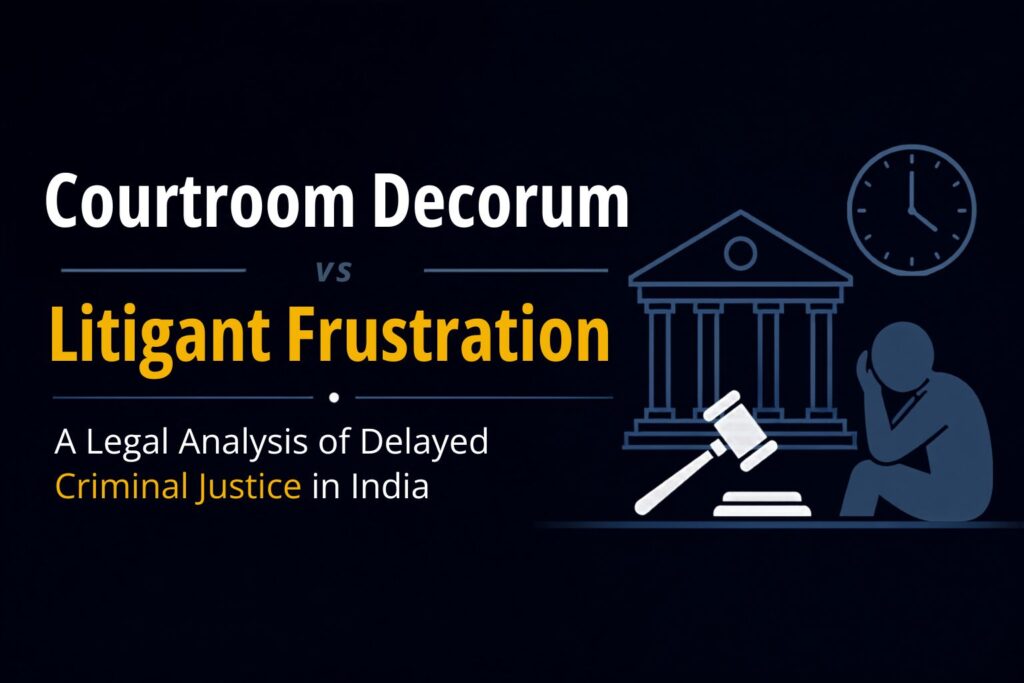
Criminal justice administration operates on the basis of two vital concepts, which include maintaining the independence of the judiciary and providing timely administration of justice. Whereas courtroom decorum ensures the sanctity and independence of the judiciary, delays in criminal proceedings result in frustrations amongst the litigants owing to the perceived unavailability of justice. In recent times, when there have been reports of a litigant disrupting proceedings in the Supreme Court of India and using abusive language against the Chief Justice of India, the crucial question has again come into focus regarding the relation between judicial dignity and popular disaffection with the justice delivery mechanism. This paper attempts to discuss whether or not delays in criminal trials are sufficient enough to account for but never justify courtroom misbehavior. In this context, the paper examines the constitutional provisions, statutory enactments, and judicial pronouncements on the right to a speedy trial, contempt of court, and freedom of expression.
Introduction
Legitimacy of any judicial system rests not just on its sound decisions but also on its promptness. Courts earn trust from people by ensuring a fair trial and prompt justice delivery. However, in the case of India, the ever-repeating issue of delay in the criminal justice system has resulted in a wide gap between the constitutional ideology and reality. Millions of cases are pending in front of courts all over India, making millions of criminals and victims wait for years, sometimes even decades.
The saying “Justice delayed is justice denied” is very significant in the case of the Indian criminal justice system. The delay in the process results in deterioration of evidence, loss of credibility of witnesses, high litigation costs, long detention of the accused, etc. This results in helplessness and frustration of people involved in the legal procedure. Though such an attitude is understandable to some extent, still it should not be taken as an excuse to disrespect courts’ dignity.
The most recent case of the Supreme Court, wherein the litigant is alleged to have assaulted the Chief Justice of India in addition to causing disruption to the process of the hearing in court, highlights how the growing dissatisfaction of the people has clashed with the authority of the institution. The reason for its immediate notoriety is the fact that the event brings to light a significant constitutional issue: can there ever come a time when judicial delay would mitigate the contempt of court?
Courtroom decorum means much more than the mere formality of a ritual. It not only safeguards judicial independence but also ensures the orderly progress of the process in court, equality before the law and promotes public confidence in the process of justice delivery. At the same time, the Constitution recognizes that access to justice does not have any meaning if it takes too long to resolve disputes.
This article suggests that courtroom misbehavior should never go unchallenged. However, punishment will do little to solve the structural problems responsible for creating disgruntled litigants. Unless delays in the Indian criminal justice system are tackled structurally, such instances can go on to pose challenges not only to judicial dignity but also public confidence.
Constitutional Foundations of Courtroom Decorum and Speedy Justice
The Constitution, while not using the phrase “courtroom behavior,” recognizes this as an integral part of the constitutional scheme that governs the conduct of the judicial institution. Articles 129 and 215 make the Supreme Court and High Courts courts of record have the power to punish for contempt. The provisions do not protect the honor of judges but that of the judicial process.
Time and again, the Supreme Court has clarified that contempt jurisdiction is institutional and not personal in nature. In Brahma Prakash Sharma v. State of Uttar Pradesh (AIR 1954 SC 10), the Supreme Court made it clear that the acts are treated to be contemptuous only if they affect the administration of justice in substance and not merely the sentiments of the Judges.
In another landmark case of Supreme Court Bar Association v. Union of India ((1998) 4 SCC 409), it was laid down by the Supreme Court that the purpose of the contempt jurisdiction is to protect the dignity and the authority of the Courts for their proper functioning.
But the constitutionality of contempt jurisdiction is not confined to just the concept of judicial dignity alone. Under Article 21, no person shall be deprived of his life or personal liberty except according to the procedure established in Article The ambit of this guarantee has been widened by the judicial pronouncements to include a fair, reasonable, and speedy process of law.
The judgment in Hussainara Khatoon v. State of Bihar (1980) 1 SCC 81 revolutionized the criminal jurisprudence of India by recognizing the right to speedy trial as an integral part of Article 21 of the Constitution. According to Justice P.N. Bhagwati, a long delay in the criminal process is in violation of constitutional guarantees, as long detention and criminal proceedings not yet completed constitute a form of punishment for the individual even before the completion of the criminal proceeding.
This decision is a watershed moment and is of great significance. The focus of the constitutional discourse was shifted from mere adherence to legality of procedure to the substantial requirement of fairness in the criminal adjudication process. Thus, delayed criminal justice in India ceased to be an administrative matter and emerged as a constitutional problem relating to fundamental rights.
Further, the Court in A.R. Antulay v. R.S. Nayak ((1992) 1 SCC 225) ruled that the right to speedy trial shall apply at all stages of criminal proceedings, namely investigation, inquiry, trial, appeal, revision and re-trial. Significantly, the court refused to lay down any hard and fast rule regarding the time limit to be adhered to.
This balance was reiterated in the decision in P. Ramachandra Rao v. State of Karnataka (2002) 4 SCC 578. In this case, the court did not support mandatory judicial deadlines for trials, stating that even though unreasonable delays are a violation of Article 21, mere lapsing of time cannot lead to an automatic termination of the proceeding since the constitutional court must decide on the question of prejudice to the accused and whether the process is tainted by such prejudice.
All these decisions prove that the Constitution aims at protecting the institution of the judiciary and the rights of the litigants alike. The former requires court decorum while the latter involves the right to a speedy trial.
Judicial Delay and the Growth of Litigant Frustration
Prolongation of criminal proceedings in India is not merely a problem of pendency statistics. It is, in fact, a violation of the constitutional commitment of providing equal justice under law. Victims have to wait for resolution, accused individuals live in stigma for years, witnesses become frustrated, and people start losing faith in the legal system.
There are a number of reasons for judicial delay. They include lack of judges, lack of proper infrastructure, frequent adjournments, lack of prosecutorial capacity, complexities of procedures, excessive workload on investigative authorities, and an increase in criminal litigation. All these problems together result in prolongation of each separate case by several years.
From a constitutional point of view, judicial delay entails certain effects that cannot be traced in legal dogmas. Litigants spend lots of money, emotional resources, and years on criminal procedure. When there are frequent adjournments and incomplete investigations, litigants feel frustration, which can sometimes express itself in the form of criticizing the court or even improper conduct in the courtroom.
However, constitutional democracy necessitates a proper demarcation between explanation and justification. While the delay in the criminal justice system of India explains the emotional state of mind of some litigants, the former cannot, in law, justify abuse to the judges and interruption of judicial business. The rule of law is premised on the orderliness of adjudication despite how emotional the dispute might be.
Thus, the constitutional problem is one of balancing the two. Preserving courtroom decorum without doing anything about judicial delay would mean addressing the symptoms of the disease without addressing the cause of the disease. On the other hand, accepting courtroom misbehavior on the basis of institutional inefficiency would be detrimental to judicial independence.
In light of the foregoing, any reform worth its salt must acknowledge that judicial dignity and swift justice are compatible constitutional ideals.
Courtroom Decorum, Contempt of Court, and the Limits of Litigant Frustration
Courtroom manners are essential to the dispensation of justice. They help in ensuring that court proceedings are orderly, fair, and devoid of any form of intimidation. The respect for the court is not meant to put judges in positions that are above reproach, but it is rather aimed at maintaining the dignity of the judicial process. Without the discipline in the court, the process of settling disputes will be severely undermined.
The Indian constitutional law on the issue of courtroom behavior is contained in Articles 129 and 215 of the Constitution and the Contempt of Courts Act, 1971. Civil contempt is defined as any willful violation of court orders. Criminal contempt is defined as any act that disrespects the court, prejudices judicial proceedings, and obstructs the administration of justice.
However, the Supreme Court has repeatedly held that criticism of judicial process is valid in a democratic country where the constitution is followed. In Indirect Tax Practitioners’ Association v. R.K. Jain, (2010) 8 SCC 281, the Supreme Court held that in good faith and for public interest purposes, questioning the judicial process will not constitute contempt.
The recent instance of Supreme Court proceedings being disrupted by the litigant due to him allegedly using abusive language to address the Chief Justice of India and disrupting the court proceedings can be seen as an example of the restrictions on the constitutionally protected freedom of speech and expression. Regardless of the grievance of the litigant, abuse and disruption of the court proceedings cannot fall within the purview of Article 19(1)(a).
However, the said incident cannot only be viewed in the ambit of contempt of court. In fact, the said situation highlights the wider problem of the criminal justice system being delayed in India, wherein litigants have been facing years of agony until their dispute gets any judicial attention at all. The question for the Constitution would be to recognize the frustration but not let it act as an excuse for contempt.
Critical Analysis: Does Judicial Delay Reduce Moral Responsibility?
One of the hardest questions posed by recent happenings is if judicial delay should affect the determination of a litigant’s misconduct from a legal point of view. Legally, the answer is no. The rule of law necessitates that a litigant’s conduct be respectful even when litigation is protracted. It will lower moral responsibility if frustration is accepted as a ground for defense.
However, the constitutional analysis demands a deeper insight. Courts should distinguish between justification in terms of law and institutionalization of reasons. A litigant who has faced years of court delays and other difficulties like financial problems will feel frustrated to a great extent. This does not justify contempt of court; however, it shows institutional problems that need to be sorted out.
The decisions of the Supreme Court relating to Article 21 show that justice delayed is a violation of the Constitution of India. In Hussainara Khatoon, A.R. Antulay, and P. Ramachandra Rao, the court observed that delay in justice violates personal liberty and dignity of the person. This implies that the delay in criminal justice in India is a constitutional issue.
It is unfortunate, however, that reactions to misbehavior in court tend to concentrate only on punishment without addressing the institutional flaws that make litigants dissatisfied. This can pose the danger of making the process of contempt one that is reactive instead of preventative. It is necessary to punish individual misconduct whenever there is obstruction of judicial processes, but it will be impossible to rebuild public confidence when the system continues to delay without remedial measures.
Selective perception of judicial accountability is another issue of importance. The litigants are supposed to behave themselves, but so should the justice delivery system in regard to its failure to deliver justice and cause emotional and financial stress to the citizens. Reciprocal accountability is key to constitutional legitimacy.
To me, the constitutional dialogue needs to transcend placing the blame on individuals or the institutions of the judiciary. The constant conflict between the court’s etiquette and the frustrations of the litigants is an indication of fundamental flaws in the Indian criminal justice system. Courts will not be able to retain their respect forever by using only their power. They also need to earn their respect by being efficient, accessible, transparent, and fast.
Comparative Perspective
The practice of comparative constitutional law reveals that there is an attempt to harmonize the two concepts of judicial prestige and freedom of expression as opposed to considering them as conflicting ideas.
In the United Kingdom, the courts have contempt jurisdiction by virtue of their office, yet criticism of judicial pronouncements is allowed so long as it does not obstruct any proceeding or hamper the administration of justice. The reputation of the courts is achieved through openness and rational decision-making instead of the extensive use of their contempt powers.
Likewise, there is a heavy focus on freedom of expression in the United States Constitution. While the judge has the power to control the court process and deal with direct contempt, the right of free speech covers even criticism of the judiciary.
India falls in the middle. Contempt jurisdiction is still constitutionally valid, but judicial pronouncements now recognize the necessity of fair critique and accountability. The dilemma is how to make sure that the contempt law safeguards the dispensation of justice but at the same time does not discourage any healthy debate about the delayed criminal justice system of India.
Recommendations
The solution to the tension between court decorum and litigants’ frustration involves changes that go beyond any disciplinary action.
First, there is a need to fill up vacant judicial positions and to give sufficient infrastructure support to trial courts. Second, stricter control over frivolous adjournments would immensely increase trial effectiveness. Third, extensive use of information technology like digital case management and electronic filing will minimize procedural delays without affecting the process of justice delivery.
Fourth, courts have to set up an efficient mechanism for assisting litigants with timely updates about the status of the cases. More often than not, it is not the delay but rather uncertainty that causes frustration. Fifth, there is a need for judicial officers to keep on encouraging reasonable communication with litigants.
Lastly, contempt of court jurisdiction should still be applied with caution. There has to be a distinction between those who use abusive language as a means of blocking justice and those whose purpose for such actions is to improve the judicial process. This way, order can be maintained without undermining democracy.
In essence, reform must involve an understanding of the fact that the delay of criminal justice not only undermines the rights of litigants but also the very legitimacy of constitutional government in India.
Conclusion
The problem of courtroom decorum versus litigant frustration is perhaps the most crucial constitutional problem of the Indian criminal justice system. The dignity of the judiciary and public confidence are essential components of the rule of law, which are simply impossible without justice being delayed. Therefore, the Constitution calls for a proper balancing of institutional authority and justice.
From the decision of Hussainara Khatoon onwards, judicial precedents have been laid down wherein the principle of a right to speedy trial has become an essential component of Article 21. At the same time, the provisions of Articles 129 and 215, along with the Contempt of Courts Act, have accepted the need for safeguarding the dignity of the courts. Both the constitutional values cannot be considered in isolation from each other.
The incident of the Supreme Court is yet another example of the fact that whereas abusive conduct in court can never be tolerated under any circumstances whatsoever, it may often reflect the dissatisfaction of the system at a much higher level, brought about due to the delay in criminal proceedings in India.
It is my view that the respect accorded to the process of maintaining court etiquette and speediness in administering justice does not in any way constitute contradictory constitutional values, but rather are complimentary aspects of the rule of law. Neither should the respect accorded to the judiciary be wholly reliant on contempt jurisdiction, nor should the impatience of litigants become the justification for undermining court processes.