This article is written by Astha Tripathi, a law student at Maharaja Sayajirao University of Baroda, Faculty of Law, with a keen interest in Environment law, Constitutional law, Jurisprudence, Administration law.
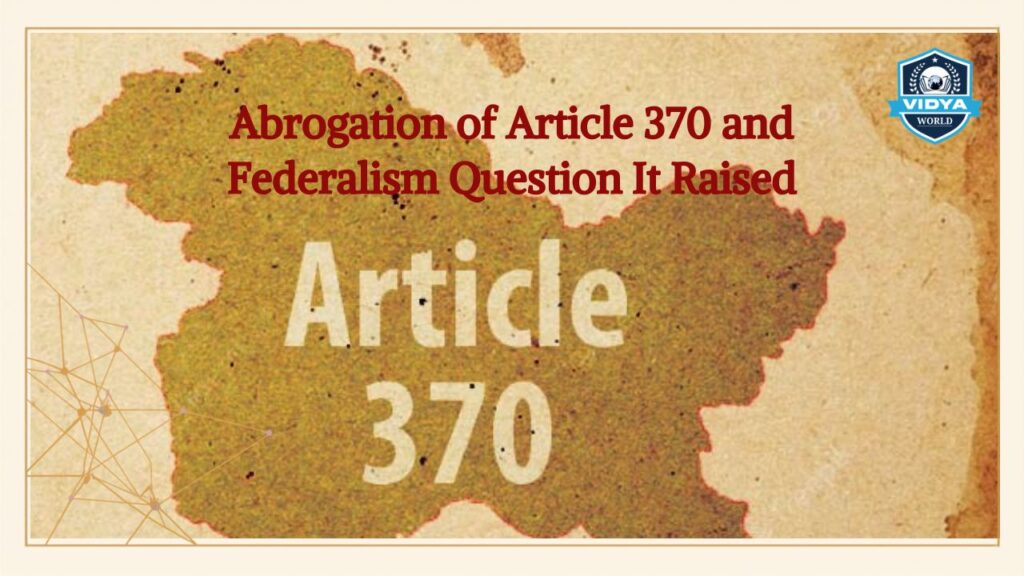
While most discussion on a five-judge Bench of the Constitution of the Indian Constitution, which unanimously validated the abrogation of Article 370 on 11 December 2023, dwelled on what the judgment said, less attention has been paid to what it did not say. Six years after abrogation and two years after the verdict, Jammu and Kashmir still do not have statehood as per the very remedy the Court mandated – and the issue of the restoration of statehood, not the repeal, is what the abrogation actually raised as a federalism issue.
What the Court Actually Said
Article 370 of the Constitution (formally the Shah Faesal petitions), the five-judge Bench comprising then Chief Justice of India D.Y. Chandrachud, S.K. Kaul, Sanjiv Khanna, B.R. Gavai, and Surya Kant delivered a 476-page judgment on the petitions challenging the abrogation of the article in 2019. The Court held that
Article 370 was a temporary provision that lost its permanence when J&K’s Constituent Assembly was dissolved in 1957; that the President could exercise his powers under Article 370(1)(d) without the concurrence of the state government when President’s Rule was in force in the state as the Union’s concurrence was sufficient; and that the Constitution Order 272 that applied the entire Indian Constitution to J&K was valid. It declined to pronounce on the validity of dividing the state into two Union Territories, considering the Ladakh issue as one Parliament could revisit while holding that there was no malice in the abrogation process.
Two of the orders contained in this judgment, however, are more pertinent to the larger federalism questions. First, the Court took note of the government’s contention in the petition which was also observed to have been accepted by the petitions that the Union Territory status of J&K was meant to be temporary as well and directed that elections to the J&K Assembly should be held by 30 September 2024. Second, the Court mandated the restoration of statehood to J&K, albeit without giving any timeframe for the restoration, as contrasted to a specific date for the elections.
The Elections Took Place. The Statehood Has Not Taken Place.
The elections to the J&K Assembly were held in September-October 2024, resulting in Omar Abdullah’s National Conference forming the government for the first time since 2019. They were the first Kashmir elections in over a decade and, importantly, not a single polling station had to be re-polling or, more accurately, “re-secured” due to security concerns. They marked a significant electoral turnout across the Kashmir Valley, Jammu, and Ladakh, where Omar Abdullah’s NC, Geeta Bhullar’s Jammu Union Party, and Shri Prakash’s Ladakh Buddhist Council were elected in a relatively secure environment.
At the same time, Omar Abdullah himself has repeatedly pointed to the fact that while the Union government fulfilled its commitment to hold elections, it has not delivered on its promise to restore statehood to J&K, which has been reiterated by the Union Home Minister Amit Shah at a public meeting in March 2025. Deputy Chief Minister Surinder Choudhary noted in July 2026 that the Centre had kept its promises “except for one”, and the NC staged a protest outside of the Jantar Mantar on 20 July 2026. The Centre has not commented publicly on the call for statehood restoration, but a petition for the restoration of statehood to J&K was filed in the Supreme Court in August 2026, seeking a time-bound restoration of statehood to J&K. It relied on the Court’s own orders mandating restoration and argued that the Centre’s indefinite postponement of the restoration “gravely affects the rights of the inhabitants of Jammu and Kashmir and also violates the basic structure of federalism.” The request was granted by the Chief Justice’s Bench to be listed for hearing.
Why This is Federalism Question, Not Merely a J&K One
While the abrogation was defended as an act of “integration”, integration achieved by downgrading J&K to a Union Territory was inherently contradictory. It was an action accomplishing what was presented as its opposite: whereas the objective of integrating J&K into the Indian Republic was universally acknowledged, the means of doing so by revoking its statehood made the abrogation simultaneously an act of separation. The situation in which an elected government in J&K finds itself in with significantly reduced legislative and administrative powers as compared to any other state in the Union is an open question on the permanence of such an integration, which lasts already six years after an initially merely provisional downgrade. It is a question of whether the integration is truly complete if it is entirely reversible at the Centre’s will and whether the federalism principles enshrined in the Indian Constitution, particularly in the S.R. Bommai v. Union of India (1994) verdict, are truly “basic structure” that cannot be dismantled by the Union at its discretion.
The abrogation of Article 370 and the subsequent federalism questions it raises go beyond merely a Jammu and Kashmir issue. Even as they are directly pertinent to the residents of the state who find themselves in a uniquely uncertain position as residents of a Union Territory that is meant to exist only temporarily, the Centre’s ability to indefinitely postpone the restoration of statehood to J&K raises questions about the Union’s commitment to federalism principles. It is a question the Supreme Court itself will have to answer when the aforementioned petition for the restoration of statehood to J&K is heard unless the government chooses to rescind the abrogation, which it has not indicated any willingness to do.
Until then, the abrogation of Article 370 will remain a uniquely Jammu and Kashmir issue, one which has already cost the residents of the state dearly.
Conclusion
The litigation over the abrogation is concluded but the constitutional arithmetic around it is far from complete. A ruling that set a firm date for elections while leaving the question of statehood deliberately open was not a resolution of the tension between the Union’s will and the guarantee of federal integrity, but merely postponed the reckoning with it, with costs that are proving to be borne disproportionately by Jammu and Kashmir. Six years into the transition, the state’s elected representatives have powers unlike those of any other state in the Indian Union, and the very court that mandated this ‘temporary’ arrangement has not specified when, if ever, this anomalous situation is meant to conclude. The longer it persists, the more does its institutionalised indeterminacy between fiction and reality erode the very principle of federalism that the basic structure doctrine was supposed to safeguard. If there is to be any meaning to the basic structure other than an ideological fig leaf for majoritarianism, then even a government that has successfully defended its position in the court of public opinion and law must not be permitted to annul inconvenient constitutional provisions unilaterally. The 2026 petition before the Supreme Court is a test not only of the fate of Jammu and Kashmir’s statehood, but of the very concept of federalism as a constitutional value in India.