This article is written by Arya Priya, a law student at ICFAI University, Dehradun, with a keen interest in Intellectual Property Rights (IPR) laws.
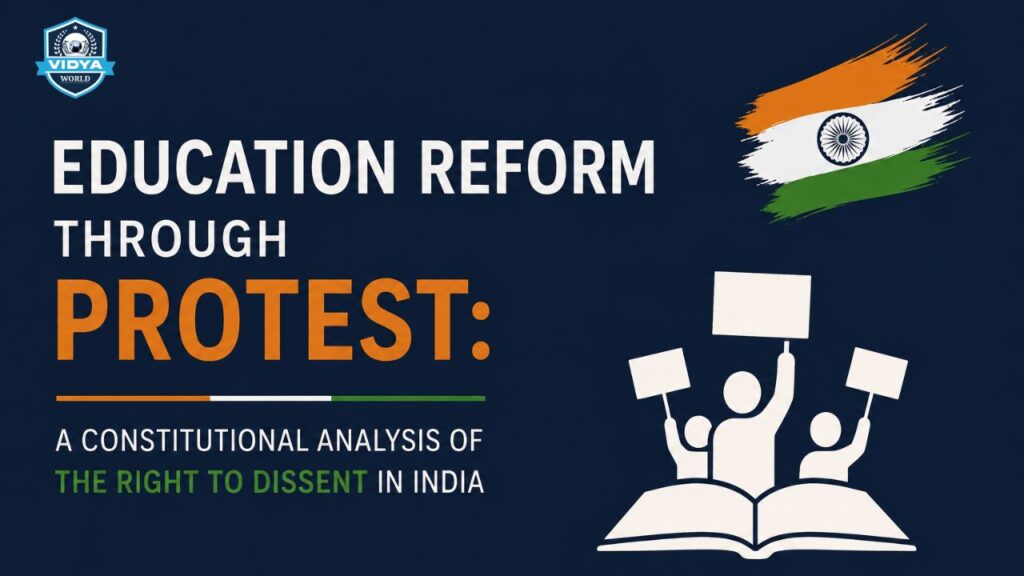
In many cases, the Indian education sector has seen reforms based on public discourse, protests, students’ voices, and calls for accountability. Protest is used as one of the ways of participation in the process of democratic dialogue in cases where official methods of representation turn out to be ineffective in dealing with problems related to access, affordability, cheating during exams, autonomy, curriculum, and inequalities. The topic of this research paper will be the legality of the use of protests as a means of education reform in India. Although there is no fundamental right to protest enshrined in the Constitution of India, the right to peaceful dissent is mostly derived from freedom of speech and expression and the right to assemble peacefully under Articles 19(1)(a) and 19(1)(b). Analyzing the Constitution and case laws, namely Kameshwar Prasad v. State of Bihar, Himat Lal K. Shah v. Commissioner of Police, S. Rangarajan v. P. Jagjivan Ram, Shreya Singhal v. Union of India, Ramlila Maidan Incident, In re, Anuradha Bhasin v. Union of India, and Amit Sahni v. Commissioner of Police, this paper will explore the opportunities and limitations of protest as a means of educational reform. Nevertheless, constitutional protection of protest does not mean that one will automatically win over public policy. An equitable approach based on proportionality, institutional dialogue, accountability, and appreciation of competing rights is thus necessary.
Introduction
Education is not just about classrooms, examinations, and qualifications. It is an institution that defines whose knowledge is relevant, what kinds of opportunities there are, and who will take part in public life in the future. In India, discussions on education can be based on such themes as accessibility, cost-effectiveness, integrity of examinations, language, curriculum, institutional independence, and equality. When conventional institutional means do not resolve all the issues, students, teachers, educators, and civic organizations can appeal to protests. In this connection, it is important to consider constitutional aspects of the link between education reform and the right to dissent in India.
The process of protesting has been used for centuries as a way of demonstrating dissatisfaction with institutional failures. Educational reforms were often the result of protests carried out by people, students, teachers, and even representatives of marginalized communities. The constitutional relevance of these movements is due to the fact that dissent is not only a way of expressing dissatisfaction.
While the constitutional right to dissent in India is not stated explicitly as a standalone fundamental right in the Constitution, it arises out of the constitutional protection provided by Article 19(1)(a) and 19(1)(b), which guarantee freedom of speech and expression, and the freedom to assemble peaceably and without arms. Restrictions on these two rights may arise under Article 19(2) and 19(3).
The issue here is thus not about whether protests may be regulated but whether the regulation itself is reasonable and is being used as a tool for suppressing critical comments or not. In relation to education, this question assumes importance because when education is constitutionally linked with dignity, equality, opportunity, and citizenship, demands for reform cannot always be regarded as purely administrative grievances. It is the contention of this article that protesting for educational reform is a legitimate mode of participating in constitutionalism.
Constitutional Foundations of Right to Dissent and Education
There is no explicit use of the word “dissent” in Part III of the Constitution, although it can be found in the nature of constitutional democracy. Freedom of speech and expression is guaranteed under Article 19(1)(a), whereas freedom of assembly and without arms is guaranteed under Article 19(1)(b). Both the articles become the cornerstone of demonstrations, public campaigns, marches, etc.
Kameshwar Prasad v. State of Bihar AIR 1962 SC 1166 is a leading case concerning a blanket ban on demonstrations by government servants. It became evident from the decision of the Court that peaceful demonstrations can be considered as falling within the purview of Articles 19(1)(a) and 19(1)(b) although demonstration is distinguished from the right to strike which is not a fundamental right under the Indian Constitution.
In Himat Lal K. Shah v. Commissioner (1973) 1 SCC 227 of Police, Ahmedabad, the Supreme Court ruled that there could be regulation of public meetings by the State but not any restriction that destroys the right itself. Regulation and prohibition are constitutionally separate. This differentiation is vital in appreciating the right to dissent in India: The State may regulate when, where, and how to protest for reasonable reasons, but regulation shall never become an excuse for repression in disguise.
The constitutional importance of education has evolved a lot. Article 21A makes free and compulsory education a fundamental right for all children in the age group of 6 to 14 years. Even prior to the inclusion of this provision, the Supreme Court in Mohini Jain v. State of Karnataka (1992) 3 SCC 666 linked education with dignity and Article 21 of the Constitution. The link between education and Article 21 was further elaborated by the Supreme Court in Unni Krishnan, J.P. v. State of Andhra Pradesh (1993) 1 SCC 645.
Nevertheless, education goes beyond admission into schools. Articles 14, 15, 21, 21A, 29, and 30, along with the Directive Principles of State Policy, make it very clear that educational policy is intimately associated with equality, dignity, cultural rights, and social justice. When students oppose discriminatory policies, unapproachable institutions, examination malpractice, or arbitrary administration, such students may thus address themselves to matters having a clear constitutional dimension.
Protest as a Democratic Instrument of Education Reform
Education systems are also highly centralized and bureaucratized. A student dissatisfied with an unjust examination system or a teacher calling for restructuring reforms may lack sufficient access to decision-making authorities. Protest becomes a public way of making demands in the event formal administrative mechanisms are not effective enough. In this context, the right to dissent in India serves the purpose of democratic correction.
An example of contemporary educator and reformer Sonam Wangchuk can serve as an appropriate illustration of the link between education innovations and public activism. His actions within the Students’ Educational and Cultural Movement of Ladakh were connected with efforts to make education more sensitive to local circumstances and students’ needs. The significance of such public initiatives lies in the fact that education reform is never separated from issues of administration, representation, regional requirements, and public accountability.
The relevance of protests comes neither from the accuracy of all demands made by protestors. Democracy does not provide for the accuracy of dissent, but rather the ability to voice dissent. Education policy consists of various stakeholders with opposing views, limited resources, differences in opinion on pedagogy, and complications inherent to administration. Nonetheless, the State cannot ignore dissent simply due to its discomfort or embarrassment.
The Supreme Court in S. Rangarajan v. P. Jagjivan Ram (1989) 2 SCC 574 made it clear that free speech cannot be restricted just because the speech itself will invite an adverse reaction. The larger point about the principle of constitutionality is that without it, fundamental rights will become very vulnerable when they can be stifled by the very fear of opposition.
Likewise, the Supreme Court in Shreya Singhal v. Union of India (2015) 5 SCC 1, while declaring Section 66A of the Information Technology Act, 2000, unconstitutional, highlighted the difference between discussion, advocacy, and incitement. This is especially pertinent for modern-day student protests using social media. Modern protests and campaigns are organized online by students and teachers alike. Criticism of universities, exam boards, ministries, and education policies should not be equated with any wrongdoing unless there is an infringement of legally acceptable limits set down by the Constitution.
The State’s Power to Regulate Protest
There are no absolute fundamental rights. Article 19(2) and Article 19(3) provide for reasonable restrictions on the exercise of rights to freedom of speech and assembly within certain constitutionally defined limits. The concept of public order becomes important in this regard, as it may refer to large-scale demonstrations that occupy public places.
The decision of the Supreme Court in the case of Ramlila Maidan Incident, In re, (2012) 5 SCC 1, focused on the actions of the police regarding a demonstration in Ramlila Maidan, Delhi. The judgment underscores not only the right of peaceful assembly but also the duty of the state to uphold public order. The ruling strengthens the principle that any state actions with respect to the protest should be reasonable and proportional to valid concerns.
The second dimension of restriction was demonstrated by the decision of the Supreme Court in the case of Amit Sahni v. Commissioner of Police (2020) 10 SCC 439, linked to the Shaheen Bagh protests. Public highways and public places could not be occupied in an indefinite manner in such a way that there is interference with the rights of other people.
This issue is relevant to the dissent of Indians but raises some difficult questions as well. When the protests have to be done in places where no problems arise and where no one takes any notice of them, the value of these protests for democracy will be severely hampered. After all, a protest by nature is meant to get noticed. However, the blockade may hurt both the movement and the rights of others.
Hence, a solution to the constitutional dilemma cannot be an either/or one of absolute occupation or absolute prohibition. In such a case, the path to follow should be that of regulation, while permitting protests, ensuring proper spaces and order, and setting only such restrictions as are really necessary, while making sure at the same time that the protestors are respecting others’ rights.
Universities as Spaces of Constitutional Dialogue
Universities are unique entities within a democracy because they are more than just places that award degrees; they are places where traditional notions are questioned. A university that allows academic freedom but does not allow any dissent from its own policy will be drawing a false line between the two types of freedoms.
Thus, the dissenting rights in India need to be given sufficient recognition within educational institutions. Dissent from the increases in fees, discrimination, academic policies, administrative actions, and government actions affecting education needs to be allowed. However, this is not to say that there is a right to resort to violence, threats, damage to property, and coercion against other students.
The most crucial constitutional issue emerges when the provisions of the discipline code are expressed in vague terms like “indiscipline,” “anti-institutional behavior,” or anything that might harm the image of the institution.
One can apply the principle from the case of Shreya Singhal to this issue: vague limitations might have a chilling effect because people would begin to self-censor themselves for fear of facing punishments. In such a way, educational institutions need to differentiate between dissent and disruption, critique and harassment, as well as peaceful gatherings and violence. Without differentiation, there will be an existence of dissent as a legal right, but it’s practically non-effective in India.
Critical Analysis: Can Protest Actually Reform Education?
The presumption that any protests result in reformative progress needs to be examined. While public mobilization can attract attention to underrepresented problems, it does not mean that the information regarding those problems will lead to educational policy. There might be certain demonstrations based on incomplete information, political agitation, and opposition to necessary reforms.
The value of protests is in compelling institutions to hear, respond, reason, and reconsider. In a constitutional democracy, the process of shaping public policies ought not to be unilateral, with experts deciding and citizens passively complying. On the other hand, neither can policymaking rest solely on the most vocal group in the streets. Education policymaking needs proof, consultation, expertise, and even consideration of stakeholders who do not have the same capacity to protest.
It is here that there arises the distinction between the right to be heard and the right to win. The Indian right to dissent is a right to air dissent; it is not a right to veto government decisions. The government should retain its ability to govern, but its legitimacy is enhanced by its ability to govern by providing transparency and reasoning and by consulting.
There is an inherent danger of selective treatment of protests. Governments and institutions may see their own demonstrations as democratic participation while viewing the opposing demonstrations as disruption. The constitutional right to protest cannot turn out to be conditional to the sympathy of the government. The legality of the protest must be evaluated through actions, not ideas.
Likewise, criminal laws and preventive restrictions must not be the common answer to peaceful dissents within educational institutions. Restrictions may have a short-term benefit in providing administrative control but may undermine the trust of the institution. Frustration may rise among the students if they believe that their criticism may bring punishment rather than discussion. Thus, the right to dissent in India is necessary not only for personal freedom but also for democracy.
Towards a Rights-Based Framework for Educational Protest
India needs an effective rights-based approach for the management of educational protest. Firstly, there should be institutional dialogue. The universities, examination boards, educational regulatory bodies, and the government should ensure grievance redressal and consultation processes. Dissent often becomes stronger when people perceive that their complaints through normal channels are futile.
Secondly, any form of restriction of peaceful dissent should conform to the constitutional standards of legality, necessity, and proportionality. In Anuradha Bhasin v. Union of India (2020) 3 SCC 637, while the issue involved restrictions imposed by the Government of Jammu and Kashmir, the Supreme Court reaffirmed the need for proportionality and review when state action interferes with fundamental rights. The general message from the constitutional case is that the restrictions cannot continue just because of administrative convenience.
Third, educational institutions must have proper protest policies. Students must know where they can assemble peacefully, what is their procedure, and what kinds of behavior may be punished. It is important that the permission procedures cannot be made so hard that the right to dissent in India remains merely theoretical.
Fourth, there should be a distinction between peaceful protesters and those people who commit unlawful actions on their own accord. Collective punishment violates constitutional justice. Individual responsibility for one’s actions must be a rule.
Finally, protesting can be viewed as an element of civic education itself. In a democracy, constitutional principles are not taught from books alone. Democracy is learned by practicing disagreement, negotiation, participation, and accountability. Peaceful dissenting, accordingly, can be seen as a learning process itself.
Conclusion
The link between reforms in education and protests shows us an important feature of constitutional democracy-improvements take place not only internally but also externally. The Indian Constitution creates a regime in which the people are active participants of the process rather than passive recipients of government policies. Dissent in India becomes an important component of the Indian constitution.
Cases from Kameshwar Prasad to Himat Lal, from Ramlila Maidan to Shreya Singhal, from Anuradha Bhasin to Amit Sahni show us that the Indian constitutional jurisprudence is trying to strike a balance between liberty and maintenance of public order. This balance is neither absolute liberty nor unlimited regulation by the state.
In the context of education, this needs to be done with a special degree of caution. The students and teachers are not outsiders in the governance of education. Their protests might help identify deficiencies that go unnoticed by the official system. On the other hand, the necessary reforms cannot be achieved just through protest but through evidence, conversation, institutional accountability, and proper policies.
In the end, the right to dissent in India has to be seen as a constitutional tool for correcting democracy. Protest itself does not undermine democracy just because it confronts authority. If it is peaceful, responsible, and protected by the Constitution, then it will make the institutions confront uncomfortable truths and change their way of doing things. Hence, education reform through protest is not simply a struggle between citizens and the state. At its best, it is a model of constitutional democracy in action.