The fast-paced digitalization of governance in India has redefined the relationship between the citizen and the State. Digital identity has become essential for accessing public services, ranging from welfare distribution and banking to education and taxation. The Aadhaar system, introduced under the Aadhaar (Targeted Delivery of Financial and Other Subsidies, Benefits and Services) Act, 2016, is central to this transformation. Aadhaar was conceived as revolutionary tool to bring in transparency, eliminate duplication and deliver services in a streamlined manner. But while the system has undoubtedly simplified administrative processes, it has also raised serious concerns about exclusion, privacy and technical failures.
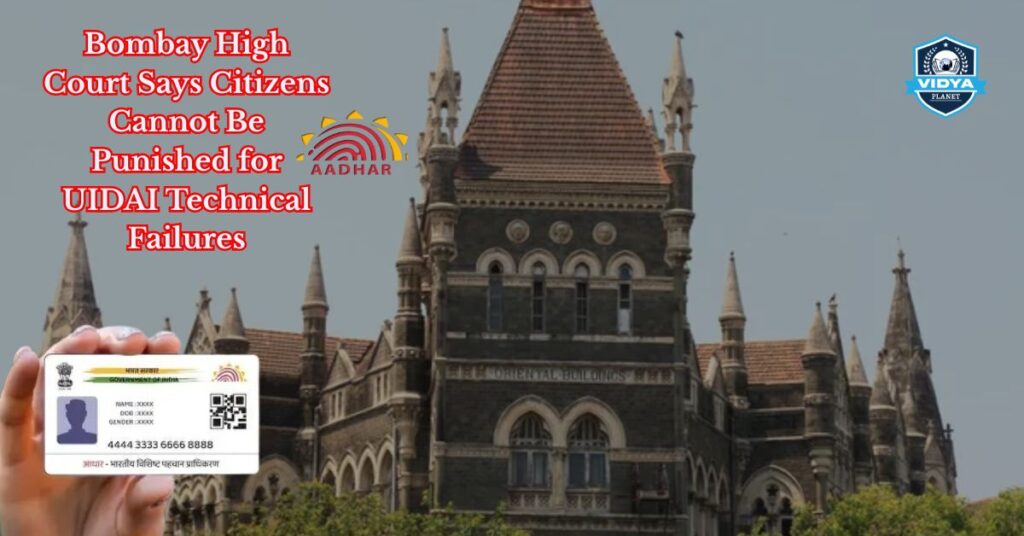
These concerns have come into sharp focus again on a recent observation of Bombay High Court. The Court severely criticised the Unique Identification Authority of India (UIDAI) for causing citizens to suffer due to technical irregularities and biometric mismatches in Aadhaar records. The Court stressed that ordinary citizens must not bear the consequences of technological defects beyond their control. The significance of this judicial intervention is that it reaffirms the constitutional principle that administrative efficiency cannot be achieved at the cost of human dignity and fundamental rights.
The case was the result of the plight of twin brothers whose Aadhaar authentication process failed reportedly due to biometric similarities and mismatches. Their Aadhaar records were deactivated, causing them serious difficulties in accessing basic services. The Bombay High Court said the citizens should not be put to “unnecessary hardships” merely because the system is not perfect from the technology point of view. The Court asked UIDAI to adopt a humane and pragmatic approach in dealing with such cases.
This is not just a decision on procedures for correction of Aadhaar. It’s part of a larger constitutional conversation about digital governance, procedural fairness, and the limits of technological reliance in a welfare state.
Aadhaar and the Legal Framework
The Aadhaar programme was started in 2009 as an executive action and was subsequently given statutory backing through the Aadhaar Act, 2016. The legislation’s preamble says the aim of the legislation is to provide targeted delivery of subsidies, benefits and services by assigning unique identity numbers to residents of India.
3 of the Aadhaar Act, every resident has the right to obtain an Aadhaar number by submitting demographic and biometric information. Biometric information includes fingerprints, iris scans, and photos. The government is empowered under Section 7 to mandate Aadhaar authentication for receipt of subsidies and welfare benefits funded out of the Consolidated Fund of India.
As per Section 11 of the Act, it is the Unique Identification Authority of India (UIDAI) which is tasked with issuing Aadhaar numbers and maintaining the Central Identities Data Repository (CIDR). The authority is also responsible for the security and accuracy of the data.
But the practical implementation of Aadhaar has exposed major flaws in biometric authentication. Biometric technology isn’t infallible. Age, illness, manual labour, injury and even the genetic similarities between twins can all cause authentication failures. Such failures can result in exclusion from welfare schemes, denial of banking services and disruption of everyday life.
The observations of the Bombay High Court point to an important issue. By making Aadhaar central to public services, the State assumes the role of ensuring that citizens are not unduly punished on account of system failures.
The Bombay High Court’s Observations
The Bombay High Court has expressed serious concern over the rigid and insensitive approach adopted by the UIDAI in dealing with biometric mismatches in the current case. The Court reportedly said that technology is meant to help human beings and not to create hindrances in their lives. It said those with genuine complaints regarding Aadhaar deactivation or failure of authentication should be treated with empathy and not with suspicion when they approach authorities.
The Court criticised the UIDAI for not having put in place an effective grievance redressal mechanism to resolve such technical problems on time. “Citizens cannot be rendered helpless because of the failure of machines or software systems to recognise their biometrics,” the judges said.
One of the most significant features of the decision is the Court’s emphasis on proportionality and fairness. The judiciary acknowledged that Aadhaar has become indispensable in modern government. As a result, any systemic error can have disastrous effects for people, particularly those from economically disadvantaged backgrounds who rely largely on government support programs.
The Court allegedly urged UIDAI to create clearer standards and take a more humanitarian approach when dealing with biometric discrepancies and deactivation concerns. Such views underscore the judiciary’s position as a defender of constitutional rights in the age of digital government.
Constitutional Dimensions of Aadhaar
The Aadhaar debate in India has always raised substantial constitutional issues. At the heart of these issues is Article 21 of the Constitution, which protects the right to life and personal liberty. The Supreme Court has often interpreted Article 21 broadly to encompass the freedom to live with dignity.
When biometric errors deny people access to food, pensions, healthcare, or education, the problem goes beyond mere technical inconvenience. It has a direct influence on the constitutional guarantee of dignity and livelihood.
Right to Privacy
The landmark ruling in Justice K.S. Puttaswamy v. Union of India, 2017 substantially transformed India’s constitutional landscape in terms of privacy rights. A nine-judge bench of the Supreme Court unanimously recognized privacy as a basic right under Article 21.
The Court determined that informational privacy and bodily autonomy are fundamental to human dignity. Because Aadhaar collects and stores biometric data, there are legitimate worries about abuse, spying, and data security.
In K.S. Puttaswamy (Aadhaar-5J.) v. Union of India, 2018, the Supreme Court affirmed the constitutionality of the Aadhaar Act while imposing significant constraints. The Court affirmed Aadhaar for assistance schemes under Section 7, but rejected forced connection for private services like mobile SIM cards and bank accounts.
Importantly, the Supreme Court accepted the potential of exclusion resulting from authentication errors. The Court stated that no worthy applicant should be denied benefits owing to a mismatch in biometrics or technological difficulties. This principle is directly consistent with the Bombay High Court’s recent observations.
Biometric Errors and Exclusion
Biometric authentication is based on probabilistic technologies, rather than perfect assurance. Even advanced biometric systems are prone to false negatives and recognition errors. In India, where millions of people work in manual labor, fingerprints frequently wear out, causing authenticity issues.
Several reports over the years have revealed incidents in which elderly, laborers, and disabled people were refused ration handouts because fingerprint scanners failed to verify their identities. Such exclusion undermines the welfare goals that Aadhaar was intended to achieve.
The Bombay High Court correctly recognized that citizens cannot be forced to suffer indefinitely due to faults in technical infrastructure. When the state enforces digital identity systems, it must also provide accessible alternative verification techniques.
This principle reflects the doctrine of reasonable accommodation, which requires institutions to adapt systems to human realities rather than forcing individuals to conform rigidly to technological processes.
Landmark Judgments on Aadhaar and Welfare Rights
Justice K.S. Puttaswamy vs. Union of India (2017)
This historic privacy decision established that privacy is a basic right guaranteed by Part III of the Constitution. The Court concluded that dignity, autonomy, and informational self-determination are essential components of liberty.
The decision established the constitutional framework for assessing the legality and proportionality of Aadhaar-based data collecting.
K.S. Puttaswamy’s (Aadhaar) judgment (2018)
In its 2018 Aadhaar decision, the Supreme Court upheld the plan while acknowledging the risks of exclusion and surveillance. The Court underlined that Aadhaar authentication should not be used to deny benefits to legitimate recipients.
The Court noted that technology should be utilized to empower citizens rather than to exclude them.
Swaraj Abhiyan vs. Union of India, 2015
Although not directly related to Aadhaar, this lawsuit highlighted the state’s constitutional commitment to provide food security and protect vulnerable communities during times of crisis. The decision upholds the notion that welfare benefits cannot be withheld arbitrarily.
When biometric deficiencies prevent access to social benefits, they may breach these constitutional requirements.
Administrative Accountability and Procedural Fairness
One of the primary issues raised at UIDAI is the lack of effective grievance redressal channels. Citizens typically face bureaucratic barriers while attempting to amend Aadhaar details or revive deactivated accounts.
The Bombay High Court’s findings highlight the significance of administrative accountability in digital governance. Technology cannot be used as an excuse to dodge justice or duty.
Natural justice principles necessitate that individuals affected by adverse administrative proceedings be given a fair opportunity to plead their case. If Aadhaar authentication fails, authorities must provide alternate methods of verification rather than simply deny services.
This approach is in in accordance with Article 14 of the Constitution, which guarantees equality before the law and prevents arbitrary state action. Arbitrary deactivation of Aadhaar or reluctance to address genuine biometric concerns may constitute uneven and unreasonable treatment.
The Need for a Humane Approach
The judiciary’s emphasis on a “humane approach” is particularly relevant in the context of welfare management. Digital governance must remain citizen-centered. The goal of technology is to make governance easier, not to add new barriers for vulnerable communities.
Many persons affected by biometric mismatches come from marginalized communities with inadequate digital skills and financial means. For such people, frequent visits to Aadhaar centers, document verification procedures, and bureaucratic delays can be extremely unpleasant.
As a result, the state must implement inclusive systems that understand technological constraints. Alternative identification methods, manual verification procedures, and timely grievance resolution systems are critical for maintaining fairness.
The Supreme Court has consistently emphasized that constitutional administration should be motivated by compassion and substantive justice rather than rigid technical system.
Digital India and the Future of Governance
India’s Digital India plan seeks to transform governance through technology integration. Aadhaar has become a cornerstone of this transition. However, the effectiveness of digital governance is ultimately dependent on public trust.
If citizens regard digital systems as inaccessible, arbitrary, or coercive, their trust in governance institutions may decrease. As a result, technological innovation must always be balanced with constitutional protections.
The Bombay High Court’s involvement serves as a timely reminder that technology is merely a tool. Human rights, dignity, and constitutional ideals must be central to governing structures.
The decision also highlights the courts’ expanding involvement in overseeing algorithmic and digital decision-making systems. As governments rely more on automated systems, judicial oversight becomes critical to preventing exclusion, discrimination, and procedural injustice.
Conclusion
The Bombay High Court’s strict judgments against UIDAI are a critical turning point in India’s constitutional and technological history. The Court reiterated a basic principle of democratic government when it said that persons should not be burdened as a result of biometric inaccuracies in Aadhaar. Administrative systems exist to serve people, not punish them.
The Aadhaar initiative has surely helped to improve service delivery and reduce duplication in benefit packages. However, its execution must acknowledge the reality of technical fallibility and human frailty. Biometric mismatches, data inconsistencies, and authentication failures are more than just technological issues; they can have a direct impact on access to food, healthcare, education, and employment.
Human dignity is important to Indian administration, according to its constitution. Articles 14 and 21 compel the State to be fair, reasonable, and compassionate. Justice K.S. Puttaswamy’s landmark decision emphasized the importance of digital governance operating within constitutional constraints.
The Bombay High Court’s appeal for a humanitarian and citizen-friendly approach is thus both timely and required. UIDAI and other state governments must ensure that no one is denied important services due to technological flaws. Effective grievance redressal processes, alternate verification methods, and increased administrative sensitivity are critical to attaining this goal.
In a constitutional democracy, technology cannot replace humanity. The genuine measure of development is not only digital advancement, but also the ability of governing institutions to defend each citizen’s rights, dignity, and welfare.