This article is written by Navya Tiwari, a law student at ICFAI University, Dehradun, with a keen interest in Corporate Governance and Alternative Dispute Resolution (ADR).
The Constitutional Framework
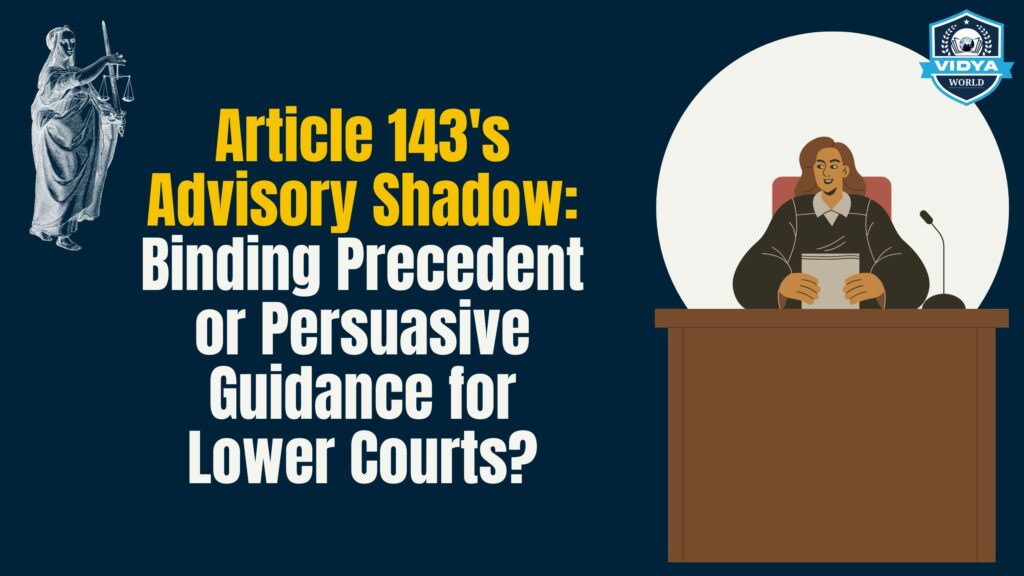
The President of India has the power to ask the Supreme Court for its opinion on any matter of law or fact. This power is given to the President by Article 143 of the Constitution of India.
The Article 143 has two parts:
- The first part, Article 143(1) says the President can ask the Supreme Court for its opinion on a question and the Court can choose to give its opinion. This means the Supreme Court has the freedom to decide whether or not to give an opinion.
- The second part, Article 143(2) says the President can ask the Supreme Court for its opinion on a kind of dispute and the Court must give its opinion.
The title of Article 143 is “Power of President to Consult Supreme Court”. The word “consult” is important here because it means the President does not have to do what the Supreme Court says.
We should also look at Article 142 which’s about making sure the Supreme Court’s decisions are followed. It says that only the Supreme Courts final decisions can be enforced. Since an opinion is not a decision it cannot be enforced. The Constitution of India and the Supreme Court and the President of India all have roles to play here.
The Legal Position: Non-Binding in Theory
Unlike parts of the Constitution where it says “judgment” Article 143 only talks about the Court giving its “opinion”. Article 145(3) of the Constitution mentions “judgments” and “reports and opinions under Article 143” separately which means the Constitution itself sees them as different things.
In the Keshav Singh case Chief Justice Gajendragadkar said that an advisory opinion is not a real decision and does not affect anyone. Justice J.M. Reddy in the Kesavananda Bharati case said that while an advisory opinion is very respected it is not final when a real issue comes up.
The Arguments for Binding Effect
Some important judges think that the Supreme Court’s decisions should be followed by all courts in India. In the Special Courts Bill case in 1978 Justice Y.V. Chandrachud said that even if the Supreme Court can change its mind about something it already decided other courts in India should still follow what the Supreme Court said, even if it was just an advisory opinion under Article 143(1) of the Constitution. He said that other courts in India ought to be bound by what the Supreme Court says.
However, Justice Y.V. Chandrachud also said that this issue might need to be looked at closely in the future. He also mentioned that someone else a writer disagreed with him and said that the Supreme Courts advisory opinions are very influential but they do not have the force of law as stated in Article 141 the Supreme Court’s decisions are not law in this case.
The Special Courts Bill case is an example of this the Supreme Court’s decision in this case is still followed by other courts in India the Supreme Court’s decisions have a big impact on the law in India.
The Berubari Union Case: A Binding Advisory Opinion
The Berubari Union case from 1960 is an example to look at. The President asked for advice on how to implement an agreement between India and Pakistan about the Berubari Union territory. On in the Calcutta High Court lawyers said that the Supreme Court’s decision in the Berubari Union case was not final because it was just an opinion.
The Calcutta High Court did not agree with this. They said the decision was law because of Article 141. It had to be followed even though the Supreme Court was only giving an opinion. The Court said if the Supreme Court was not making the law clear when giving its opinion then it was not doing its job. They also said that “declares” means to make something clear and that is what the Supreme Court did.
It is worth noting that this decision was very convincing. The Union Government could not put the India-Pakistan agreement into action without following what the Supreme Court said. So, the Parliament passed the Constitution Ninth Amendment Act in 1960 to give the territory to Pakistan like the Supreme Court suggested in its opinion about the Berubari Union case.
The 2025 Presidential Reference and Its Implications
This reference happened a month after the Supreme Court made a decision in the State of Tamil Nadu v. Governor of Tamil Nadu case.
The Constitution Bench gave its opinion on this matter. It said that setting timelines and “deemed assent” is not allowed by the Constitution. The Court also said that it was only giving its opinion and not changing the earlier decision. Chief Justice B.R. Gavai said “We will only give our view on the questions of law in the Reference and not make a judgment in the Tamil Nadu case”. This created a situation. The exercise was meant to clear up confusion. It made things more confusing. The Tamil Nadu judgment from April 2025 is still valid under Article 141. Even though the November 2025 advisory opinion said that its main points are not allowed by the Constitution.
The five-judge bench said that the Court needs to give an opinion on the functions of the Governor and the President under Article 200 and Article 201. Because the law on this matter cannot be left unclear. The Governors powers under Articles 200 and 201 of the Constitution need to be clear so the Court should give an opinion on this matter. The Governors powers are important. The Court should make sure that the law, on this matter is clear.
Practical Reality: A Doctrine of Functional Precedent
Despite the uncertainty it is clear that advisory opinions are treated as binding precedent, in practice. The Court does not usually review its judgments when answering references. However, it does make adjustments to them. The Court expects stakeholders to follow its opinions. It keeps the power to change or revise them later.
Examples of functional equivalence:
- The Third Judges Case is another example. This was an opinion that changed the Collegium. The Collegium used to have the Chief Justice and two judges. The Third Judges Case changed this. Now the Collegium has the Chief Justice and four judges. The Third Judges Case has been followed for a time. It has been over two decades. The Collegium is still made up of the Chief Justice and four judges.
- The Presidential Poll Reference is also important. All the judges agreed on this. The Government was able to fill the vacancy when the Presidents term ended. The Presidential Poll Reference showed that the Government could still do its job. It could fill vacancies when there were problems, with the Legislative Assembly of Gujarat.
My Theory: The Paradox of Unsettled Precedent
They are not clearly settled in doctrine. Are practically followed. The 2025 Presidential Reference case shows this clearly:
- Doctrinal Ambiguity: The Constitution Bench in the Governors case used some parts of Justice Chandrachud’s opinion in Special Courts Bill to say that all courts should follow an opinion. They left out the rest of his points, which showed there were different views and did not clearly say if it was binding or not.
- The Overruling Problem: The Court used Article 143 to overrule the Tamil Nadu Governor judgment, which was decided months before. However, it did not clarify if its advisory opinion would bind courts. This created confusion that the Court could have and maybe should have addressed directly.
- The “Functional Reference” Category: The Court said there is a kind of reference a functional reference noting that earlier Presidential References were not about how constitutional parts work. Now many constitutional issues about how constitutional actors work every day could be called references.
- The Practical Reality: with doctrinal uncertainty, advisory opinions under Article 143 often act like binding precedent. There is no case where they were ignored or disobeyed. The Court expects people to follow its opinions but as the recent case shows, it keeps the power to change or revise them creating a situation where its decisions bind others but not the Court itself. The advisory opinions under Article 143 are followed in practice.
Conclusion
The Supreme Courts advisory opinion under Article 143 is not an issue for lower courts. These opinions are advisory. Do not become law under Article 141. Article 141 talks about “law declared” not just judgments. When the Supreme Court gives its opinion on a law it does not matter if it is advisory or a judgment its authority remains the same. As Justice Bhagwati said, when the Supreme Court explains the law, it is declared, no matter what kind of jurisdiction it is.
The Court needs to answer this question do advisory opinions under Article 143 become “law declared” under Article 141? Until then there will be confusion: lower courts must follow judgments under Article 141. However, it is unclear if an advisory opinion can overrule a judgment and this creates uncertainty. The Supreme Courts advisory opinion and judgments are important. The Court must provide a clear ruling on this matter. The Supreme Courts role, in declaring the law is crucial and its opinions, whether adjudicatory carry significant weight. Lower courts rely on the Supreme Courts guidance to make decisions.