This article is written by Arya Priya, a law student at ICFAI University, Dehradun, with a keen interest in Intellectual Property Rights (IPR) laws.
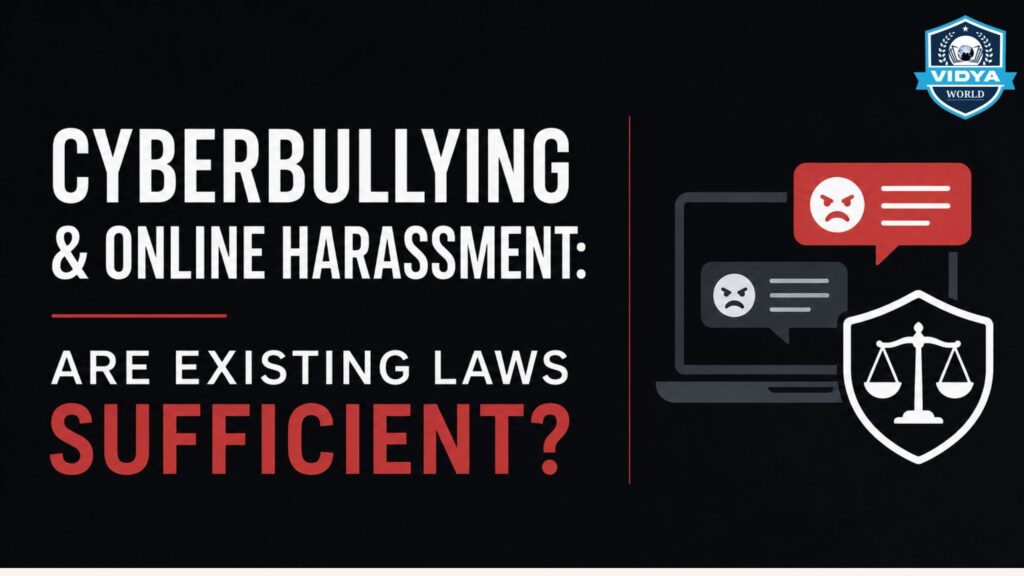
People today communicate, explore, and express themselves differently by utilizing the internet. Social networking platforms, online gaming groups, messaging software and digital workspaces have made communication faster and more accessible. However, these technological improvements have also given rise to cyberbullying and online harassment, posing severe issues for individuals, corporations and governments. These days, threats, doxxing, stalking, revenge pornography, impersonation, deepfakes, trolling, and orchestrated hate campaigns are all considered forms of online abuse.
The number of accusations of cyber harassment has dramatically increased in India due to the country’s increasing use of cellphones and social media. Even while the nation has passed a number of laws to deal with internet crimes, there are still concerns about whether the current legal system is sufficient to confront new types of digital abuse. Not only is it difficult to penalize perpetrators, but it is also difficult to ensure prompt investigations, victim protection, and platform accountability.
The Legal Framework: India’s Response to Online Abuse
According to Indian law, cyberbullying is not considered a distinct crime. Rather, depending on the type of behavior, different types of internet harassment are charged under separate statutes. Both victims and law enforcement organizations are frequently confused by this disjointed legal approach.
The Information Technology Act, 2000
India’s principal cyber law law is the Information Technology Act, 2000. The Act does not expressly make cyberbullying illegal, while having a number of significant restrictions.
Among the crucial clauses are:
- Section 66C: Identification theft including the fraudulent use of another person’s electronic signature, password, or identification information.
- Section 66D: addresses personation-based cheating using computer resources.
- Section 66E: Individuals’ privacy is safeguarded, which prohibits the unlawful taking or dissemination of personal photos.
- Section 67: Penalizes the publication or electronic transmission of pornographic content.
- Section 67A: Electronic content that is sexually explicit is covered by.
- Section 67B: Children are better protected against internet sexual exploitation.
While these laws are helpful in certain situations, they frequently do not address many contemporary kinds of cyberbullying, such as persistent online humiliation, orchestrated trolling, or non-sexual harassment.
The Bharatiya Nyaya Sanhita: The Intersection of Digital and Criminal Law
Even though the Bharatiya Nyaya Sanhita, 2023 (BNS) replaced the Indian Penal Code, a number of conventional criminal offenses still apply in cyberspace.
Online criminals could face legal action for:
- Criminal intimidation Defamation
- Stalking
- Sexual abuse
- Voyeurism
- Outraging the modesty of women
- Intimidation of criminals via internet communication
- Extortion and deliberate insults that cause a breach of peace
The BNS understands that illegal acts remain punishable regardless of whether they occur physically or digitally. However, it often takes sophisticated digital evidence, technical know-how, and international collaboration to prove internet crimes.
The Constitutional Balance: Free Speech versus Online Safety
One of the greatest legal difficulties is combining freedom of speech with protection against internet harassment.
Article 19(1)(a) of the Constitution ensures freedom of speech and expression. Article 19(2), however, allows for reasonable limitations in the sake of morality, decency, public order, defamation, and other justifiable governmental interests.
India’s digital free speech jurisprudence was greatly influenced by the historic ruling in Shreya Singhal v. Union of India (2015). The Supreme Court struck down Section 66A of the Information Technology Act, concluding that its imprecise language authorized arbitrary arrests and violated constitutional free expression safeguards.
The ruling improved civil freedoms, but it also raised issues because it did not specifically address abusive internet comments that do not qualify as criminal intimidation or obscenity.
Platform Responsibility: The Growing Role of Intermediaries
In order to stop online harassment, social media corporations are now key players. The detection, reporting, and removal of harmful content are now influenced by digital platforms.
The Information Technology (Intermediary Guidelines and Digital Media Ethics Code) Rules, 2021
Intermediaries are subject to a number of obligations under the 2021 Rules.
Among them are:
- Grievance officers are appointed.
- mechanisms for promptly resolving complaints.
- removal of illegal content following receipt of a legitimate court order.
- Important social media intermediaries are subject to additional due diligence requirements.
- collaboration during investigations with law enforcement.
Failure to comply may result in the loss of statutory safe harbour protections under the Information Technology Act.
However, critics counter that content moderation is still uneven across platforms. While victims must deal with difficult reporting procedures and a lack of transparency regarding platform decisions, harmful posts frequently stay online for long stretches of time.
The Challenge of Anonymous Abuse
Anonymity is one of the most challenging characteristics of cyberbullying.
It is challenging to identify criminals due to phony accounts, virtual private networks (VPNs), encrypted chat services, and transient social media identities. Many perpetrators operate across jurisdictions, requiring cooperation between different agencies.
Digital investigations usually involve:
- tracing IP addresses.
- seizure of a device.
- digital forensic analysis.
- Metadata analysis.
- requests to international service providers.
- Mutual Legal Assistance Treaty (MLAT) processes.
These investigations frequently become protracted, diminishing the effectiveness of legal remedies for victims.
Special Protection for Women and Children
Children and women continue to be among the most susceptible victims of cyberbullying.
Typical offenses consist of:
- photographic morphing.
- posting private photos without permission.
- Pornography of revenge.
- grooming online.
- Child sexual abuse material.
Indian law gives protection through numerous statutes.
Children are protected from online sexual exploitation by the Protection of Children from Sexual Offenses (POCSO) Act, 2012. Similarly, provisions of the Information Technology Act and the Bharatiya Nyaya Sanhita penalize certain sorts of sexual harassment and privacy abuses.
Despite these legal protections, slow investigations, fear of social stigma and limited digital awareness sometimes dissuade victims from reporting events.
Corporate Accountability and Cyberbullying in the Workplace
Professional settings are becoming more and more impacted by online harassment. Remote employment, virtual meetings and digital communication platforms have raised chances for workplace malfeasance.
Employers are obligated to maintain secure digital workplaces by implementing:
- policies on cyber harassment.
- programs for employee awareness.
- Confidential reporting techniques.
- methods for preserving digital evidence.
- committees for internal complaints under the Sexual Harassment of Women at Workplace (Prevention, Prohibition and Redressal) Act, 2013, where appropriate.
Organizations risk legal liability and reputational damage if they don’t deal with online workplace harassment.
Emerging Challenges: AI, Deepfakes and Digital Manipulation
New types of cyber harassment have been brought about by artificial intelligence.
Deepfake technology makes it possible to produce fake photos, movies, and voice recordings that could harm someone’s reputation. AI-powered impersonation, automated trolling and synthetic media have hampered traditional law enforcement.
Victims frequently encounter:
- character assassination.
- identity theft.
- scam with money.
- Emotional trauma.
- repercussions for employment.
- social exclusion.
Lawmakers are currently working to close regulatory gaps caused by the fact that most of the current laws were written before these technologies became widely used.
Global Advancements and Comparative Views
Cyberbullying laws have been introduced in a number of places.
For instance:
- An eSafety Commissioner has been appointed in Australia with the authority to order the removal of dangerous online content.
- Through the Online Safety Act, 2023, the UK has tightened its requirements for digital safety, placing significant obligations on online platforms.
- The European Union’s Digital Services Act (DSA) increases transparency, risk management and responsibility for large online platforms.
India has generally relied upon broad criminal prohibitions rather than establishing a comprehensive anti-cyberbullying statute. Although this offers flexibility, uneven enforcement could result.
The Requirement of Legal Reform
Stronger legislative frameworks that strike a balance between effective victim protection and free speech are necessary in light of the growing reliance on digital technology.
Possible reforms are:
- A legal definition of cyberbullying.
- expedite the complaint process for internet harassment.
- Websites specifically designed to report cyberbullying.
- increased capacity for digital forensics.
- more openness on the platform with relation to content moderation.
- stronger systems for compensating victims.
- programs for digital literacy that are required at colleges and universities.
- Clear guidelines for deepfake abuse and harassment caused by AI.
Legal reform must make sure that safeguards against harassment are not used to stifle democratic expression or valid criticism.
Conclusion
Through the Information Technology Act, the Bharatiya Nyaya Sanhita, the POCSO Act, and intermediary rules, India has a rather robust set of legislation that may deal with many types of cyberbullying and online harassment. Nevertheless, rather than a complete cyberbullying statute, these provisions function through a disjointed legal structure. Rapid advancements in technology, such as deepfake technology, encrypted communication, anonymous platforms, and artificial intelligence, have revealed serious weaknesses in victim protection, enforcement, and platform responsibility.
It takes more than just criminal consequences to combat cyberbullying. Modern law, effective investigation, responsible platform governance, digital literacy, and prompt judicial remedies are all necessary for effective regulation. The law must develop in tandem with technology as India’s digital ecosystem grows in order to guarantee that the internet continues to be a platform for creativity, free speech, and meaningful engagement without endangering people’s safety, privacy, or dignity.