This article is written by Priya Chauhan, a law student at ICFAI University, Dehradun, with a keen interest in Intellectual Property Rights (IPR).
Introduction
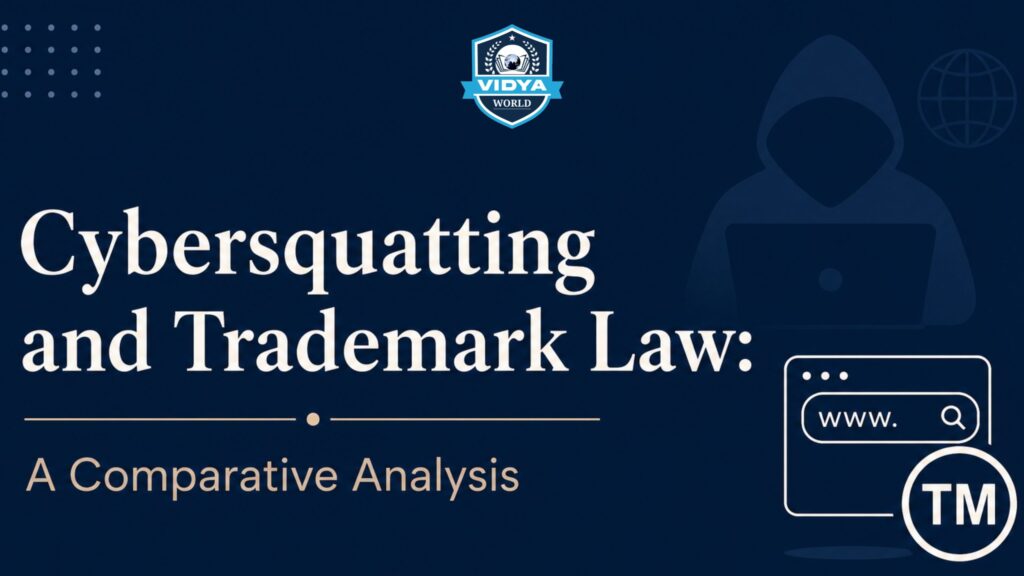
Because companies may now use online platforms to contact customers beyond regional boundaries, the digital economy has drastically changed the nature of trade. In this context, a domain name plays a crucial role in identifying a business’s reputation and commercial identity in addition to acting as an online address. A domain name is a crucial part of contemporary branding tactics since customers often identify it with a company’s trademark.
Cybersquatting, a practice that takes advantage of the goodwill associated with well-known trademarks, has emerged as a result of the growing commercial worth of domain names. Cybersquatters unlawfully register domain names that match well-known trademarks, then demand exorbitant fees from trademark owners or redirect internet traffic in order to profit.
The tension between domain name registration and trademark rights highlights the difficulties in adapting conventional intellectual property concepts to the global reach of the internet. People can register well-known brand names before their legitimate owners since domain names are distributed on a “first come, first served” basis.
As a result, in order to reclaim their domain names, trademark owners are frequently forced to start court cases or arbitration.
National legal frameworks nevertheless range significantly, despite the fact that international institutions like the Uniform Domain Name Dispute Resolution Policy (UDRP) have made dispute resolution easier. While some nations mainly depend on trademark infringement and passing off principles, others have passed special anti-cybersquatting laws. This comparative study investigates these various strategies and assesses their efficacy.
Understanding Cybersquatting
The registration, purchase, or usage of a domain name that is identical to or confusingly similar to another person’s trademark, trade name, or brand in bad faith with the goal of making money is known as cybersquatting.
Cybersquatters usually register well-known brand names before reputable companies do. Later on, they either demand large sums of money to transfer the domain or take advantage of customer confusion by drawings .Registering a well-known trademark as a domain name for resale is known as classic cybersquatting. Typosquatting is the practice of registering common misspellings of well-known websites in order to attract unintentional visits.
Identity-based cybersquatting: unlawfully registering the names of politicians, celebrities, or businesses.
Reverse cybersquatting is the illegal attempt to take away a valid domain owner’s registered domain. Combo squatting is the practice of creating deceptive domain names by combining wellknown trademarks with descriptive terms. The commercial worth of domain names has skyrocketed due to the growth of e-commerce, making cybersquatting a desirable but illegal business. While some cybersquatters use such domain names for phishing, fraud, counterfeit sales, or malicious cyber activities, others make money from advertising through increased online traffic.
The Connection Between Trademarks and Domain Names
Despite having separate legal uses, trademarks and domain names have similar commercial uses. While a domain name defines an online location, a trademark sets products or services apart in the marketplace. Nonetheless, domain names are increasingly seen by customers as markers of a company’s provenance.Customers typically anticipate, for example, that a well-known company’s registered trademark will match its domain name. As a result, confusion about the origin of goods and services is caused by the illegal registration of similar domain names.Because domain names serve as corporate identities, courts in a number of nations have acknowledged that they have trademark value. As a result, misusing domain names frequently amounts to passing off or trademark infringement.
India’s legal position
There isn’t yet a specific law in India that deals with cybersquatting. Rather, trademark law, court rulings, and international arbitration procedures are used to settle conflicts.The Trade Marks Act of 1999 offers protection against unapproved use of registered trademarks in situations where such usage damages goodwill or confuses consumers. Indian courts have routinely interpreted trademarks broadly enough to encompass domain names used as corporate identifiers, even though the Act does not specifically mention domain names.
Due to the fact that both distinguish commercial sources, Indian courts have consistently ruled that domain names should enjoy the same level of protection as trademarks.
The Delhi High Court prohibited the defendant from using a domain name that was confusingly similar in Yahoo! Inc. v. Akash Arora, one of the seminal rulings in this area. The Court noted that users of the internet can readily presume that similar or identical domain names are associated with well-known companies.In a similar vein, the Supreme Court acknowledged domain names as important business identifiers with legal protection under trademark principles in Satyam Infoway Ltd. v. Sifynet Solutions Pvt. Ltd. The Court ruled that as consumer misunderstanding on the internet can seriously harm a company’s brand, passing off actions apply equally to domain names.
For quicker and less costly dispute resolution, Indian trademark owners often turn to the World Intellectual Property Organization (WIPO) under the UDRP in addition to legal remedies.
Despite these advancements, India does not have laws that specifically punish cybersquatters, hence enforcement is not as strong as in other countries with such laws.
Legal Status in the US
The Anti-Cybersquatting Consumer Protection Act (ACPA), 1999, established one of the most robust legal frameworks against cybersquatting in the United States. In cases where the registrant acts in bad faith, the ACPA expressly forbids the registration, trafficking, or use of domain names that are identical to or confusingly similar to well-known or distinctive trademarks.
When assessing ill faith, courts take into account a number of issues, such as:
- Intent to profit.
- Prior legitimate use.
- Offer to sell the domain.
- False contact information.
- Registration of multiple famous trademarks.
- Consumer confusion.
In contrast to many other jurisdictions, the ACPA permits courts to offer trademark owners compensation, transfer domain names, issue injunctions, and award statutory damages.Because cybersquatters may be subject to severe financial penalties in addition to losing the disputed domain, the law serves as a powerful deterrence.Therefore, compared to India’s current structure, the American approach significantly strengthens enforcement by combining trademark protection with particular statutory remedies.
Legal Status in the United Kingdom
The major methods used in the UK to combat cybersquatting are trademark legislation, passing off lawsuits, and Nominet’s dispute resolution process for “.uk” domain names.
The UK has not passed a specific anti-cybersquatting law, in contrast to the US. Rather, courts decide if domain registration constitutes passing off or trademark infringement.Trademark owners can recover abusive domain registrations without protracted litigation according to Nominet’s Dispute Resolution Service, an effective administrative process. In order to prevent legitimate businesses from being unjustly denied access to legally registered domains, the UK model places a strong emphasis on striking a balance between trademark protection and acceptable commercial use.
International Framework: Uniform Domain Name Dispute Resolution Policy (UDRP)
In 1999, the Internet Corporation for Assigned Names and Numbers (ICANN) adopted the Uniform Domain Name Dispute Resolution Policy (UDRP) in recognition of the worldwide scope of cybersquatting.
The majority of generic top-level domains, including “com,” “org,” and “net,” are covered by the UDRP.A complaint must prove three crucial components in order to be successful under the UDRP:
1. The contested domain name is confusingly similar to or identical to a trademark.
2. In the realm, the respondent has no genuine rights or interests.
3. In false faith, the domain was registered and utilized.
The UDRP is substantially quicker and less expensive than traditional court action because proceedings are carried out electronically and often end in two months. Transferring or canceling the contested domain name are potential options. However, the UDRP does not allow for the award of monetary damages.
The most well-known organization in the world for handling UDRP disputes is still the World Intellectual Property Organization (WIPO).
Comparative Evaluation
Various legal systems have various attitudes to cybersquatting, as may be shown by comparing them.India mostly relies on trademark law and judicial interpretation. Despite the fact that courts have established robust precedents safeguarding domain names, the lack of specific legislation frequently leads to drawn-out legal proceedings and uneven remedies.
The Anti-Cybersquatting Consumer Protection Act in the United States provides what may be the strongest legal protection. Trademark enforcement is greatly strengthened by the possibility of statutory damages, compensation, injunctions, and explicit acknowledgment of cybersquatting.
By combining trademark law with specialized domain dispute procedures run by Nominet, the UK takes a more impartial stance. Despite not having specific laws like the ACPA, its administrative processes effectively settle a lot of conflicts.Because internet business is worldwide, the international UDRP system offers a cross-border procedure that works well. However, its deterrent power against persistent cybersquatters is limited by its incapacity to grant damages.Comparatively speaking, the UDRP gives the quickest dispute settlement, while the American approach delivers the most legal deterrence. Although judicial innovation has significantly improved India’s framework, comprehensive legislation revisions that expressly target cybersquatting would be beneficial.
Difficulties in Controlling Cybersquatting
Because of globalization and technological growth, cybersquatting is still evolving despite important legal improvements.The internet’s global reach presents a significant obstacle. Enforcing domestic court rulings is made more difficult by the fact that domain registrants frequently live abroad.The creation of new generic top level domains presents another difficulty since it increases the possibility of fraudulent registrations.Additionally, hundreds of domain names may now be automatically registered in a matter of seconds thanks to artificial intelligence, making cybersquatting more advanced than it has ever been.
Furthermore, when cybersquatters use proxy registrations or privacy protection services to hide their identity, it could be challenging to prove bad faith.
Identification of offenders is made more difficult by the growing usage of cryptocurrencies for domain transfers.Finally, international corporations looking for consistent protection face uncertainty due to disparate legal norms between nations.
Recommendations
A number of improvements should be taken into consideration in order to improve protection against cybersquatting.Similar to the American Anti-Cybersquatting Consumer Protection Act, India should pass specific anti-cybersquatting laws. A precise definition of cybersquatting, statutory remedies, and financial penalties for bad faith registrants should all be included in such law.Domain name disputes may also be resolved more quickly with the help of specialized cyber intellectual property tribunals.Before allowing the registration of economically significant domain names, domain registrars should improve identity verification protocols.Addressing cross-border cybersquatting requires more collaboration between ICANN, WIPO, national governments, and law enforcement organizations.Public awareness efforts should inform companies about trademark protection and proactive domain registration tactics.
Lastly, technical solutions like artificial intelligence-based monitoring systems can help trademark owners spot questionable domain registrations before serious consumer harm happens.
Conclusion
One of the most important ways that intellectual property law and the internet economy interact is through cybersquatting. As companies rely more and more on their online identities, domain names have grown to be important corporate assets that should have robust legal protection. Even while trademark law has effectively developed to handle numerous cybersquatting challenges, conventional legal norms are still being challenged by the quickly evolving technology landscape.
There are significant differences between jurisdictions, according to a comparative analysis. The Anti-Cybersquatting Consumer Protection Act in the United States has the most extensive legal framework, whilst the United Kingdom depends on trademark principles combined with effective administrative dispute resolution. The UDRP has become a vital tool for swiftly and successfully settling cross-border domain disputes on a global scale.