Table of Contents
ToggleIntroduction
The Constitution of India is not an inert piece of legal parchment; it is the dynamics of a sovereign, socialist, secular, and democratic nation, meant to grow and expand with the times. Its framers provided for its amendment by Parliament as and when the need would arise. Therein, however, lies the rub. Amendment of the Constitution is one thing; its destruction is another. The principle that was forged in the crucible of judicial thinking has drawn an unmistakable line. Parliament may amend the Constitution but cannot alter or destroy its basic features, the features that give to this country its basic personality. Some features were fundamentally sacred and could not be impaired. The attempt of Parliament to delete those features was beyond the amendatory power; it was, in other words, rewriting the Constitution. Thus, Parliament had the power to modify the rules. But it could not exercise its amending power to destroy the basic pillars of the constitutional edifice.
The Need for the Basic Structure Doctrine
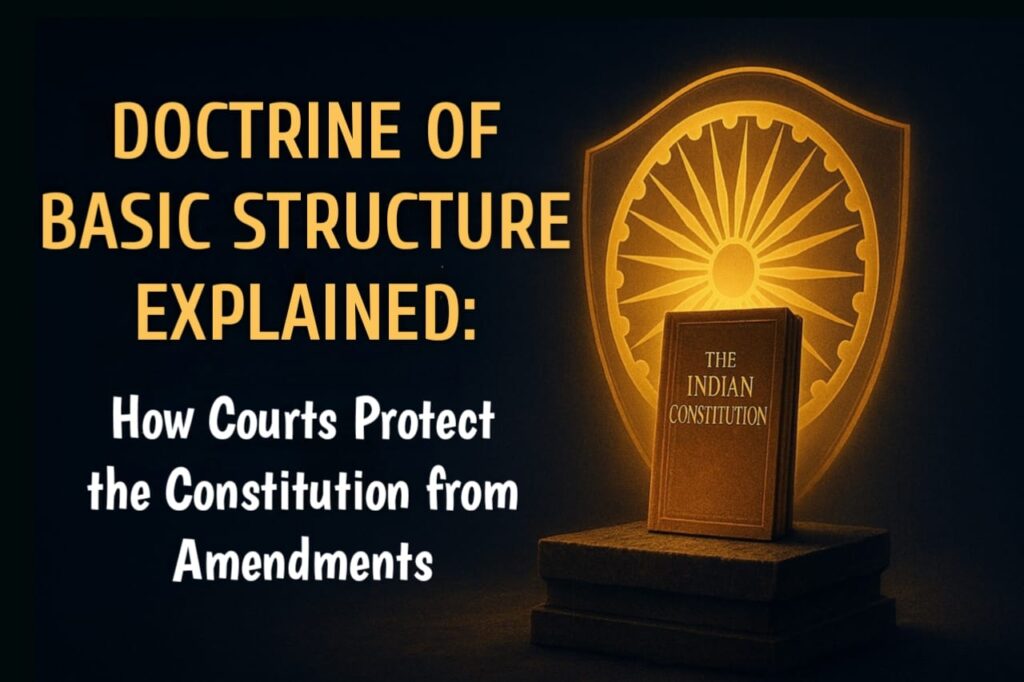
The Basic Structure Doctrine is fundamental for the protection of the essential features of the Indian Constitution as a check by the judiciary on arbitrary or superfluous amendments that would defeat democracy, secularism, and the rule of law. It acts like a guardrail to ensure those core values and democratic ideals stick around, no matter who’s in power. The doctrine upholds the supremacy of the Constitution as the highest law of the land. Consequently, it supports the principles of constitutional morality and makes sure that constitutional amendments conform to the general values of justice, equality, and fairness.
The Birth of the Doctrine: Early Constitutional Cases
Where did this idea originate? It originated from tension between Parliament’s authority to amend the Constitution and the untouchable status of Fundamental Rights. Article 368 empowers Parliament to add, vary, or delete any provision of the Constitution. Initially, it was perceived as an unlimited power. Take the case of Shankari Prasad v. Union of India (1951). The Supreme Court had to decide if the First Amendment, which cut back on the right to property, was okay. The Court said yes-Parliament could amend Fundamental Rights, and these amendments weren’t even considered “laws” under Article 13, so they couldn’t be challenged for violating Fundamental Rights. The Court doubled down on this in Sajjan Singh v. State of Rajasthan (1965), letting Parliament call the shots on amendments. For a while, it looked like nothing in the Constitution was off-limits.
But everything changed in 1967 with the Golaknath case. The Supreme Court, by a razor-thin majority, flipped its own earlier decisions. The justices said Fundamental Rights were untouchable-they couldn’t be taken away by Parliament. Now, constitutional amendments counted as “laws,” and if they clashed with Fundamental Rights, they didn’t stand. Suddenly, Parliament’s amending power hit a wall. This didn’t sit well with the government, especially since Prime Minister Indira Gandhi was pushing for land reforms and other big changes that often collided with the right to property. In response, Parliament passed the 24th Amendment in 1971, trying to sidestep the Supreme Court’s ruling. They rewrote Articles 13 and 368 to say, basically, “Hey, amendments aren’t covered by Article 13, and Parliament can amend anything.” This set the stage for a massive showdown. That showdown happened in the famous Kesavananda Bharati v. State of Kerala case in 1973.
Kesavananda Bharati Case
The ascertainment of the basic structure proved to be quite tricky. It could not be nailed down precisely as to what constituted it. Thirteen judges sat together to decide whether the 24th Amendment, among others, would stand. Their judgment is legendary. The Court held, by a single vote, that Parliament had the competence to amend Fundamental Rights, but not everything. The justices drew a new rubicon: while the Constitution can always be amended by Parliament, it must not destroy its basic structure or essential features. This doctrine-protecting the essence of the Constitution-was perhaps one of the boldest and significant principles laid down in Indian jurisprudence. In one fell swoop, it contained the Serena dream of Parliament and ensured that the foundational values of Indian democracy would not be destroyed, howsoever the goalposts of progress might be changed.
A major part of the Kesavananda decision was that the Supreme Court refrained from giving a comprehensive and final list of what comprised the basic structure. That was deliberate. It left the concept open to evolve over time through a process of incremental build-up in various cases. Yet, the court did indicate some examples. These were by no means exhaustive. They merely illustrated features that it perceived to be part of the basic structure. In later decisions over the years, that list expanded. Among the main items now considered basic are the supremacy of the Constitution. In other words, the Constitution is the law of the land. All organs of government are obliged to act in conformity with it. Next comes the republican and democratic form of government. The state derives its powers directly from the people. Another vital component is the secular aspect of the Constitution. The state does not adopt any particular religion. It treats all religions alike. Federalism plays an important role. It refers to the distribution of powers between the Centre and the states. Separation of powers involves the division of functions among the legislature, the executive, and the judiciary. Judicial review empowers courts to review laws and actions for their validity under the Constitution. The rule of law implies that everyone is equal before the law. The government must act in accordance with the rules of law. Equality is the signifying feature that runs throughout the length and breadth of the Constitution. Free and fair elections are the cornerstone of democracy. There is also the balancing of fundamental rights and directive principles. Symbiotic harmony between them should be maintained.
Post-Kesavananda Developments
The basic structure idea really got tested after the Kesavananda case. That happened in the years right after, especially during the rough political times in the mid-1970s.
- Indira Nehru Gandhi v. Raj Narain (1975)
The first big use came in Indira Nehru Gandhi v. Raj Narain in 1975. It started as a fight over an election. The challenge was to Prime Minister Indira Gandhi’s win. While the court was still hearing it, Parliament pushed through the 39th Amendment Act. That law did a few things. One was to put the Prime Minister’s election out of reach from any court check. The Supreme Court stepped in with the basic structure rule. It threw out that part of the law. The court said it broke the ideas of free and fair elections and the rule of law. Those were vital parts of the Constitution.
- Minerva Mills v. Union of India (1980)
The notion gained further strength in the case of Minerva Mills v. Union of India in 1980. That one challenged the 42nd Amendment Act. Parliament had passed it during the Emergency period. The amendments inserted words into Article 368. They provided that Parliament’s power to amend had absolutely no limitations. No court could challenge any amendment on any ground whatsoever. The Supreme Court invalidated those insertions. It iterated that Parliament’s power to amend had definite limits. Judicial review was a part of the essential features of the Constitution. The court also invalidated a provision which attempted to give directive principles an overriding effect over the fundamental rights always. It said the balance and harmony between them was an essential feature.
Conclusion
The basic structure doctrine shows how lively and tough the Indian Constitution can be. It grew out of a hard fight between lawmakers and judges. It altered Indian constitutional ways in profound ways and now, it is a main rule in Indian constitutional law. This one-of-a-kind judge-made tool has shaped power, freedom, and how government works in India and acts as an effective barrier to prevent Parliament from overstepping its limits. It prevents any ephemeral majority in Parliament from distorting the Constitution to pursue its goals. It establishes the supremacy of the Constitution over Parliament. The Constitution grants all powers to the state, including even the power to amend itself. The basic structure doctrine protects the soul of the Constitution, that is, the main democratic, secular, and federal principles, among others. No one can destroy those. It sealed the judiciary’s role as the ultimate protector of the Constitution. Judicial review provided it with the wherewithal to protect the entire scheme of things. Still, many find reason to fault it for not being adequately democratic. People still argue about whether it fits with democracy and how far judges should go. A few unelected judges can veto what the people chose through their elected representatives. As long as the basic features are not sharply defined, it remains woolly. This leaves the judges with the untrammelled freedom of choice. This precipitated allegations of judicial overreach into the legislators’ turf.
But the doctrine stays as the top protection for the Constitution. It lets the Constitution change and improve. Its promise to democracy, personal freedom, and rule of law cannot be broken. With worries about democracy slipping in many places, this doctrine reminds everyone. The right to change a constitution should never mean the freedom to wreck it.

Jyoti Bhojwani is a highly motivated first-year LLB student at Banaras Hindu University with a strong passion for clear and accurate legal communication. Leveraging prior experience in proofreading and content creation, Jyoti is committed to delivering well-researched and accessible legal analysis. She is dedicated to developing expertise in legal writing and contributing valuable content to the legal community.