Table of Contents
ToggleINTRODUCTION
The Committee of the Constituent Assembly on fundamental rights proposed that the independence of elections should be recognized as a fundamental right for every citizen. The Assembly concurred with the Committee’s view that the issue of fair elections holds significant importance; however, it did not support the inclusion of such a right within the chapter on fundamental rights. Following the Assembly’s decision, the Drafting Committee excluded this matter from the fundamental rights category and established it in a distinct section, which ultimately became Part XV of the Constitution.
CONSTITUTIONAL FOUNDATIONS
The Commission is established as a permanent entity under Article 324(1). It serves as an all-India body with jurisdiction over elections to Parliament, State Legislatures, and the offices of the President and Vice-President.
The Election Commission consists of the Chief Election Commissioner [CEC] and such number of Election Commissioners [ECs], if any, as the President may fix from time to time [Art. 324(2)].
The Chief Election Commissioner acts as the Chairman of the Election Commission in case any other Election Commissioner besides him is appointed [Art. 324(3)].
No person is ineligible for inclusion in the electoral roll on the grounds only of religion, caste, sex or any of them [Art. 325]. Equality has thus been accorded to each citizen in the matter of franchise and the electoral roll prepared on a secular basis.
Article 326 prescribes the qualifications for membership of Parliament and State Legislatures, which the Commission enforces in the nomination process.
Article 327 gives Parliament the power to enact laws for the making of electoral rolls, while Article 328 gives the same power regarding the conduct of elections.
Article 329 restricts the intervention of the courts in the electoral process, except for the cases explicitly mentioned, hence securing the functional independence of the Commission.
Apart from the constitutional provisions, there is a rich statutory framework that consists of the Representation of the People Act, 1951 (RPA) (the 1950 and 1951 Acts together), and the Representation of the People (Election Rules) 1972 that cover the procedures for voter registration, delimitation, nomination, polling, counting, and dispute resolution.
COMPOSITION AND TENURE
The Election Commission consists of the Chief Election Commissioner [CEC] and such number of Election Commissioners [ECs], if any, as the President may fix from time to time [Art, 324(2)). All these Commissioners are appointed by the President subject to the provisions of any law enacted by Parliament for the purpose [Art. 325(2)).
On October 2, 1993 the Government issued an Ordinance (which is now on Act) and converted the one-man Election Commission into a multi member Commission by appointing two persons as Election Commissioners.
According to the Election Commission (Conditions of Service of Election Commissioners and Transaction of Business) Act, 1991, the Chief Election Commissioner and the Election Commissioners hold office for a term of 6 years or until they attain the age of 65 years, whichever is earlier.
The Chief Election Commissioner acts as the Chairman of the Election Commission in case any other Election Commissioner besides him is appointed [Art. 324(3)].
CORE FUNCTIONS
The Election Commission performs the following functions:
- The superintendence, direction and control of the preparation of electoral rolls for all elections to Parliament and to the State Legislatures and to the office of the President and the Vice-President;
- Conduct of all the above-mentioned elections; and
- The Commission frames the Model Code of Conduct laying down norms regulating the conduct of political parties, candidates and the various governments during the period of election
- Removal of disqualification arising out of conviction for a specified offence, for purposes of voting or standing as a candidate at an election. The Election Commission is required to record the reasons in writing while deciding any such matter.
- Advising the President on the question of disqualification of any Member of Parliament, or advising the Governor on the question of disqualification of a member of a State Legislature.
- Allot symbols for purposes of elections to political parties and to adjudicate upon disputes with regard to recognition of political parties and rival claims to a particular symbol for purposes of elections.
LANDMARK SUPREME COURT JUDGEMENTS SHAPING THE COMMISSION
- In Inderjit Barua v. Election Commission of India, the validity of the Assam Legislative Assembly elections held in February 1983 was challenged. The Supreme Court held that:
- preparation of electoral rolls is not part of “election”
- no election can be challenged on the ground of defect in electoral rolls
- an election can be challenged only by an election petition as required by Article 329(b), even if election not to a particular constituency or seat but to all constituencies or seats generally is being challenged.
- The Supreme Court has ruled in Digvijay Mote v. Union of India,” that the conduct of election is in the hands of the Election Commission which has the power of superintendence, direction and con-mol of elections vested in it as per Art. 324 of the Constitution. If the Election Commission is of the opinion that having regard to the disturbed conditions in a State, or a part thereof, free and fair elections cannot be held, it may postpone the same. However, this power is not uncontrolled.
- In Mohinder Singh Gill v. Chief Election Commissioner, the Supreme Court has lucidly explained the scope of Art. 324. This is a plenary provision vesting the whole responsibility for national and state elections and, therefore, the necessary powers to discharge that function. Article 324 has however to be read in the light of the constitutional scheme and the Representation of the People Acts, 1950 and 1951.
- In Venkatachalam v. A. Swamickan, the Supreme Court has held that Art. 329 (b) which bars interference of court in electoral matter does not come into play in a case which falls under 191 and 193 which provides for disqualification of membership and penalty for sitting and voting when disqualified and the whole of election process is over. In such case the High Court can interfere under Art. 226 and declare that he was not entitled to sit in the State Assembly.
SAFEGUARDING DEMOCRATIC PROCESSES
A State Government might discriminate against outsiders by organizing things in such a way that they would not qualify to vote and, as a result, would lose their franchise which is a very fundamental right of democracy. In order to prevent injustice being done to any section of the people, the Election Commission controls over the entire election machinery in the country.
The mechanisms established by the Commission to resolve disputes-Election Tribunals and the SC’s supervisory jurisdiction make it impossible for violations of the RPA to remain unaddressed. The ‘no-objection’ principle (meaning that the Commission can reject a candidate’s nomination if that candidate is not eligible) adds to the rule of law prior to the election.
The ECI launched special initiatives such as ‘Voter Helpline 1800-11-0222’, ‘Sukanya Samriddhi’ (outreach to women voters), and ‘Voter ID’ to expand the franchise to new and deserving voters, particularly, first-time voters and marginalized segments of society.
The Commission’s disinterested administration of elections is one of the foundations of the democratic legitimacy of India. The Commission has control over the entire mechanism of elections-voter registration to the declaration of results-meaning that there can be no intervention from within to influence the election. The Model Code of Conduct (MCC) restricts the ability to use state resources in favor of an election candidate, and the monitoring of electoral expenditure, along with the MCC, works to eliminate the distortion of the free, fair competition by wealthier candidates.
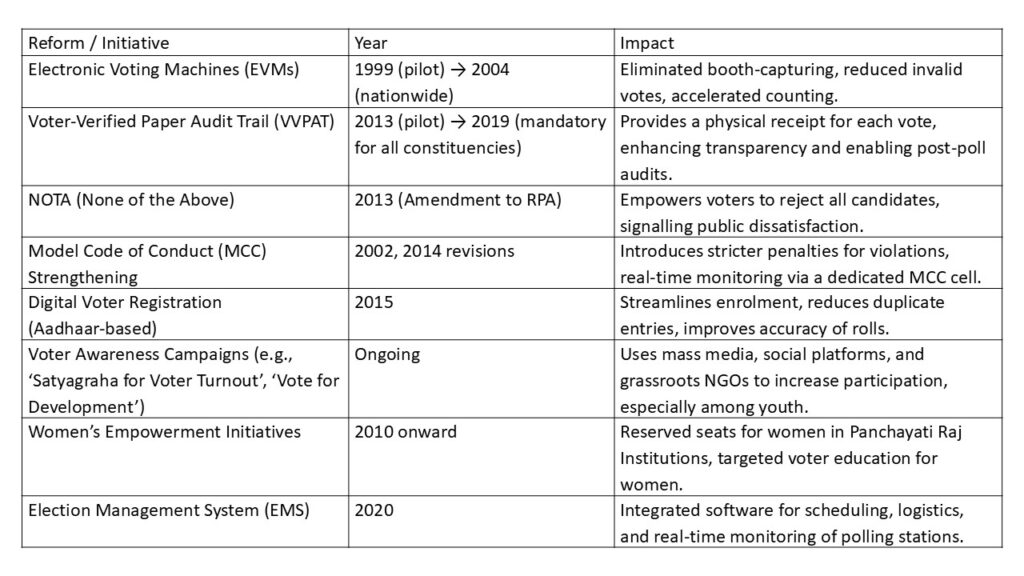
MAJOR REFORMS AND INITIATIVES
CHALLENGES AND CRITICISMS
Political Interference – The Election Commission of India (ECI) encounters pressure from political parties and influential interest groups that aim to sway electoral results through unethical methods. This type of political interference compromises the independence and neutrality of the ECI, thereby threatening the integrity of elections.
Limited Powers – The authority of the ECI to enforce its rulings and penalize violators is restricted. This limitation obstructs its capacity to effectively apply regulations and guarantee adherence to electoral laws.
Electoral Fraud and Malpractice – The ECI contends with the ongoing issue of tackling electoral fraud and malpractice, which includes voter intimidation, the use of financial and physical coercion, among other tactics.
Technological Challenges – As technology becomes increasingly integrated into the electoral process, the ECI faces difficulties regarding the security and integrity of elections, including the potential manipulation of Electronic Voting Machines (EVMs).
Disinformation and Fake News – The rise of disinformation, hate speech, and fake news on social media platforms presents a significant challenge to the ECI’s initiatives aimed at ensuring informed and equitable elections.
CONCLUSION
The Election Commission of India is an exceptional constitutional institution that not only represents but also practices the democratic spirit of the world’s largest voter base. Its constitutional mandate (Art. 324‑329), backed by the Representation of the People Act, 1951, provides a strong legal basis. Independence of its members is guaranteed by tenure, removal processes, and financial self-governance, thus the Commission can operate without fear or favor. The deployment of reforms and technology (EVMs, VVPAT, NOTA, digital enrolment) has updated the system whilst maintaining the basic principle of democracy—one person, one vote. However, the Commission still has to deal with political pressures, lack of resources, and changing technological vulnerabilities. Its ongoing watchfulness and reform will be essential to the vibrant and healthy Indian democratic polity for the coming generations.