This article is written by Astha Tripathi, a law student at Maharaja Sayajirao University of Baroda, Faculty of Law, with a keen interest in Environment law, Constitutional law, Jurisprudence, Administration law.
Introduction:
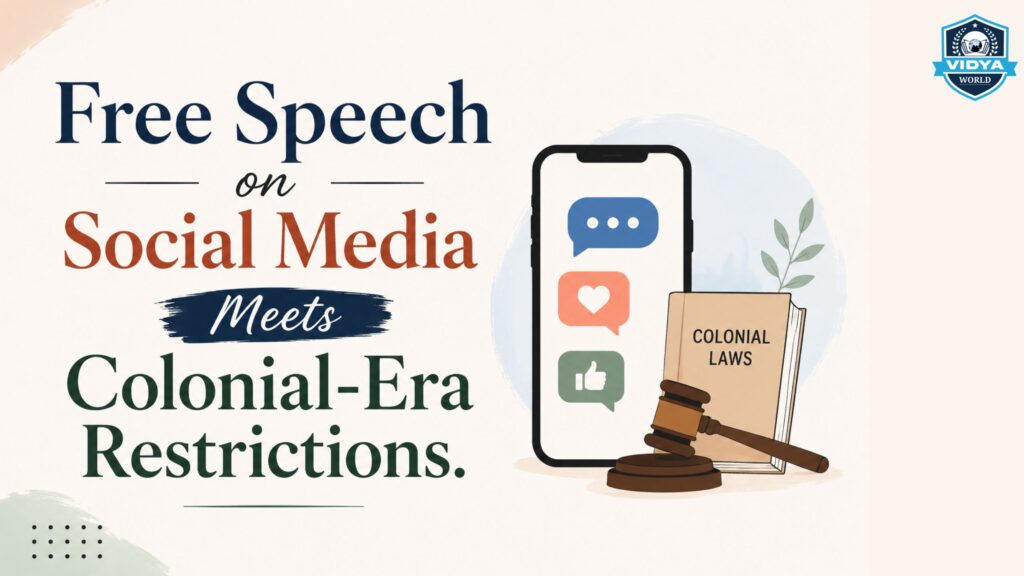
In August 2012, a Mumbai student Shaheen Dhada posed a question on Facebook asking why Mumbai was shutdown to mark the death of a politician. Her and her friend who ‘liked’ the post were arrested within hours of its upload. There was no riot or violence that caused this arrest, but another form of protest that has unfortunately become very common in recent years. That one act of pressing the enter key has led to the police pressing charges that have been filed not against people who seek to destabilize a republic but citizens who use the same republic’s democratic freedoms in ways that the empire that ruled over the land no longer does. The power of social media has made everyone both a publisher, a broadcaster, and a critic. However, what was once a tool for the empire to rule the colonies now faces the strange problem of being unsuited to handle the demands of an increasingly vocal and expressive citizenry. A tweet can take down a minister, a social media post can catalyse a revolution but in this strange system of modern day censorship, the tools used to prosecute such actions were made to silence subjects, not citizens.
A. Why Colonial Laws Were Created
The British colonial authorities were always guided by the idea that freedom of press and speech should not exist if they may challenge the colonial rule. In particular, British officials started developing legislation to impose restrictions on the Indian press from the late 18th century. Initially introduced with the Censorship of Press Act, 1799, and subsequently reinforced by the Licensing Regulation Act, 1823, Vernacular Press Act, 1878 (“Gagging Act”), and the Indian Press Act, 1910, a series of repressive legislation was enacted to censor the press, suppress nationalist sentiments, and sustain imperial authority. The insertion of IPC section 124A in the year 1870, which made “disaffection” to the government a punishable offence, gave the colonial rulers extensive powers to suppress nationalist voices. The very fact that such laws were formulated indicates the anxiety of the British rulers in India about the reactions of the Indian people to their policies, and especially to political changes in Britain itself. This is why the first laws on freedom of speech and expression were so closely related to the repression of public opinion in India. Framed as measures for “public order,” they were nevertheless tools of suppression and a means of discouraging dissent and mass mobilization.
Independent India inherited many instruments of control and ways of thinking about control from its predecessors.
B. The Constitutional Turn
The framing of the Indian Constitution marked a clear break with the colonial mindset of control and oppression. Article 19(1) (a) of the Constitution of India lays down that all citizens shall have the right to freedom of speech and expression which includes the right to talk, express or spread one’s opinion in any manner including oral, written, print, visual, electronic or any other media, freedom to gather and impart information and freedom of the press. Yet the framers did not mean to confer it as an absolute right. The article allows for reasonable restrictions, such as those imposed for the sake of sovereignty, security of the state, friendly relations with other states, public order, decency, morality, contempt of court, defamation, and incitement of an offence (Article 19(2). Therefore, any law that curtails this freedom has to be justified, reasonable, and related to any of these issues. This dual structure of a broad right plus limited exceptions was a significant improvement on the colonial arrangement in which restrictions on speech were the norm and permissions the exception. By creating this new First Amendment structure, the Framers did not merely shift the site of the contest between liberty and control from the speech acts themselves to the medium of their articulation. More fundamentally, they reversed the very logic of the relationship between the state and the liberty of expression. Previously, the default assumption had been that the state could control speech, but now the default was that the state could not control speech – that is, that liberty was the norm and security the carefully apportioned exception.
C. Social Media Changed Everything
If the printing press was a discovery that threatened to disrupt the speech domain of authorities, social media goes as far as completely redefining communication. Individual posts can go viral and exponentially increase their reach in a matter of hours. The algorithm controls what is seen and thus determines whose voice is heard and what is not. It creates an environment where citizen journalism can thrive and ordinary people report on scandals and human rights abuses as effectively as any official media outlet. Algorithms democratize news production while simultaneously eliminating many traditional jobs. Political campaigns are redefined as social media allows campaigns to target specific demographics and create a tailored impression that wasn’t possible before. Movements can be started and gain traction on the platform, threatening to replace many traditional institutions such as the press. However, it is important to note that as the new tool was integrated into the existing system, some of its features were adjusted to fit the old mold. For example, with the advent of AI, there is an increased risk of disinformation through deep fakes and fake text that can fool the general population and sway elections. The mechanisms of cancel culture can also be weaponized to ostracize individuals from society on spurious grounds. Harassment is another threat, especially for women, as doxxing and other unpleasant activities can severely limit their engagement with the online space. Overall, the phenomenon of social media has irreversibly changed the way humans communicated and thus influenced the evolution of free speech as we know it.
D. Colonial Restrictions in the Digital Era
The colonial lexicon of control has not been entirely buried; it lives on in cyberspace. The same sedition laws that once unjustly targeted Tilak continue to threaten free speech, with authorities weaponizing Section 124A IPC against social media posts critical of the government long after the Supreme Court significantly narrowed its scope in Kedar Nath Singh v. State of Bihar (1962). Criminal defamation laws (Sections 499-500 IPC) with their colonial-era focus on reputation also find new life in tweets, posts, and comments, with powerful men often using them to silence criticism rather than respond to legitimate defamation. The rationale for upholding these laws finds echoes in colonial attempts to ban vernacular newspapers that questioned the Crown – today, similar arguments are used to justify content blocking under Section 69A of the IT Act, 2000. Section 66A IT Act, 2000, which attempted to broadly criminalize “grossly offensive” online expression, was infamously struck down in Shreya Singhal v. Union of India for its unconstitutional vagueness. Laws regarding national security and official secrets have also been repeatedly invoked to justify censorship, from internet shutdowns to surveillance. In Anuradha Bhasin v. Union of India (2019), the Supreme Court ruled that access to the internet falls under freedom of speech and expression (Article 19(1)(a) and any restrictions have to be narrowly tailored. Preventive policing continues to shape India’s digital policy with traceability requirements, takedown notices, and the newly enacted IT Rules, 2021, with the colonial suspicion of free speech remaining largely undiminished – if updated with modern technologies.
E. Landmark Judgments
The case of Kedar Nath Singh v. State of Bihar (1962) is noteworthy in that it declined to let sedition continue as an essentially colonial law. The Court upheld the provision’s constitutionality but with a substantial limitation the charge would apply only in cases of intention to “by any act or declaration tend to promote or prejudice public order or peace by exciting feelings of hostility against any community or person.” In other words, sedition laws shall only be utilised when the allegedly seditious speech or action directly aims to provoke violence. This one gesture of leniency made it clear that criticism of government, however severe, could no longer be. Penalized as “disaffection” by the very law that had so loosely and erroneously been applied by the British to Tilak himself.
The case of Shreya Singhal v. Union of India 2015, which challenged the constitutionality of Section 66A of the Information Technology Act, has relevance today because it dealt with the digital-age manifestation of that same impulse. The problematic provision criminalized speech that could be considered “annoying” or “inconvenient,” and the Court struck it down for chilling effect “a very large amount of protected and innocent speech” was being stifled due to the unclear language of the law.
Anuradha Bhasin v. Union of India, 2020 is significant because it brought in a new dimension to the existing constitutional jurisprudence on colonial-era control. The Court ruled that an order for the indefinite internet shutdown was unlawful, and that measures for the internet shutdowns must be tested by the standards of necessity and proportionality, requiring the authorities to justify their decisions to impose such restrictions. Read together, the two cases demonstrate how the judiciary has steadily moved to curtail the executive’s ability to control and regulate the use of speech.
F. International Perspective
The differences between the American, British, and German approaches to regulating online speech suggest that the issue is less about technology and more about philosophy; about the different ways in which liberal constitutional democracies think about their governments’ relationships with society. The US views freedom of speech as something sacrosanct that has to be protected at all costs because of its dark historical experience with state oppression. This is why it is difficult for Facebook to be treated as a medium that spreads information as the Section 230 does. The British do not have a written constitution, and their approach to online speech seems to reflect their more pragmatic attitude towards governance in general. Meanwhile, the Germans have the most restrictive approach to regulating online speech because of their dark past with Nazis and propaganda. Their NetzDG law requires platforms to remove illegal speech within 24 hours, which reflects the country’s belief that the government must take an active role in ensuring that the principles enshrined in the Basic Law are followed.
G. Reform proposals
Reforms should begin with replacing colonial-era weasel words such as “disaffection” and “public tranquillity” in Section 124A with precise definitions that specify intent and harm; stronger judicial safeguards are also needed, along the lines of the Anuradha Bhasin judgment, which require periodic review of restrictions and a proportionality test before any blanket restrictions can be imposed. Social media companies should be required to disclose content removals to users, as well as provide transparency about ranking algorithms, if the government seeks such information. There is a need to promote digital literacy among users, so they are not easily misled by fake accounts or misinformation. An alternative to the ambiguous ministerial discretion could be an independent regulatory authority with judicial and technical expertise that could undertake content moderation. Most importantly, all restrictions need to be narrowly drawn and periodically reviewed – so that they are not a permanent fixture.
H. Conclusion
Every age has its legacy, and the structures of control that define present-day India were built by its ancestors. Sedition, criminal defamation, and preventive censorship are all colonial constructs, dressed up and mainstreamed by the constitution. But the question should not be why do we have them, because it is obvious that we do; it should be why do we still use them, and in service of whom? A republic is measured not by its efficiency at suppressing dissent, but by the confidence with which it embraces its contradictions. Every line of code is a choice, every takedown a reaffirmation, every outage a referendum. The Internet has simply made the issue inescapable; the people can no longer look away. And so the moment of reckoning arrives with a simple question: who exactly does the Indian Republic want to speak for?