
This article is written by Astha Tripathi, a law student at Maharaja Sayajirao University of Baroda, Faculty of Law, with a keen interest in Environment law, Constitutional law, Jurisprudence, Administration law.
A Banarasi weaver may spend weeks at the loom, coaxing out delicate patterns, which may be woven into a saree sold in an aboard destination, fetching a price that only the owner of a branded label can earn. While the Geographical Indication rests safely with the Government, its poor implementation leaves the artisan vulnerable. What good is the protection of reputation of a good or service, if not reflected in the security and prosperity of the one who makes it?
Such is the crux of the argument over Geographical indications currently being made in India. The protection offered to geographical indications has undeniably bolstered the authenticity of products and services, as well as aiding in their branding and marketing. However, the benefits reaped by the producers are much less significant, with many being unable to secure bargaining power or better livelihoods due to the inability to utilize the GI status.
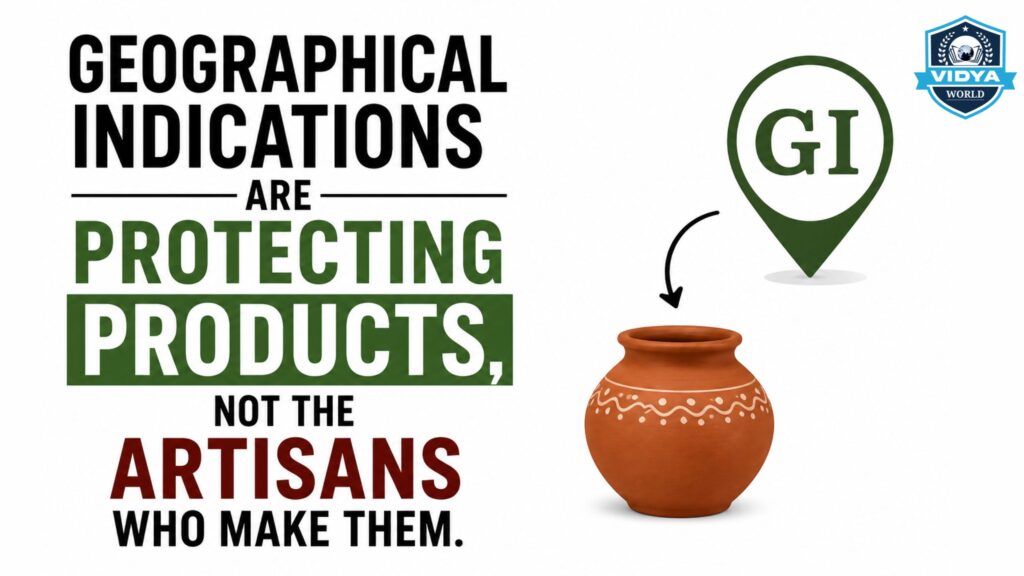
This article aims to highlight the importance of Geographical indications, and how its implementation in India fails to serve the needs of the poorer producers despite the protections it offers to the brand and reputation of the good/service. In doing so, the article will argue that GI laws in India must strive to improve not only the recognition and authenticity of protected goods/services, but should also focus on economic and welfare aspects, including enhanced bargaining power and better living standards for GI producers
Understanding Geographical Indications
A GI emerges as a result of places that are different in terms of climate and soil, as well as traditional expertise and methods that provide goods with qualities not found anywhere else. In this regard, the very purpose of the law is to protect and ensure the uniqueness of regional products and prevent their imitation. The primary objective of the 1999 Act is to register and protect geographical indications and control the use of GI tags, as well as register and manage the registration of geographical indications. Moreover, the current legislation allows India to meet its WTO obligations under the TRIPS Agreement, which obligates states to adopt measures to prevent the use of false indications of origin and misleading trade practices.
Finally, it should be noted that although India’s GI regime is designed to protect commercial authenticity, such protection does not always translate into economic benefits for the labour and resources that have gone into producing the goods. Thus, the 1999 Act is designed to protect geographical indications and ensure the authenticity of goods, and its passage fulfilled India’s needs in protecting its regional products. However, in reality, the law is not designed to benefit artisans, weavers, farmers, or other local producers who often have little economic potential.
The Success story of GI Protection:-
Geographical indications in India have been a significant legal tool in protecting geographical indication products. This protection helps achieve several objectives, including providing assurance of quality and authenticity of goods, promoting and sustaining traditional industries and their products, and providing brand value to products that have acquired a certain status among consumers on the basis of the reputation of an area or locality associated with them. The GI system is also crucial for ensuring that the local economy benefits from branding, which subsequently leads to an increase in export demand as well as promoting local tourism related to local specialties and traditional craftsmanship. Thus, geographical indication products are considered to potentially offer much more than trademarks do; they offer the ability to ‘capitalize on’ a local heritage, given that GI protection is combined with appropriate promotion and enhanced marketability of the product in question. The GI system, therefore, promotes the development of protected areas by linking the image and reputation associated with a particular good, its authentic production, and its geographical location, thereby combining consumer interests with local producers’ needs.
Where the system fails artisans
The first failure of the system to protect the interest of artisans is reflected in their income. In GI-related sectors, artisans are mostly on a piece-rate basis or waged employment, which does not benefit from the premium commanded by GI products in the market, but rather accrues to middlemen and capital owners, who appropriate the surplus value – thus GI privileges tend to favor capitalistic relations over labor.
The second reason why the GI system is not sufficient in protecting the interests of artisans is the intermediary role of traders, Stuckists, and registered proprietorships in the supply chain, who rob artisans of their bargaining power and dictate terms of credit or sale, despite the GI tag, which protects the product and not the seller.
The third shortcoming is the lack of awareness of GI-related rights among artisans, who neither negotiate GI registration nor participate in its maintenance. The example of artisans in Varanasi shows that the legal GI-related protection is mostly unknown to those not involved in its creation, which limits their ability to enforce it or benefit from it directly, as it remains a tool to protect the product and not the producers.
Furthermore, the social security provided by GI registration is limited to product protection, leaving artisans to fend for themselves in terms of health, old-age security, compensation for work-related accidents, and other social needs, which were previously provided by the traditional informal sector.
Artisans’ gender and age stratification negatively impacts their ability to benefit from GI privileges, as women are often pushed into manual labour while men hold decision-making roles, undermining the value of their work, while youth are discouraged from participating in the production process, which threatens the survival of traditional skills and know-how in the long term. Thus, GI tags do not automatically translate into protection and prosperity for artisans, threatening to leave them in the same position as before GI registration, deprived of bargaining power and formal access to resources or social security.
Case Studies.
Darjeeling tea is a perfect example of a GI product that is highly recognizable and popular both in the domestic market and the global market. However, according to the source, even though the GI tag helps address some issues, the benefits are conditional to active participation on the supply chain, not just relying on the GI status quo.
Another example of a GI product is Banarasi saree, which also has significant market value, although the industry’s significant employment potential does not necessarily translate into workers’ stable incomes. Research on Banarasi brocade and Banarasi saree highlighted the need to evaluate GI’s impact on market positioning while recognizing that pricing power may still depend on other factors, most importantly, the presence of trade intermediaries and appropriate marketing strategies.
Same goes for Kanchipuram silk, which successfully leveraged GI to maintain its premium image and dedication to regional specialties; however, the benefits are conditional to the active participation of weavers in trading activities and access to alternate marketing channels, including the internet. Madhubani painting and Channa Patna toys are both examples of GI-protected cultural products that have recognized value in the market, but the current state of affairs may challenge younger generations of weavers and painters to adopt the profession and suffer from low wages since GI tags do not automatically guarantee stable incomes.
Overall, the examples highlight the fact that GI tags are mostly effective tools on the front of brand positioning and reputation, but the actual value and stability of income are conditioned by supply chains, marketer strategies, and broader organizational capacity in the respective sectors. In other words, GI tags may protect the geographical uniqueness of a product but have little impact on the overall system selling it.
Comparative Perspective:-
Other jurisdictions’ experiences confirm GI’s protective capacity, which is related to producers’ welfare in addition to the protected product’s authenticity. GI protection in the EU involves establishing producer groups, control over compliance, and closer relationships between groups and authorities while policy notes stress the importance of regional promotion, tourism, and access to distribution networks and markets.
Another comparison is informative in terms of GI development – the role of producer cooperatives in artisanal communities bargaining for quality control, brand value, and overall higher prices for products without threatening their production volumes and access to resources. Fair-trade certification addresses the same set of concerns as Geographical Indications but with closer attention to the link between origin and quality produced under specific ethical standards. It allows enhancing GI’s economic impact while providing consumers with assurance of quality and value.
Therefore, the comparison reveals that while the objectives of protecting the product and the producer may seem at odds, GI can be a tool for achieving both. This is primarily facilitated by articulating the branding process and its outcomes, collective bargaining for higher prices and quality control, and establishing organizational capacity to manage a GI-led value chain.
Way Forward:-
The way forward is to change the policies on geographical indications from protecting products to protecting the interests of the producers. More involvement of artisans in the process will ensure that they benefit from their labor and the changes will take place because the buyers will be more informed hence putting pressure on the middlemen. Creating digital platforms will connect artisans directly with the buyers thus removing some of the agents in the supply chain.
The policies should require compulsory benefit-sharing mechanisms because the geographical indications were meant to add value to the products and bring more income to the producers due to their labor. Educating artisans on financial matters such as branding, credit, and business development will empower them and make them more competitive in the market. There is a need to prosecute counterfeiters of geographical indications since they diminish the value of the original products and deny people their due share of profits.
The government should buy from artisans to ensure there is a guaranteed market for their products. The social security, health insurance, and pension scheme should also be made mandatory for those registered under GI so that their livelihood is protected. Awareness campaigns will also help people know where to buy GI products hence increasing demand which in turn ensures that the authentic products are bought and the value is attained.
Conclusion:-
A Geographical Indication is an indication of origin that derives its essence from the skills, memory, and creativity of individuals. A GI tag could help protect and promote a product but failing to improve the labour conditions of the producers and artisans involved defeats the purpose. Hence, for a GI, the most important is not how strong it is but rather the benefits that it provides to the people creating the product. India needs to move towards a GI regime that ensures rights for these artisans and gives them access to higher markets while helping them obtain a better market price for their goods. In other words, unless the law starts to protect the name and hence the rights of the creators, a geographical indication in India would be only partially effective.