Table of Contents
ToggleIntroduction
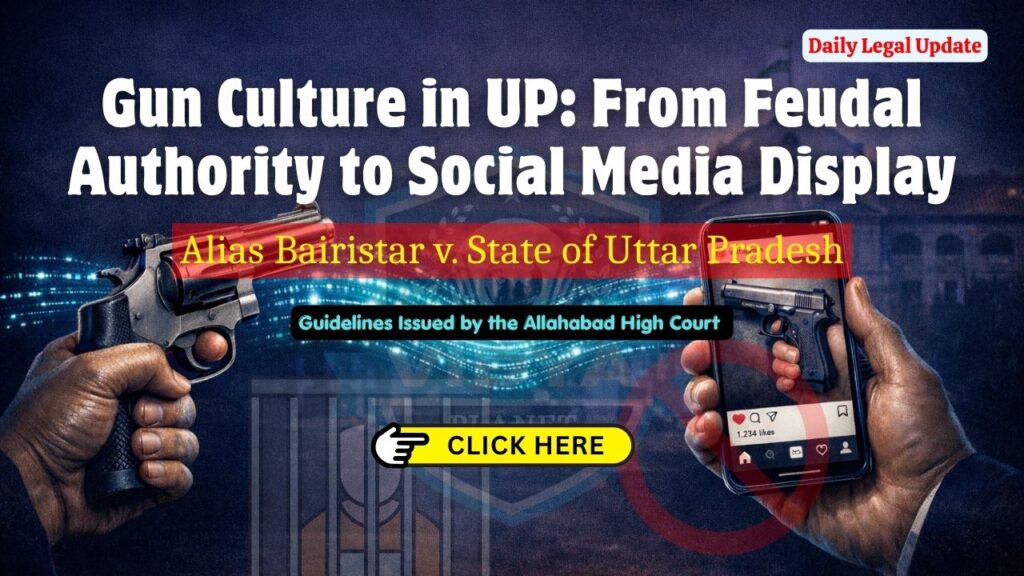
The emerging character of gun culture in UP has recently been under intense legal examination. The Allahabad High Court conducted a thorough analysis of how the display of firearms/gun culture in UP has evolved from a symbol of feudal authority to a tool of digital self-promotion on social media in a landmark ruling in Jai Shankar Alias Bairistar v. State of Uttar Pradesh.
This case covers more general systemic issues pertaining to misuse, regulatory inadequacies, and the sociological consequences of weapon possession in addition to the immediate grievance of the delay in granting an arms license. The Court has started a structural intervention to change the licensing system under Indian law by ordering the development of an extensive database of arms licenses.
Factual Matrix
The lawsuit started with an application for a weapons license that was unjustly delayed for along time. In order to obtain relief from administrative inaction, the petitioner went to the High Court.
The Court broadened the area of investigation when addressing this complaint, pointing out that these cases cannot be considered in a vacuum. Rather, they highlight more serious problems with the Arms Act of 1959’s execution, especially in regions like Uttar Pradesh, where owning a handgun has significant sociopolitical implications.
Statutory Framework Governing Arms Licences
In India, the laws pertaining to weapons are mainly found in:
• Arms Act, 1959
• Arms Rules, 2016
Key Provisions (Arms Act, 1959):
• Section 3 – Prohibits acquisition or possession of firearms without a valid licence.
• Section 13 – Lays down the procedure for the grant of licences.
• Section 14 – Specifies grounds for refusal (e.g., threat to public peace, criminal antecedents).
• Section 17 – Provides for variation, suspension, or revocation of licences,
The Court underlined that granting an arms license is a restrictive privilege that must be closely examined in the interest of public safety rather than a fundamental right.
Judicial Observations:
The ruling makes an important contribution through its sociological analysis. The Court noted that historically, guns represented:
• Feudal power and supremacy
• Political impact and masculinity
But in the modern era, this presentation has moved to Facebook, Instagram, and short-video apps. People are posting more and more images and videos showing firearms/guns to:
• Project influence and power.
• Obtain social validation.
• Intimidate competitors or rivals.
The Court observed that this change reflects the persistence of a feudal mentality that is now reinforced by digital technology. Even when weapons are not used, their performative exhibition adds to the normalizing of violence and a culture of fear.
Directions Issued by the Court:
The High Court gave broad directives to fix such issues:
1. Gathering Information on Arms Licenses
Every District Magistrate was instructed to provide:
o District-specific and police station-specific data
o Types of licensed guns
o The quantity of license holders
2. Mapping Criminal Antecedents
License holders with the following characteristics must be identified by a different category:
o Criminal cases that are pending
o Previous convictions
3. Patterns of Family-based Ownership
To investigate concentration trends, data on homes with several individuals who hold firearms licenses were requested.
4. Applications’ current status
Information about:
o Applications that are pending
o Transfers and Renewals
By establishing a centralized, transparent database, these guidelines hope to improve monitoring and policy development.
Administrative Lapses and Delay
The case also demonstrates ongoing administrative inefficiencies in the handling of applications for arms licenses. Delays allow for arbitrary decision-making and erode the rule of law.
The Court reaffirmed that authorities must follow Section 13 of the Arms Act, which mandates that applications be reviewed promptly. Judicial intervention may result from failure to do so.
Relevant Judicial Precedents
1. Kailash Nath v. State of Uttar Pradesh, AIR 1985
The Court ruled that licensing authorities must behave in a fair and reasonable manner; it is not acceptable to deny an arms license arbitrarily.
2. Sheo Prasad v. State of Uttar Pradesh, AIR 1963
It was noted that an arms license cannot be revoked for the simple reason that a criminal prosecution is pending unless it poses a threat to public safety or peace.
3. Ganesh Chandra Bhatt v. District Magistrate, AIR 1993
The Supreme Court made it clear that an arms license is a privilege rather than a right and that it must be tightly controlled for the sake of security and good order.
Sociological and Constitutional Dimensions
The Court’s reasoning underscores a wider constitutional concern under:
• Article 21 of the Indian Constitution: The right to life and liberty
• Maintaining public order and safety.
Unrestrained gun exhibition, particularly on social media, can:
• Establish a hostile atmosphere
• Undermine the security of the general population
• Erode confidence in the legal system
Therefore, controlling gun culture is both a constitutional requirement and a matter of statute.
Policy Implications and Need for Reform
The Court’s directives set the path for major reforms:
1. Data-Based Governance
A centralised arms license database can:
• Determine who is at high risk
• Identify geographical trends in the concentration of weapons
• Boost the reaction of police enforcement
2. Social Media Conduct Regulation
Although not legally binding, the Court’s findings could have an impact on:
• Future regulations regarding the online display of firearms
• Authorities’ increased surveillance
3. Tighter Examination of Licensing Authorities
Officials could now be held more accountable for:
• Delays
• Decisions made arbitrarily
• Neglecting to confirm antecedents
4. Reassessment of Licensing Regulations
The state might reevaluate:
• Requirements for licenses
• Family-based ownership restrictions
• Mechanisms for periodic reviews
Critical Analysis
The decision marks a gradual movement in judicial thought. Instead of addressing the case as a single administrative dispute, the Court has:
• Acknowledged the cultural foundations of gun ownership
• Connected conventional methods with contemporary digital behaviour
• Suggested systemic fixes as opposed to temporary fixes
But there are still issues like:
• Data collection implementation across districts.
• Making sure that records are accurate and updated.
• Maintaining a balance between state authority and individual freedom.
Conclusion
The ruling in Jai Shankar Alias Bairistar v. State of Uttar Pradesh is a significant turning point in India’s gun laws. The Allahabad High Court has brought attention to the pressing need for legal, administrative, and cultural change by addressing the evolution of gun culture from feudal assertion to social media exposure.
The mandate to create a thorough database of arms licenses is more than just a formal requirement; it is a fundamental step toward accountability, openness, and public safety.
The law must change as society does. The Court’s intervention serves as a reminder that unbridled displays of power, whether in real or virtual settings, cannot coexist with the rule of law.