This article is written by Pratyush Pandey, a law student at ICFAI University, Dehradun, with a keen interest in Constitutional law.
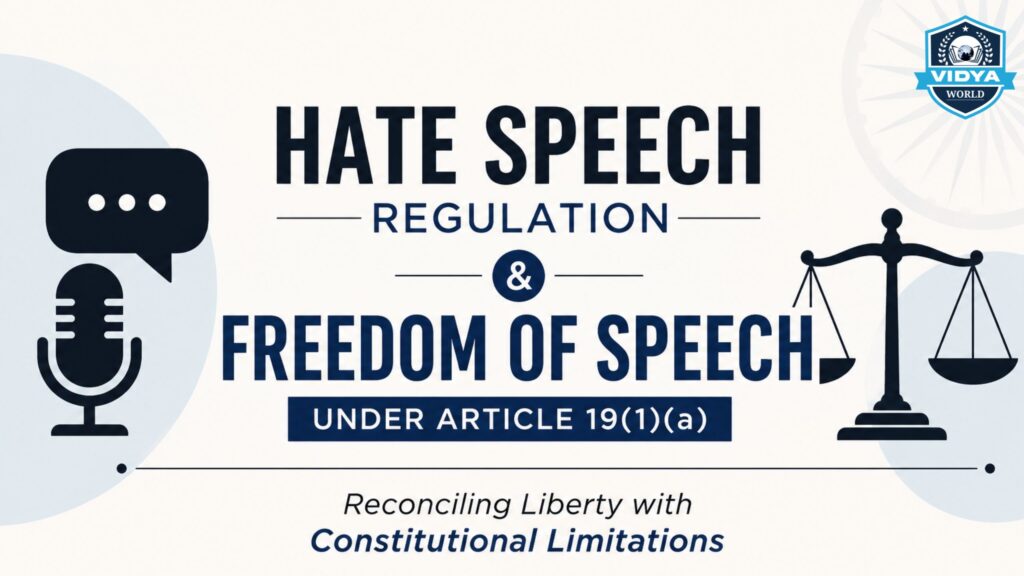
Freedom of speech is really important in India. It is part of the Constitution of India under Article 19(1)(a). This freedom of speech is what makes India a democratic country. Freedom of speech is not, without any limits. There are some rules that people have to follow which are mentioned in Article 19(2). One big problem is what to do about hate speech. Freedom of speech and hate speech are two things that do not go together. The courts have to deal with a problem, and this article is about how they handle it and what the laws say. We have to think about how to let people say what they want. Also stop them from saying mean things that hurt others. This is a balance that is changing all the time. We want to make sure everyone is treated fairly and with respect like the Constitution of India says. The Constitution of India and freedom of speech are really important because people need to be able to say what they think to make decisions and for our country to be democratic.
The Indian Constitution says that people have the right to express their thoughts and opinions in Article 19(1)(a). This freedom of speech is what makes it possible for people to share their ideas and opinions. Freedom of speech is a right that is necessary for a democratic country, like India. This means that people can say what they think criticize the government and talk about things that are happening in the country. In a country like India where there are so many different types of people if people can say whatever they want it can cause problems. Some people might say things that’re mean or hurtful to others, which can lead to fights and violence.
The Indian Constitution aims to strike a balance between allowing people to express themselves freely and ensuring everyone safety. It says that while people have the right to free speech the government can impose some limits on it if necessary for security. Article 19(2) specifically mentions that these limits can be imposed to keep the country safe and secure. Now the big question is: how can the law protect our right to speech while also preventing people from saying things that might hurt others? The law needs to find a way to balance our freedom to speak with the need to regulate speech that could harm Indians and the country. The Indian Constitution has to allow people to speak freely. At the same time, it has to protect people from getting hurt because of what others say.
Free speech and safety are both important. The law has to find a balance, between the two.
Hate speech is about expressions that make people hate to discriminate or become violent towards individuals or groups based on their religion, race, caste, gender or other identities.
In India there is no definition of hate speech in the law. There are some rules in the Bhartiya Nyaya Sanhita 2023 that deal with it indirectly.
- Section 196- This is about promoting hate between groups.
- Section 299- Deliberate and malicious acts intended to outrage religious feelings of any class by insulting its religion or religious beliefs
- Section 353- This is about statements that can cause public trouble. These rules try to stop speech that can harm order and peace between communities Because there is no clear definition it can be confusing and applied unevenly.
The Constitution and Free Speech
Article 19(1)(a) says people have the right to speak freely and express themselves. This right is crucial for democracy because it allows citizens to participate in governance and hold authorities accountable. The State can put limits on this right. They must be reasonable as stated in Article 19(2). The term “reasonable” is important because it ensures that these limits are not arbitrary or excessive. Court have stated that any limit on speech must be fair and necessary.
The challenge is determining when speech crosses the line from being protected to being hate speech, which can be punished. Free speech is essential. So is protecting people from hate speech. The Constitution and courts play a role in balancing these two rights. People have the right to free speech. This right is protected by the Constitution. However, this right is not absolute. Has limits, which are put in place to maintain social order. The key is to find a balance, between speech and social responsibility. This often depends on the situation, intention and effect.
Courts and Hate Speech
The judiciary has helped decide the balance between speech and regulating hate speech.
In Ramesh Thappar v. State of Madras (1950) the Supreme Court said that free speech is the base of all organizations.
- It also said this freedom can be limited for public order.
- It also mentioned that this freedom may be restricted for the sake of public order.
In Shreya Singhal v. Union of India (2015), the Court struck down Section 66A of the Information Technology Act, due to its vague and overly expansive nature.
- The ruling stated that there is a distinction among “discussion,” “advocacy,” and “incitement,” with restrictions applicable only to incitement of violence or public disorder.
- Regulation of hate speech must be transparent and just. The courts will continue assisting in achieving this balance.
In the 2014 case of Pravasi Bhalai Sangathan v. Union of India the Court stated that hate speech negatively affects individuals. The Court further stated that the government ought to enact legislation to address hate speech rather than the Court taking action independently.
These instances indicate that the judges are exercising caution. They aim to ensure individuals can express their opinions. They likewise aim to prevent hate speech from harming anyone.
The Doctrine of Reasonable Restrictions
The idea of reasonable restrictions is important to balance freedom with what the constitution says. For something to be restricted it has to meet some rules:
- It has to be based on a law.
- It has to be for a reason as stated in Article 19(2).
- It has to be fair and not too harsh.
When it comes to hate speech this means that just because someone says something mean or unpopular it does not mean they can be stopped from saying it. Only speech that makes people want to be violent or creates hatred between groups or threatens to disrupt order can be restricted.
Challenges in Regulating Hate Speech with rules to protect people there are still some problems:
- Lack of Clear Definition
The fact that hate speech is not clearly defined means that the laws are not enforced consistently and can be used in the way.
- Over-Criminalization
If the laws about hate speech are too broad they might stop people from saying things they think even if they are not being hateful and that is not good for democracy.
- Selective Enforcement
The people in charge of enforcing the laws might. Choose who to go after and that can seem unfair.
- Digital Media and Social Platforms
The internet and social media have made it easier for hate speech to spread and it is hard for these platforms to know what to allow and what not to.
Comparative Perspective
Different countries deal with hate speech in ways. For example:
The United States protects what people say a lot only stopping them if they are telling people to be violent.
Countries in Europe have rules and can punish people for hate speech more often.
India is somewhere in the middle trying to balance what people can say with what’s good for society.
Reconciling Liberty with Constitutional Limitations
To make sure people can say what they think but stop hate speech some things need to happen:
1.Transparent Legal Structure ;
The government ought to establish a law that defines hate speech explicitly so that everyone understands the regulations
- Judicial Guidelines
The judges should keep making rules to help figure out what hate speech is and think about what someone meant to say the context and how it affects people.
- Proportionality Principle
Any rules should be fair. Not stop people from saying things they think unless it is really necessary.
- Public. Education
If people know more, about why hate speech’s bad and why we should be tolerant there will be less hate speech.
- Regulation of Digital Platforms
Social media companies need to be transparent and responsible when it comes to stopping content.
Conclusion
The issue of hate speech in India is a problem that needs to be solved carefully. Freedom of speech is very important for governance in India but it should not be allowed to disturb public order or hurt people dignity and equality. The law says that there are some limits to freedom of speech and these limits are stated in Article 19(2). These limits have to be applied very carefully.
The courts in India have done a job of finding a balance between allowing people to express themselves and stopping hate speech. However, because society and technology are changing we need to come up with more consistent ways to deal with this issue.
In the end we need to find a way to balance freedom with the rules of the constitution. This requires not just laws, but also a commitment to doing what is right being tolerant and respecting differences. Then can India protect both freedom of speech and the values of brotherhood, in its democratic system.
Keywords: Freedom of Speech, Hate Speech, Article 19(1)(a) Article 19(2) Reasonable Restrictions, Constitutional Law, India.