INTRODUCTION :
Nowadays, the internet is not just something people use for entertainment. It has slowly become part of everyday life. From attending online classes to paying bills, applying for jobs, watching news, or talking to people, almost everything now depends on internet access in some way. Earlier, people treated the internet like an extra facility, but today many daily activities become difficult without it.
India is also among the countries with the highest number of internet users in the world. According to the Telecom Regulatory Authority of India, the number of internet subscribers in India has crossed 850 million. This itself shows how important internet access has become for ordinary people. During the COVID 19 pandemic, its importance became even more visible because schools, offices, businesses, and even courts shifted to online platforms.
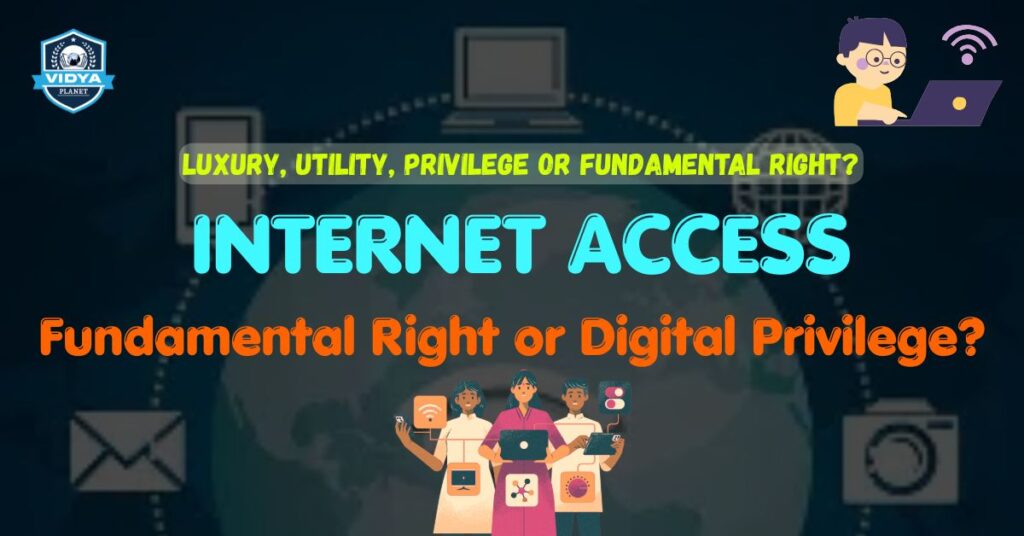
Because of this growing dependence, an important constitutional question comes forward. Should internet access only be treated as a service, or should it be recognised as a fundamental right? The Indian Constitution guarantees freedom of speech under Article 19(1)(a) and protection of life and liberty under Article 21, but it nowhere directly mentions internet access as a fundamental right. This creates confusion regarding its legal position. In today’s digital age, many important rights cannot be properly exercised without internet access. For this reason, there is a strong argument that internet access should receive constitutional protection, although reasonable restrictions can still exist whenever genuinely required.
Legal Basis and Constitutional Support :
The Constitution was written at a time when the internet did not even exist. Still, many constitutional rights today are deeply connected with digital access. One of the most important among them is freedom of speech and expression under Article 19(1)(a).
Earlier, people mostly shared opinions through newspapers, books, public speeches, or television. But now, most communication happens online. Social media platforms, websites, online discussions, blogs, and digital videos have become common spaces where people express ideas and participate in debates. Without internet access, a person may technically have freedom of speech, but practically they may not be able to fully use it in modern society.
Article 21, which protects life and personal liberty, has also expanded a lot through judicial interpretation. Courts have included rights such as dignity, education, livelihood, and privacy within Article 21. In today’s world, all these areas are linked with the internet in some way. Students depend on online classes and study material. Many job applications happen online. Even important government services are becoming digital.
However, this does not mean internet access should become completely unrestricted. The Constitution itself allows reasonable restrictions under Article 19(2). The government can regulate speech for reasons such as public order, national security, morality, and sovereignty of India. Therefore, recognising internet access as a fundamental right would not remove government control. It would simply ensure that restrictions are imposed fairly and only when genuinely necessary.
UNDERSTANDING THE NATURE OF INTERNET ACCESS :
There are three main ways to understand the status of internet access.
1. Internet as a Luxury
Some people still believe that internet access is only a luxury. Earlier, this idea made sense because the internet was mostly limited to entertainment and convenience. Many people lived normally without using it.
But this thinking no longer fully matches reality. Today, internet access is connected with education, jobs, communication, and access to information. A person without internet access may struggle to participate equally in modern society.
2. Internet as a Utility
Another opinion is that the internet should be treated like electricity or water. According to this view, it is an important service that helps society function smoothly, but it should not become a constitutional right.
This argument accepts the usefulness of the internet, but it still treats it mainly as a service instead of recognising its connection with basic freedoms.
3. Internet as a Fundamental Right
The strongest argument is that internet access should be recognised as a fundamental right because many other rights now depend on it.
Students use the internet for classes and study material. Job seekers apply for work through online platforms. Citizens use social media to express opinions and stay informed about public issues. Without internet access, people can become disconnected from opportunities, information, and participation in society.
This shows that the internet is no longer just a technological invention. It has become an important part of modern democratic life.
JUDICIAL PERSPECTIVE ON INTERNET ACCESS :
Indian courts have already started recognising the importance of the internet through important judgments such as :-
In Anuradha Bhasin v. Union of India (2020), the Supreme Court dealt with internet shutdowns in Jammu and Kashmir. The Court held that freedom of speech and expression through the internet is protected under Article 19(1)(a). It also stated that any restriction on internet access must be reasonable, necessary, and temporary. The Court made it clear that indefinite shutdowns are not allowed. This case is very important because it directly connects internet access with a fundamental right.
In Faheema Shirin v. State of Kerala (2019), the Kerala High Court considered a case where a student was denied internet access in her hostel. The Court held that access to the internet is part of the right to education and also a part of the right to life under Article 21. This judgment showed that the internet is essential for students in the modern world.
In K.S. Puttaswamy v. Union of India (2017), the Supreme Court recognised the right to privacy as a fundamental right. Since a large part of our personal life now exists online, this judgment indirectly strengthens the argument that internet access is important for protecting individual freedom.
At the same time, India has seen many internet shutdowns. According to government data and parliamentary discussions, India has recorded a high number of shutdowns in recent years, often for reasons like maintaining public order. This shows that while the internet is important, the government still exercises control over it. These cases and facts show that the judiciary understands the importance of the internet but has not yet clearly declared it as a separate fundamental right.
ANALYSIS : WHY INTERNET ACCESS SHOULD BE A FUNDAMENTAL RIGHT ?
The internet has become deeply connected with modern life. Communication, education, employment, business, and even democratic participation now depend heavily on digital access. In a country where more than 850 million people use the internet, its importance cannot be ignored anymore. If freedom of speech is considered a fundamental right, then the medium through which people exercise that freedom should also receive protection. Today, social media and online platforms have become major spaces for discussion, awareness, and public participation. Education and employment are also increasingly dependent on internet access. Students attend online classes and use digital learning platforms. Companies conduct online applications and interviews. Without internet access, many people lose equal opportunities.
Some people fear that recognising internet access as a fundamental right may increase misuse or create difficulties in regulation. However, every right under the Constitution already comes with reasonable restrictions. Freedom of speech itself can be restricted under Article 19(2) whenever necessary. This means that recognising internet access as a right would not create unlimited freedom. The government would still have the authority to regulate harmful activities whenever genuinely required for public interest or security.
Another major issue is digital inequality. Even today, many rural areas still face weak connectivity and lack proper internet infrastructure. Government programmes under Digital India are trying to improve this situation. If internet access receives stronger constitutional recognition, it may encourage better efforts toward digital inclusion. At the same time, complete absence of regulation is also not practical. Harmful activities, misinformation, and online crimes cannot be ignored. Therefore, a balance between freedom and regulation is necessary In simple words, restrictions should exist to prevent misuse, but they should not become excessive enough to destroy digital freedom itself.
CONCLUSION :
The debate regarding internet access clearly shows how much society has changed in the digital age. Earlier, the internet was seen as something optional, but today it has become closely connected with normal life and basic opportunities. Although the Constitution does not directly mention internet access, rights like freedom of speech, education, privacy, and livelihood are now strongly linked with it. Courts have also recognised its importance in several important judgments.
In modern times, internet access should be recognised as a fundamental right because many constitutional freedoms cannot be effectively exercised without it. At the same time, such a right should continue to remain under reasonable restrictions whenever necessary for public safety or national interest.
The real challenge is maintaining balance. A democratic society must protect digital freedom while also ensuring responsible regulation. Only then can both individual liberty and public interest exist together properly in the modern world.

Parth Sahu is a first-year BA.LLB student at NALSAR University of Law, Hyderabad. He is an enthusiastic law student with a strong focus on legal research, article writing, and along with mentoring CLAT and AILET aspirants. He chose the field of law out of a genuine interest in the subject and its application. He aims to grow in this field by continuously improving his skills and contributing meaningfully through his work.