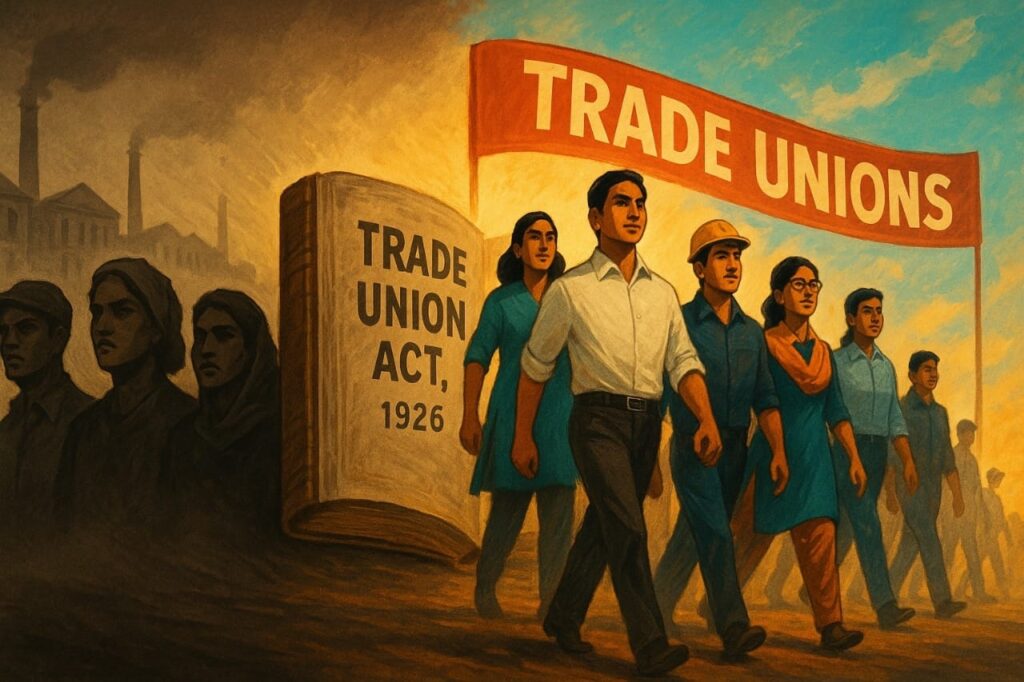
“Born from the struggles of industrial workers, trade unions became the voice of the voiceless.”
Table of Contents
ToggleIntroduction
Trade union is an organization of worker forms to protect and promote the interest and welfare of its members through collective actions. The act of 1926 was enacted to legally recognise trade unions and to define the rights liabilities and privilege before this there was no law to protect workers.
It is a central labour legislation contains 33 sections and one schedule and is administered by Ministry of Labour and employment Government of India, it serves as a key mechanism for balancing and improving the relations between employer and employee by securing better pay benefits working conditions and job security.
History
- Before 1914 India saw the rise of industrialisation in Bombay Calcutta Madras, worker faced poor wages, long hours and unsafe conditions.
- 1918 and 1920 post war economic hardship and inflation led to severe major strikes like Bombay mill strike, madras labour union.
- The Madras labour union 1918 founded by BP wadia is considered first registered trade union.
- In 1920 formation of AITUC All India trade union Congress was establish, this was the first national level trade union federation. Leaders like lala Lajpat Rai, Joseph baptista and NM Joshi
- 1921 trade union bill was introduced in the Indian legislative assembly
- 1923 the Government of India began detailed discussion on regulating unions to balance workers right and employer’s interest.
- 25 March 1926 the trade union act was passed by Indian legislative assembly and came into force on 1st June 1927 it was the first comprehensive law in Indian India to provide legal status to trade union.
Objective
- To regulate the formation and registration of trade unions.
- To protect the right of workers and employees and issued at workers are collectively raise their issue without fear and punishment.
- To maintain internal democracy and discipline within unions.
- Define the key major terms like how many minimum members should be there, the general and political fund and the age of minority.
Why registration necessary
The registration under trade union act is not mandatory but it is highly beneficial for a union to function effectively and assert is right in industrial relation.
Why important
- Upon registration the union become body corporate by the registered name.
- As a body corporate the union can acquire and hold property both movable and immovable enter into contracts and can sue and can be sued.
- Maintain accounts summit annual return and follow democratic rules in sewing credibility.
- Registration ensure the unions action are lawful and protects the members right.
Process
- The procedure of registering a trade union is detailed under chapter 2 which is from Section 3 to 14 of the act.
- Section 3 talks about the appropriate government shall appoint a person to be the registered of trade union for each state and also appoint additional registrar as deem fit.
- Section 4 talks about the mode of registration any 7 or more members of the trade union me make an application for registration of trade union.
- Section 5 talks about fci application for the registration of trade union cell limit to registrar and also a copy of rules of the trade union and its statement must contain name occupation and addresses of the member making the application the name of credit union and the address of the head office the title name each addressee and occupation of the office bearer.
- According to section 8 if registrar think the trade union has compiled with all the provision of the act it shall register the trade union by entering in register.
- Section 10 talks about the cancellation of registration or withdrawn of an application, if the registrar finds the certificate has been obtained by fraud or mistake or the trade union has ceased to exist, he may cancel it.
- Section 11 talks about the appeal any person agrees by the decision of registrar he may file an appeal.
Conclusion.
The journey of trade union movement in India represents a fundamental chapter in the country’s social and industrial history initially a trade union serve as a collective voluntary voice of a workers dedicated to regulating the employer-employee relations and securing fair wages better working condition and security for its members.

Prashu Singh a final-year BBA LL.B.student at Parul University. My legal interests include criminal law, arbitration, and forensic law. I aim to develop a strong professional foundation through practical experience and meaningful legal work.