Table of Contents
ToggleIntroduction
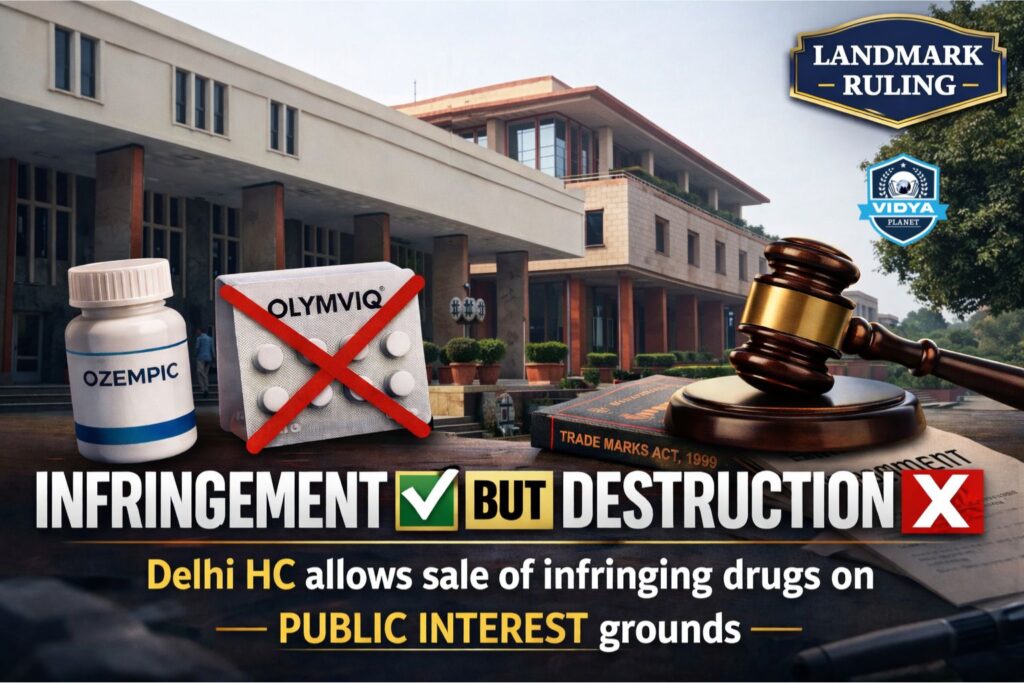
The contradiction between intellectual property protection and public health is especially relevant in the pharmaceutical industry, where even small legal choices can have a direct influence on human lives. The recent Delhi High Court ruling in Novo Nordisk A/S v. Dr. Reddy’s Laboratories Ltd. (CS (COMM) 317/2026) exemplifies this fine line.
While the Court found prima facie trademark infringement in Dr. Reddy’s use of the mark “Olymviq,” it did not order the destruction of the existing drugs stock. Instead, it created a nuanced remedy based on public interest considerations, reaffirming India’s unique approach to pharmaceutical trademark jurisprudence.
Factual Matrix
The controversy occurred when Novo Nordisk, a worldwide pharmaceutical firm, filed a trademark infringement complaint against Dr. Reddy’s Laboratories for using the mark “Olymviq,” arguing that it was deceptively similar to its well-known anti-diabetic medicine “Ozempic.”
According to Novo Nordisk,
- “Ozempic” is a unique mark that has gained international prominence.
- The defendant’s mark “Olymviq” was phonetically and structurally similar, which likely caused misunderstanding.
- Continued use will violate its trademark and create third-party rights.
At the interim stage, the Delhi High Court determined that the two marks were phonetically similar, which is especially important in pharmaceutical items where even minor confusion is prohibited.
The Court therefore ordered Dr. Reddy’s to:
- Stop future production and sales under the disputed mark.
- Switch to a different brand name (later proposed as “Olymra”).
However, the main issue arose with the drug’s already created supply.
Core Legal Issue
The main issue before the Court was:
“Whether existing stock of a drug found to be sold under an infringing trademark should be destroyed to safeguard trademark rights, or allowed to be utilized for public benefit.”
Statutory Framework
- Trade Marks Act, 1999
- Section 28 – Grants exclusive rights to the registered proprietor
- Section 29 – Defines infringement, including deceptive similarity
- Section 135 – Provides remedies such as injunction, damages, and delivery-up/destruction
Ordinarily, after infringement is confirmed, courts may order the delivery or destruction of infringing products.
2. Special Consideration in Pharmaceutical Cases
Due to the nature of narcotics, Indian courts use a tougher criterion. Drugs are not regular consumer commodities, even the likelihood of confusion is enough preventing use.
Judicial Reasoning
- Finding of Prima Facie Infringement
The Court clearly acknowledged that:
- “Olymviq” and “Ozempic” are phonetically similar.
- In pharmaceutical products, such similarity crosses the permissible threshold.
This aligns with settled jurisprudence that even minimal confusion in drug names is unacceptable due to risks to patient safety.
- Refusal to Order Destruction of Existing Stock
Despite finding infringement, the Court refused to direct destruction of the existing inventory. It observed:
- The drug is used to treat Type-2 diabetes, a serious condition
- It is a Schedule H prescription drug, dispensed under medical supervision
- Its quality was not in dispute
The Court explicitly held that:
“Destruction of such drugs would not be in public interest.”
Instead, it allowed:
- Sale of existing stock for 30 days
- Remaining stock to be donated to a government hospital
- This approach prioritizes public benefit over rigid enforcement of trademark remedies.
- Rejection of Alternative Measures
The Court also addressed concerns about relabeling:
- Potential safety issues in injectable medications.
- Commercial and practical impossibility
As a result, it chose a context-sensitive cure over mechanical enforcement techniques.
Key Precedents:
This historic judgment established that:
- Pharmaceutical items are subject to a stricter misleading similarity test.
- Even the chance of confusion should be avoided.
- “Drugs are poisons, not sweets” emphasises the importance of errors.
This idea is precisely reflected in the Delhi High Court’s ruling of similarity in Olymviq v. Ozempic.
- The subsequent jurisprudence
The courts have repeatedly held that:
- Even the slightest phonetic resemblance can trigger injunctions.
- Public health factors may impact the solutions.
For instance:
Sun Pharma v. Hetero Healthcare (2022): Differentiated marks from INN in cases where there was no confusion.
Balancing Public Interest and Trademark Rights
The ruling exemplifies a two-phase judicial balancing process:
Stage 1: Safeguarding Trademark Rights
- Court prohibited the continued use of infringing mark.
- Implemented discontinuance and transition to a new mark.
Stage 2: Public Health Protection
- Refused to destroy lifesaving medications.
- Allowed for interim sale and eventual donation
This illustrates the principle that:
“Intellectual property rights are not absolute and must be subordinated to public interest in appropriate instances.”
Doctrinal Significance
- Limitations on Remedies under Section 135.
While Section 135 permits the destruction of infringing products, this decision clarifies:
- Such remedies are voluntary and not mandated.
- Courts can adjust remedy based on equitable factors.
- The Constitutional Value of the Public Interest
Implicitly, the ruling is based on:
- Article 21 of the Indian Constitution (Right to Life and Health)
The Court aligned trademark law with constitutional principles by preventing the waste of necessary pharmaceuticals.
- The distinction between Harm and Infringement
The Court divided:
Legal wrong (trademark violation) from practical harm (patient medication loss)
This distinction allowed it to sanction infringement while preserving public benefit.
Critical Analysis
The decision advances IP jurisprudence in a practical and forward-thinking manner:
Strengths
- Prevents necessary medications from being wasted
- Preserves the integrity of trademark legislation
- Acknowledges the practical aspects of indian healthcare
Issues
- May be considered as a weakening deterrent against infringement.
- Could motivate pharmaceutical companies to take measured risks.
But the Court addressed these issues by:
- Awarding expenses to Novo Nordisk
- Mandating the total discontinuance of the infringing mark
Conclusion
The Delhi High Court’s decision in Novo Nordisk v. Dr. Reddy‘s is regarded as a watershed moment in pharmaceutical trademark law. While acknowledging that the public interest cannot be sacrificed at the altar of intellectual property protection, it upholds the stringent criteria against deceptive resemblance.
The Court created a balanced, humanitarian, and legally sound solution by allowing for the limited sale and donation of existing stock rather than its destruction.
Finally, the judgment reiterates a fundamental concept of Indian IP law:
“Trademark protection is vital, but protecting human life is even more crucial.”