Introduction
An Act’s Preamble lays out the primary goals that the legislation is meant to accomplish. It serves as a kind of introduction to the law and is frequently quite beneficial in understanding the legislative intent and policy. Similarly, the Preamble of the Constitution outlines the goals and aspirations of the Indian people, which are reflected in the practical provisions of the Constitution. What we had thought or dreamed for so long” is expressed. The Preamble was given the “place of pride” by the drafters of the constitution. It represents all of the goals and objectives for which the nation had fought during the British rule in a solemn manner.
It embodies the values that are woven into the Constitution. The adoption of the Preamble by the Constituent Assembly following the approval of the Draft Constitution reinforces this idea. This was done to ensure that the Preamble aligns with the Constitution’s provisions and articulates its philosophy and objectives.
The Preamble to the Constitution is a key to opening the minds of the founders and demonstrating the overall aim for which they drafted the various sections in the Constitution, according to the Supreme Court’s ruling in the Reuberi case.
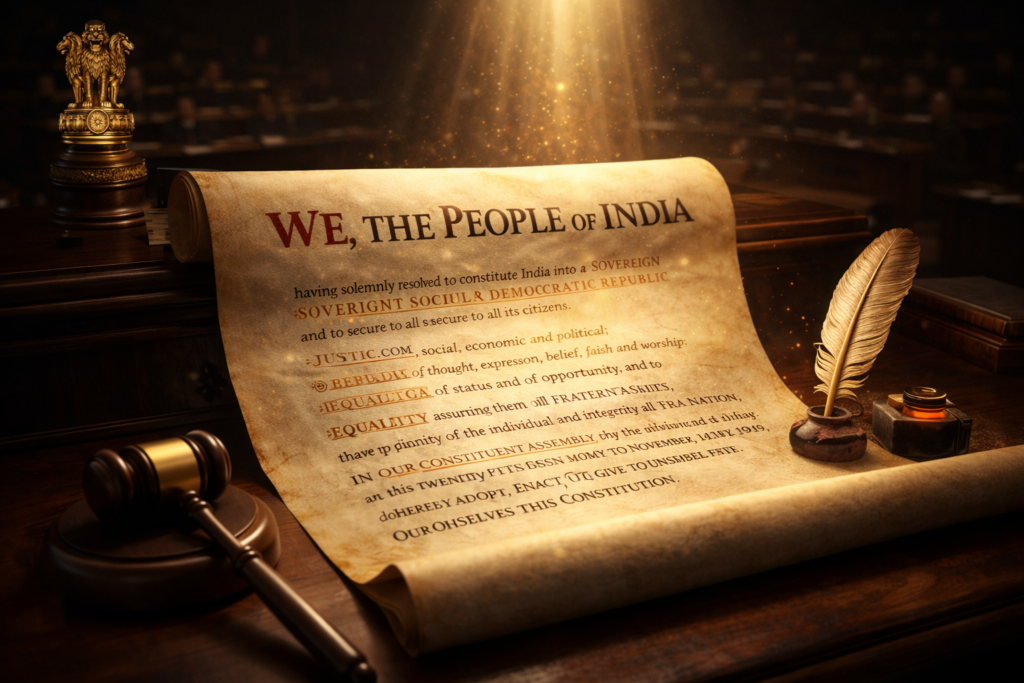
The Preamble reads as follows:
WE, THE PEOPLE OF INDIA, having solemnly resolved to constitute India into a SOVEREIGN SOCIALIST SECULAR DEMOCRATIC REPUBLIC and to secure to all its citizens:
JUSTICE, social, economic and political;
LIBERTY of thought, expression, belief, faith and worship;
EQUALITY of status and of opportunity;
and to promote among them all
FRATERNITY assuring the dignity of the individual and the unity and integrity of the Nation;
IN OUR CONSTITUENT ASSEMBLY this twenty-sixth day of November, 1949, do HEREBY ADOPT, ENACT AND GIVE TO OURSELVES THIS CONSTITUTION.
Meaning of the Preamble
We, The People of India
The Preamble states that this constitution is a gift from the Indian people to themselves. The Indian people, who firmly decided to establish India as an independent democratic republic, are the originators of the Constitution. As long as it is acceptable to them and its provisions support their goals and aspirations, the Indian people will continue to be ruled by the constitution.
Sovereign Socialist Secular Democratic Republic
The makers of Constitution aimed to establish a “Sovereign Socialist Secular Democratic Republic” in India. India’s head of state is elected rather than hereditary, which makes it a Republic. It is democratic because the government is formed and maintained at the will of the people through regular participation in its development. Its ability to make or revoke decisions pertaining to itself without external intervention makes it Sovereign.
The words “socialist” and “secular” were added in the Preamble by the Constitution (42nd Amendment) Act, 1976. The word “socialist” has been added to the Constitution to signify the inclusion of the “socialism” doctrine, which seeks to eradicate disparities in wealth, status, and living standards.
The word “secular” recognises the concept of secularism as manifested in the guarantee of freedom of religion as a fundamental right in the Constitution. Thus, secularism was as much part of the Constitution even before the word “secular” was inserted in the Preamble.
Justice, Liberty, Equality, Fraternity
Though they may be difficult to define and have no set meaning, the terms “justice,” “liberty,” “equality,” “fraternity,” and “dignity of the individual” are not empty platitudes. Part III, the Fundamental Rights; Part IV, the Directive Principles of State Policy; Part IV-A, the Fundamental Duties; and Part XVI, Special Provisions Relating to Certain Classes, in particular, provide them with substance. The chronology of these values has received particular attention, and the Constitution demonstrates this by establishing in the Preamble that justice comes before freedom and equality for minorities and by establishing special provisions for women, children, and other marginalized groups in society.
Unity and Integrity of Nation
The Preamble also includes “unity and integrity of the Nation”. Prior to insertion of words “and integrity” by the 42nd Amendment, the unity of the nation was considered as one of the three fundamentals of the Constitution which created a seamless web of the Constitution along with democracy and social revolution.” Addition of the words “and integrity” is reassertion of the same.
Enact and Give to Ourselves
Besides the fact that the Preamble says that the people of India have enacted and given to themselves the constitution, the successful working of the Constitution and its continued acceptance by the people over the years leads to no other conclusion than that the binding force of the Constitution is the sovereign will of the people of India.
Objectives of The Preamble
The following are the objectives which the Preamble secures to every citizen:-
Justice-social, economic and political:
Liberty-Of thought, expression, belief, faith and worship;
Equality Of status and of opportunity; and to promote among them all;
Fraternity Assuring the dignity of the individual and the unity and integrity of the Nation;
Democracy would be meaningless if it did not foster a sense of fraternity among all segments of society, a sense that they are all descended from the same motherland and soil. In a nation like India, where there are many different ethnicities, faiths, languages, and cultures, it becomes even more crucial. This idea of brotherhood of man, which is expressed in the Constitution’s Preamble, is given concrete form by the repeal of title (Article 18), untouchability (Article 17), and numerous other social ills that have influenced Indian society. Assuring social, economic, and political fairness is the main goal of the “Liberty, Equality, and Fraternity” that the Indian Constitution aims to provide for its citizens. Justice is the peaceful coexistence of human selfishness and societal welfare. The primary goal of delivering justice is to achieve the common good, as opposed to the individual good.
Significance of the Preamble of the Constitution
The Preamble is very important as it serves as an introduction to the constitution, capturing its philosophy, main values, and goals. It is often called the ‘Identity Card’ or ‘Political Horoscope’ of the constitution.
Source and Enacting Force
It explicitly states that the constitution gets its authority from the people of India (e.g., “We, the People of India”), establishing that sovereignty ultimately belongs to the citizens.It includes the important statement of adoption, enactment, and giving the Constitution to themselves, which is the act that legally brings the Constitution into effect (e.g., “…do hereby adopt, enact and give to ourselves this Constitution”). This clause validates the entire document.
Declaration of Rights and Government Type
It clearly sets out the fundamental rights and freedoms that the people of India intended to secure for all citizens, specifically:Justice (social, economic, and political).
Liberty (of thought, expression, belief, faith, and worship).
Equality (of status and opportunity).
Fraternity (ensuring the dignity of the individual).
It states the fundamental character of the polity, declaring the nation to be a Sovereign, Socialist, Secular, Democratic Republic, outlining the basic governmental structure and policy goals to be established.
Guiding Principle for Interpretation
Although not legally enforceable on its own, the Preamble serves as a key to understanding the intent of the framers. Courts use it as an interpretative aid when parts of the constitution are unclear, helping to clarify the law in light of the constitution’s foundational vision and values.It concisely captures the dreams and aspirations of the nation’s founding fathers and sets the political, social, and economic goals for the country’s governance.
In essence, the Preamble acts as a preface to the main document, summarizing its spirit, scope, and direction.
Can the Preamble to the Constitution Be Amended?
In the landmark case of Kesavananda Bharati v. State of Kerala, this issue was brought before the Supreme Court for the first time. In that instance, the Attorney General contended that even the Preamble can be changed under Article 365’s amending authority. It was stated that the Preamble may be changed just like any other clause in the Constitution because it was a part of it. The petitioners, however, contended that the amending power in Article 368 is limited. The authority of amendment is impliedly limited by the preamble. The essential components or essential characteristics of our Constitution are contained in the Preamble. As a result, the modifying power cannot be used to undermine or harm the fundamental characteristics listed in the Preamble.
It was urged that Preamble cannot be amended as it is not a part of the Constitution. However, the Supreme Court ruled that the Preamble is a part of the Constitution, hence the ruling in the Re Beruberi case was incorrect on this point.
Regarding whether the Preamble can be changed, the majority ruled that it can, provided that the “basic elements” of the Preamble cannot be changed because it is a part of the Constitution. The Court stated. “The fundamental components listed in the Preamble form the foundation of our Constitution. The structure will not last and the Constitution will not be the same or be able to retain its identity if any of these components are eliminated. According to the Preamble, the Indian people resolved to establish a Sovereign Democratic Republic. Nobody can imply that these terms and phrases are in any way unclear. It is not possible to interpret an amending power in a way that would allow the Parliament to remove any of these essential and fundamental aspects of policy. It is argued that the court’s perspective is accurate. The Constitution cannot be altered by the amending power to the point where it no longer qualifies as a Sovereign Democratic Republic. The Constitution must be destroyed in order to do this.
Conclusion
The Preamble represents the philosophical blueprint of the Indian Republic, asserting the ultimate authority of “We, the People” and defining the state in words as a Sovereign, Socialist, Secular, Democratic, Republic. Its core objectives-securing Justice, Liberty, Equality, and Fraternity-establish the nation’s political and social promises. This makes the Preamble a document of profound significance, acting as the chief guide for constitutional interpretation. Legally, though amendable under Article 368, the Supreme Court’s doctrine of Basic Structure ensures that its core ideals remain inviolable. Ultimately, the Preamble serves as the nation’s unwavering moral compass and the definitive essence of the Constitution’s soul.