Abstract
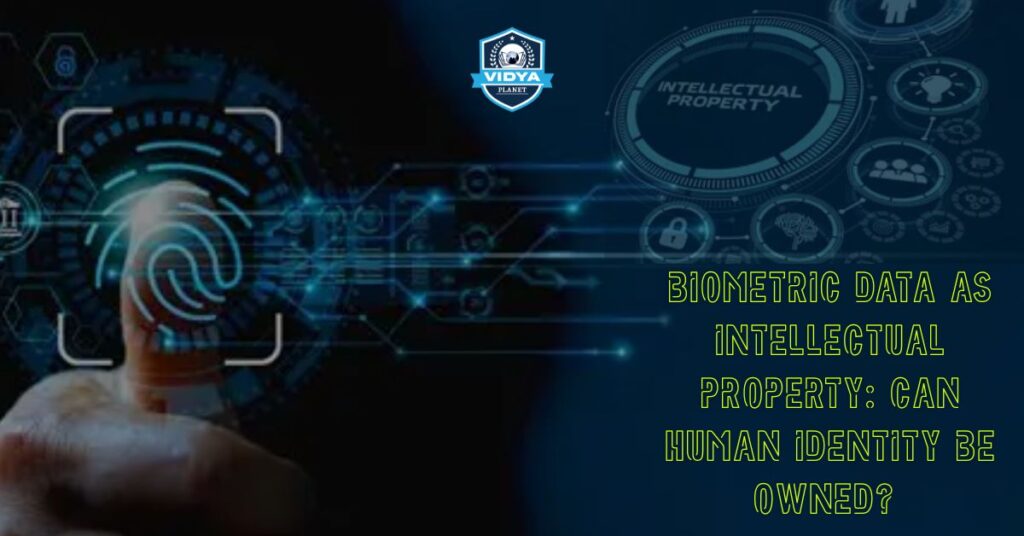
Biometric technologies have rapidly transitioned from specialised security systems to everyday instruments of governance, commerce, and digital authentication. Facial recognition unlocks smartphones, fingerprints authorise financial transactions, voiceprints verify identities, and retinal scans regulate access to public infrastructure. Yet beneath this technological convenience lies a profound legal and philosophical dilemma: can human identity itself become property?
The rise of artificial intelligence and data-driven economies has transformed biometric information into one of the most commercially valuable forms of data in existence. Governments, corporations, and technology developers increasingly rely upon biometric datasets to train machine learning systems, improve surveillance infrastructure, and develop predictive identification technologies. As a result, biometric information now exists at the intersection of intellectual property law, constitutional rights, privacy jurisprudence, and data governance.
This article critically examines whether biometric data can or should be treated as intellectual property. It analyses the ownership dilemma surrounding biometric identifiers, the patentability of biometric technologies, and the evolving regulatory frameworks governing biometric information across India, the European Union, the United States, and China. The article argues that biometric identity cannot be reduced to a purely proprietary asset because it represents constitutional personhood translated into digital form. While technological innovations built upon biometric systems may legitimately receive intellectual property protection, human identity itself must remain protected through a rights-based legal framework grounded in dignity, autonomy, and informed consent.
Ultimately, the article proposes the recognition of a distinct “Right to Digital Identity” capable of addressing the emerging threats posed by artificial intelligence, facial recognition systems, deepfakes, biometric surveillance, and large-scale data extraction.
Introduction: When the Human Face Became Data
For most of human history, identity was inherently physical. A face belonged to the individual who carried it. A voice could not be copied with precision. Fingerprints were useful only in forensic investigations. Today, that reality has fundamentally changed.
A smartphone recognises your face before your family does. Airports verify passengers through retinal scans. Employers monitor attendance using fingerprints. Artificial intelligence systems now analyse facial expressions, behavioural patterns, speech cadence, and eye movement to predict human behaviour. Biometric identity has become infrastructure.
Yet every scan raises a deeper legal question: who owns the data extracted from the human body?
The digital economy increasingly treats biometric information as a commercial asset. Technology companies train artificial intelligence systems on facial images scraped from the internet. Financial institutions deploy facial authentication systems. Governments build national biometric databases for governance and surveillance. Meanwhile, deepfake technologies can now replicate a person’s face and voice with terrifying precision.
The transformation of identity into machine-readable data has generated a constitutional and intellectual property crisis.
Traditional intellectual property law protects inventions, literary works, artistic creations, trademarks, and trade secrets. However, biometric data does not fit neatly into any of these categories. A fingerprint is not an invention. A face is not a copyrighted work. A voice is not merely commercial branding.
Biometric identity is something more intimate.
It is inseparable from personhood itself.
The challenge before modern legal systems is therefore unprecedented: how can the law encourage innovation in biometric technologies while simultaneously preventing the commodification of human identity?
Understanding Biometric Data and Its Legal Significance
Biometrics refers to technologies that identify, analyse, and authenticate individuals through unique biological or behavioural characteristics.
These include:
- Fingerprints;
- Facial geometry;
- Retina and iris scans;
- Voice patterns;
- DNA sequences;
- Palm prints;
- Behavioural biometrics such as typing speed or gait analysis.
Unlike ordinary personal data such as passwords or identification numbers, biometric information is permanent and irreplaceable.
A compromised password can be changed.
A compromised fingerprint cannot.
This permanence makes biometric data uniquely valuable and uniquely dangerous.
Modern biometric systems function through the extraction, storage, and processing of measurable human characteristics. Artificial intelligence systems use these datasets to construct predictive authentication models capable of recognising identity with increasing accuracy.
The more biometric data AI systems acquire, the more sophisticated they become.
This has transformed biometric information into one of the most commercially valuable resources in the global digital economy.
Technology corporations now compete not merely for software dominance but for access to biometric datasets capable of training artificial intelligence systems.
Consequently, biometric information today exists at the centre of three converging forces:
- Artificial intelligence and machine learning;
- Intellectual property and innovation regimes;
- Privacy and constitutional rights.
The Ownership Dilemma: Can Human Identity Be Property?
The central legal question surrounding biometric information is deceptively simple:
Who owns biometric data?
At first glance, the answer appears obvious.
Biometric traits originate from the human body. A person’s face, retina, fingerprint, and voice are inherently personal. Intuitively, they should belong to the individual from whom they originate.
Yet legal systems worldwide have struggled to consistently uphold this proposition.
Property Rights versus Personality Rights
The difficulty emerges because biometric information occupies a unique space between property law and personality rights.
Property rights are generally:
- Transferable;
- Commercially exploitable;
- Alienable;
- Assignable.
Personality rights, by contrast, are:
- Inseparable from identity;
- Rooted in dignity;
- Closely linked to privacy and autonomy;
- Resistant to commodification.
Biometric information simultaneously possesses both characteristics.
A facial scan has commercial value. It may be licensed, processed, stored, and monetised.
At the same time, a face is inseparable from individual identity.
This creates a profound legal tension.
If biometric information is treated purely as property, corporations may effectively obtain ownership-like control over human identity through consent agreements, licensing structures, or data extraction.
Conversely, if biometric information is treated solely as a privacy interest, innovation in artificial intelligence and biometric authentication systems may become economically unsustainable.
The law therefore confronts an uncomfortable reality:
Human identity now possesses market value.
The Rise of Surveillance Capitalism
Modern technology companies increasingly profit from biometric extraction.
Facial recognition systems are trained using billions of publicly available images scraped from social media platforms, websites, and online databases. AI companies treat human faces as raw material for algorithmic development.
The controversial practices of companies such as Clearview AI illustrate this tension vividly. By scraping facial images from across the internet to build massive facial recognition databases, such systems effectively converted public human identity into privately controlled surveillance infrastructure.
This raises a troubling question:
Does the public visibility of a face eliminate ownership over it?
The answer cannot simply be yes.
A person appearing in public does not imply consent to perpetual biometric extraction, algorithmic replication, or commercial exploitation.
Intellectual Property and the Patentability of Biometric Technologies
Although biometric identity itself may resist commodification, technologies built upon biometric systems frequently receive intellectual property protection.
This distinction is crucial.
The law may protect biometric technology without granting ownership over human identity itself.
Patentability of Biometric Systems
Patent law generally protects inventions that satisfy:
- Novelty;
- Inventive step;
- Industrial applicability.
Biometric technologies often involve highly sophisticated innovations in:
- Sensor architecture;
- Facial mapping systems;
- Authentication software;
- Machine learning algorithms;
- Liveness detection systems.
Hardware-based biometric systems such as fingerprint scanners, retinal sensors, or biometric chips are usually patentable if they satisfy statutory requirements.
Software-based biometric systems, however, face more complicated challenges.
The Problem of “Abstract Ideas”
Many jurisdictions exclude abstract ideas, algorithms, and mathematical methods from patent protection.
In India, Section 3(k) of the Patents Act excludes mathematical methods, algorithms, and computer programs per se.
Similarly:
- Article 52 of the European Patent Convention;
- Section 101 of the United States Patent Act;
restrict patentability of abstract concepts.
This distinction has become critically important in biometric technology disputes.
In Universal Secure Registry LLC v. Apple Inc., biometric authentication patents were challenged on the ground that they merely involved data collection and identity verification without any significant technological innovation.
Likewise, the United States Supreme Court in Alice Corporation Pty. Ltd. v. CLS Bank International established that abstract technological concepts require a sufficiently inventive application to become patent eligible.
These decisions demonstrate that while biometric technologies may receive intellectual property protection, the law remains cautious about monopolising abstract methods of identity verification.
Constitutional Privacy and Biometric Personhood
Perhaps the strongest legal protection for biometric information emerges not from intellectual property law but from constitutional jurisprudence.
The Indian Constitutional Position
In India, biometric information has increasingly been recognised as deeply connected to privacy and dignity under Article 21 of the Constitution.
The landmark judgment in Justice K.S. Puttaswamy v. Union of India recognised privacy as a fundamental right.
The Supreme Court specifically acknowledged:
- Informational privacy;
- Decisional autonomy;
- Protection of personal identity.
This judgment fundamentally altered the constitutional treatment of biometric information.
Facial patterns, fingerprints, iris scans, and voiceprints are not ordinary data points.
They are constitutional extensions of identity.
The Aadhaar litigation further highlighted tensions between state interests and biometric autonomy. While the Aadhaar framework aimed to streamline welfare delivery and governance, concerns emerged regarding mass surveillance, data breaches, and centralised biometric storage.
The constitutional challenge was therefore not merely technological.
It concerned the extent to which the State may legitimately collect and control the biological identity of citizens.
Biometric Data as Sensitive Personal Information
Indian regulatory frameworks presently classify biometric information as sensitive personal data.
The Information Technology Rules, 2011 include:
- Fingerprints;
- Facial patterns;
- Retina scans;
- DNA;
- Voice patterns.
The Digital Personal Data Protection Act, 2023 also introduces consent-based obligations concerning personal data processing.
However, India still lacks a specialised biometric privacy statute comparable to Illinois’ Biometric Information Privacy Act (BIPA).
This creates significant regulatory gaps.
The Global Legal Landscape: A Fragmented Regulatory Order
Biometric regulation across jurisdictions remains inconsistent and fragmented.
United States: Biometric Litigation Explosion
The United States has witnessed aggressive biometric litigation, particularly under Illinois’ Biometric Information Privacy Act (BIPA).
In Patel v. Facebook, Facebook’s facial recognition technology was challenged for scanning users’ faces without informed consent.
The resulting settlement of approximately $650 million demonstrated the enormous financial consequences of biometric privacy violations.
Similarly, in Cothron v. White Castle, repeated unauthorised biometric scans were treated as separate violations capable of multiplying damages exponentially.
These cases established a critical principle:
Biometric consent must be explicit, informed, and auditable.
European Union: GDPR and the EU AI Act
The European Union treats biometric information as a “special category” of data under the General Data Protection Regulation (GDPR).
Processing biometric information generally requires:
- Explicit consent;
- Data minimisation;
- Purpose limitation;
- Data Protection Impact Assessments.
The EU AI Act further classifies remote biometric identification systems as “high-risk” AI technologies subject to strict regulation.
The European model therefore prioritises dignity and human rights over unrestricted commercial exploitation.
China and State-Centric Regulation
China’s Personal Information Protection Law (PIPL) also recognises biometric data as sensitive personal information.
However, China simultaneously maintains expansive state surveillance infrastructure.
This reflects a fundamentally different regulatory philosophy where biometric governance prioritises state security and public order.
Artificial Intelligence, Deepfakes, and the Future of Identity
The emergence of generative artificial intelligence has intensified the ownership crisis surrounding biometric information.
AI systems can now:
- Clone voices;
- Replicate facial movements;
- Generate synthetic identities;
- Create deepfake videos;
- Simulate behavioural patterns.
The implications are profound.
Identity itself is becoming reproducible.
This raises several unprecedented legal questions:
- Can AI companies train models using facial data scraped without consent?
- Does voice cloning amount to theft of identity?
- Can a person license their face as intellectual property?
- Do deepfakes violate constitutional dignity?
Traditional intellectual property law offers incomplete answers because it was never designed to regulate synthetic personhood.
A copyright protects artistic expression.
A patent protects invention.
Neither adequately protects the integrity of human identity.
Toward a Right to Digital Identity
The current legal framework governing biometric information remains fragmented, reactive, and technologically outdated.
What is needed is not merely stronger privacy regulation but recognition of a distinct legal right over digital identity.
The Right to Digital Identity
A “Right to Digital Identity” should include:
- Control over biometric replication;
- Protection against unauthorised AI training;
- Consent-based biometric processing;
- Protection against deepfake misuse;
- Rights of deletion and withdrawal;
- Compensation for commercial exploitation.
This right should not be limited to celebrities or public figures.
Every individual possesses identity.
Every individual possesses dignity.
The law cannot permit human identity to become unrestricted commercial infrastructure.
Regulatory Reforms
Several reforms are urgently necessary:
Dedicated Biometric Protection Legislation
India should enact specialised legislation governing biometric collection, storage, and processing.
Mandatory Encryption Standards
Biometric information should be encrypted both during storage and transmission.
Strict Consent Requirements
Biometric processing should require explicit, informed, revocable consent.
Limited State Exemptions
Government access to biometric information must remain narrowly tailored and subject to independent oversight.
Defined Retention Periods
Biometric data should not be retained indefinitely.
AI Training Transparency
Companies should disclose whether biometric information is being used to train AI systems.
Conclusion
Biometric technology has fundamentally altered the relationship between identity, law, and commerce.
Faces, fingerprints, voices, and behavioural patterns are no longer merely biological characteristics. They are now data points, commercial assets, authentication systems, surveillance tools, and training material for artificial intelligence.
Yet despite their growing economic value, biometric identifiers cannot be reduced to ordinary property.
A person’s face is not equivalent to software.
A fingerprint is not simply a marketable commodity.
Biometric identity represents constitutional personhood translated into digital form.
The central challenge of modern legal systems is therefore not merely protecting data.
It is protecting human autonomy in an era where identity itself can be extracted, replicated, commodified, and manipulated.
Intellectual property law undoubtedly plays an important role in encouraging innovation in biometric systems. Developers of authentication technologies, AI models, and security infrastructures deserve legal protection for genuine technological advancements.
However, the law must draw a clear distinction between protecting technology and owning human identity.
No corporation, state, or artificial intelligence system should possess unrestricted control over the biological characteristics that define individual existence.
The future of biometric governance therefore depends upon recognising a simple but increasingly urgent principle:
Human identity may be processed by machines, but it cannot be owned by them.